Part 1
…because if you are,” Sheriff Dalton said carefully, “then what your sister did crosses well past a civil dispute.”
I stood in the middle of Terminal 3 with my carry-on hanging from one hand and exhaustion pressing against my bones like wet concrete.
People moved around me dragging luggage and greeting families and complaining about delays while my entire life tilted sideways inside a phone call.
“Yes,” I said quietly.
“The house belongs to me.”
There was a pause on the line.
Not disbelief.
Recognition.
“Alright then,” the sheriff replied.
“Then I need you to listen carefully before you get here.”
I moved toward a quieter corner beside a shuttered gift shop.
My reflection in the dark glass looked pale and unfamiliar.
“Your sister arrived at the property twenty minutes ago with two movers and a locksmith,” he continued.
“She claims the sale is legitimate and says the buyer’s renovation crew illegally entered private storage.”
I laughed once.
Sharp.
Humorless.
“The buyer found proof of ownership,” I said.
“She forgot the owner’s closet existed.”
“Yes,” Dalton replied.
“And judging by her reaction when we mentioned those documents, I’d say she genuinely believed those papers were gone.”
A cold feeling settled under my ribs.
Gone.
Not forgotten.
Not overlooked.
Gone.
“Sheriff,” I asked slowly, “has anyone checked whether things are missing from the house?”
Another pause.
“The contractor mentioned several empty filing drawers upstairs,” he admitted.
“And your family attorney asked us not to let anyone remove additional material.”
I closed my eyes.
The upstairs study.
My father’s room.
The room Christine avoided for years because she claimed the smell of his pipe tobacco made her nauseous.
Now suddenly she had been inside it long enough to empty drawers.
“Where’s my mother?” I asked.
“At her residence.
Upset.
Confused.
Honestly, Ms. Brennan?
I’m not convinced she understood what your sister was doing.”
That hurt more than I expected.
Because Mom had always survived by surrendering responsibility to the loudest person in the room.
When Dad got sick, she leaned on me quietly and leaned on Christine emotionally.
I handled doctors.
Christine handled narratives.
And narratives are dangerous things in families because eventually the loudest version of reality starts sounding true.
“I’ll be there as soon as I can,” I said.
“We’ll keep the property secure until then.”
Before hanging up, the sheriff added one final sentence.
“And Ms. Brennan?
You may want to prepare yourself.
Your sister’s telling people this house was stolen from her years ago.”
The line clicked dead.
I stood motionless for several seconds while airport announcements echoed overhead.
Stolen from her.
That was the story Christine had chosen.
Not greed.
Not fraud.
Not forgery.
Victimhood.
Of course.
Christine never stole things directly as children.
She reinterpreted ownership until taking felt justified.
When we were girls, she would borrow sweaters permanently and then cry if confronted.
She would take cash from Mom’s purse and insist she was “owed” because life was harder for her.
She once totaled Dad’s truck at nineteen and spent two weeks explaining how unfair it was that everyone was “making her feel guilty.”
Responsibility slid off Christine like rain off glass.
But resentment?
She carried resentment like religion.
And for seven years she had resented that beach house sitting in my name.
Not because she loved it more.
Because it represented proof that someone trusted me over her.
That was always the wound Christine could never survive:
not losing money,
but losing importance.
By the time I reached North Carolina the next afternoon, storm clouds were gathering over the Outer Banks.
The drive from the airport to Kitty Hawk felt unreal.
Gray sky.
Sea oats bending in hard wind.
Tourists riding bicycles past seafood shacks completely unaware that my family was collapsing three miles ahead.
As I crossed the final stretch toward the beach house, memories hit me so hard they almost blurred the road.
Dad teaching me to fish from the pier.
Mom hanging towels on the railing.
Christine at sixteen dancing barefoot in the kitchen after sneaking wine coolers from somebody’s cooler at the marina.
For one painful second, I remembered when she still laughed like my sister.
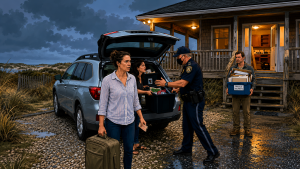
Then I turned onto our street and saw sheriff vehicles parked outside the house.
The sight hollowed me instantly.
The Brennan beach house sat at the edge of the dunes exactly as it always had:
weathered cedar siding,
white trim,
blue shutters,
the old widow’s walk Dad rebuilt twice after hurricanes.
Only now yellow temporary barriers blocked the driveway and construction vans sat crooked near the curb.
A deputy waved me through immediately.
Sheriff Dalton met me halfway up the front steps.
He was older than I expected.
Late fifties maybe.
Sunburned neck.
Kind eyes made tired by years of seeing families at their worst.
“Ms. Brennan.”
“Nicole,” I corrected automatically.
He nodded once.
“Nicole.”
Then his expression shifted slightly.
“I’m sorry about your father.”
The gentleness in that sentence nearly undid me more than the fraud had.
“Thank you.”
He glanced back toward the house.
“Your sister was taken downtown two hours ago for questioning.
No formal arrest yet.
But things are moving quickly.”
“And my mother?”
“She’s inside.”
I stepped through the front door and stopped breathing for a moment.
The house smelled wrong.
Dust.
Drywall.
Fresh-cut wood.
Not salt and lemon cleaner and old sunscreen like it should.
Cabinet doors leaned against walls.
Plastic tarps covered furniture.
A chunk of the kitchen ceiling had already been removed exposing pipes and beams above.
The buyer had moved fast.
Too fast.
People destroy history quickly once they stop seeing it as theirs.
Mom sat at the dining table wrapped in one of Dad’s old cardigans despite the heat.
She looked twenty years older than when I left for Japan.
The moment she saw me, she burst into tears.
“Oh, Nikki…”
I crossed the room immediately and knelt beside her chair despite my aching legs from travel.
“What happened?” I asked softly.
She grabbed my hands.
Cold fingers.
Shaking.
“I thought she had permission,” Mom whispered.
“She told me you agreed.
She said you were tired of paying taxes and repairs and wanted the money invested instead…”
I shut my eyes briefly.
Classic Christine.
Never full lies.
Just enough truth wrapped around manipulation to feel plausible.
“Mom,” I asked carefully,
“did you sign anything?”
Her crying deepened instantly.
There it was.
“Yes,” she whispered.
“But I didn’t understand.
She said they were transfer forms so she could help while you were overseas…”
A wave of exhaustion hit me so hard I had to steady myself against the chair.
Not because I blamed Mom entirely.
Because I suddenly saw the full shape of what Christine had done.
She hadn’t only forged documents.
She had weaponized confusion.
Grief.
Age.
Trust.
Against all of us.
Sheriff Dalton stepped quietly into the room holding a folder.
“We recovered these from your sister’s SUV.”
He placed them carefully on the table.
Inside were folders from Dad’s upstairs office.
Original insurance records.
Old bank correspondence.
Tax documents.
Even copies of his Alzheimer’s evaluations.
My stomach turned.
“She was removing evidence,” I whispered.
Dalton nodded grimly.
“And according to the movers, she told them the house technically belonged to her family already and you were refusing to cooperate.”
Mom covered her face with both hands.
“I never wanted this,” she sobbed.
I moved beside her and wrapped an arm around her shoulders automatically.
Instinctively.
Even now.
Families are strange that way.
People can devastate you and your body still remembers loving them before your mind catches up.
That evening James Patterson arrived carrying three legal binders and enough fury to power the entire coastline.
He barely sat down before opening documents across the dining table.
“The title company’s panicking,” he said.
“The buyer’s threatening litigation.
The lender froze all disbursements still in transit.
And the forged power of attorney is catastrophically bad.”
“How bad?” I asked.
James slid one page toward me.
My fake signature stared back from the bottom.
Except it wasn’t even close.
The loops were wrong.
The pressure inconsistent.
The middle initial missing.
“She really thought this would hold up?” I whispered.
James gave me a tired look.
“Nicole, people successfully commit fraud every day because most documents are never challenged.
Your sister was counting on speed,
confusion,
and family silence.”
Family silence.
There it was again.
The unspoken rule that destroys more families than conflict ever could:
don’t expose each other publicly,
even when someone deserves exposure.
Christine had counted on me protecting the family reputation more than myself.
But she forgot something important.
I had spent seven years protecting this house from storms already.
And I was no longer afraid of ugly cleanup…………………………………..

