The second doctor did not rush. He came in with steady steps, a gray folder tucked beneath one arm and a tablet in his hand. The rubber soles of his shoes made soft sounds against the polished floor. The room smelled like antiseptic, paper tape, and the faint burnt-coffee odor drifting from the nurses’ station. Daniel still held the bent X-ray film in his fist.
Dr. Greene did not look at him. She looked at me.
“Sarah,” she said, “this is Dr. Howard from maternal-fetal medicine. He reviewed the scan we ordered after radiology flagged your injuries.”
Daniel’s head snapped toward the doctor.
“Scan?” he said.
Dr. Howard lifted the tablet just enough for the light to catch the screen.
“There is a fetal heartbeat,” he said. “Strong. One hundred forty-six.”
My hand moved before my mind did. It slid over the thin hospital blanket and stopped on my stomach. The blanket was scratchy under my palm. My fingers shook against the place where I had learned to protect quietly.
Daniel swallowed.
Dr. Howard turned the tablet toward him.
“And based on the lab work in her chart,” he said, “the fetus is male.”
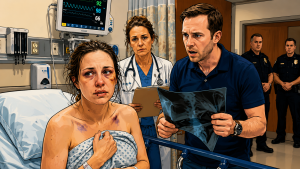
Daniel’s face changed in pieces.
First his mouth opened. Then the skin around his eyes tightened. Then his hand dropped, and the X-ray film tapped against his thigh.
A son.
The word did not come out of anyone’s mouth, but it filled the room anyway.
The two security officers stayed at the doorway. One had his hand resting near his radio. The other watched Daniel’s shoulders.
Dr. Greene set the sealed folder on the tray table beside me.
“That is not the part that concerns me most,” she said.
Daniel’s eyes flicked toward the folder.
Dr. Greene opened it.
“These images show multiple fractures in different stages of healing,” she said. “Not from one fall. Not from stairs. Not from today.”
Daniel’s nostrils flared.
“She’s fragile,” he said.
The room went very still.
Dr. Greene took one page from the folder and laid it beside the X-ray.
“Her left seventh rib is healing from an older break. Her wrist shows signs of a previous untreated fracture. Today’s injuries are fresh. We have already contacted the hospital social worker and law enforcement.”
Daniel turned toward me so fast the security officer stepped forward.
“Sarah,” he said softly, and that softness was worse than shouting. “Tell them you fall. Tell them you get dizzy.”
The monitor beside my bed beeped once, then again.
My lips were dry. My tongue stuck to the roof of my mouth. I could feel the tape pulling at my skin where the IV line entered my hand.
For eight years, Daniel had trained the house around his version of the truth.
A bruise was a cabinet door.
A split lip was a clumsy morning.
A missed dinner was fatigue.
The girls learned the shape of his footsteps before they learned multiplication. Lily stopped asking why the bathroom door locked from the outside. Emma learned to carry her cereal bowl with both hands so it would not clatter.
In our wedding photos, Daniel stood behind me with one hand on my waist. Everyone said he looked protective. I remember how tightly his thumb pressed into my ribs when the photographer told me to smile wider.
At first, he was careful.
He paid the mortgage on time. He tipped waiters twenty percent. He opened doors for older women at church. He bought my mother a $300 stand mixer the Christmas before she died and told everyone I needed help becoming “more domestic.”
When Lily was born, he brought blue balloons to the hospital room anyway.
“Just in case they made a mistake,” he said.
He smiled when he said it.
The nurses laughed because they thought he was joking.
When Emma arrived, Patricia came to the maternity ward wearing pearls and a cream cardigan. She looked into the bassinet, then at me.
“Maybe next time,” she said.
Daniel did not touch me for three months after that. Not with affection. Not with warmth. Only with correction.
The first time he shoved me into the laundry room wall, he brought me ice wrapped in a towel afterward.
“Don’t make me that kind of husband,” he said.
The towel smelled like bleach.
I learned to make breakfast without turning my back for too long. I learned which plates made the least noise in the sink. I learned to keep $417 in cash inside the lining of an old diaper bag in the garage.
And six weeks before that hospital room, I learned something else.
Daniel had scheduled an appointment at a private clinic in Scottsdale without telling me. I saw the charge on our Chase account because the alert came to my phone at 9:42 p.m. while he was asleep.
$680.
The clinic name meant nothing to me at first. Then I found the envelope in his truck console the next morning while looking for Emma’s missing pink hair clip.
Noninvasive prenatal testing.
Fetal sex: male.
He had known.
He had known before the patio. Before the insult. Before his hand closed around my wrist.
He had known there was a boy.
I folded the paper back exactly as I found it and took a photo with my cracked phone. I sent it to one person: my cousin Rebecca, a paralegal in Mesa who had been telling me for two years to document everything.
She replied with three words.
Keep it all.
So I did.
Photos of bruises with dates.
Screenshots of Daniel’s texts.
A recording from January where Patricia said, “A woman who gives only girls should know her place.”
A video Lily accidentally captured on her tablet from beneath the kitchen table. In it, only the floor showed, but Daniel’s voice was clear. So was the sound of glass breaking. So was my youngest daughter whispering, “Don’t cry loud, Mommy.”
I kept everything in a folder labeled Costco Receipts.
Daniel never opened anything that looked ordinary.
Back in the hospital room, Dr. Greene lowered her voice.
“Sarah, the social worker is outside. So are two Phoenix police officers. You do not have to speak in front of him.”
Daniel took one step toward the bed.
“I’m her husband.”
Dr. Greene did not move.
“You are no longer allowed near her without her consent.”
His jaw tightened.
“My children are at home.”
The words struck harder than his hand had.
At home.
With Patricia.
My fingers closed around the edge of the blanket.
Dr. Greene saw my face change. She leaned closer.
“Where are your daughters?”
My voice came out thin.
“With his mother.”
Daniel turned toward the door.
One officer blocked him.
“Sir, stay where you are.”
Daniel’s polite face cracked for half a second.
“You don’t understand,” he said. “My mother is elderly. The girls need breakfast.”
Dr. Greene looked at the officer.
“Can we get a welfare check at the residence?”
The officer lifted his radio.
Daniel’s shoulders rose.
“No,” he said.
One word. Sharp. Too fast.
Everyone heard it.
The officer’s eyes narrowed.
Dr. Greene turned back to me.
“Sarah.”
I looked at the folder beside my hand.
The paper edge was clean and white. My thumb left a faint smear from dried blood near the corner.
“His mother locks the pantry,” I said.
Daniel’s head turned slowly.
The first officer stepped fully into the room.
I kept speaking.
“She keeps Lily and Emma in the guest room when Daniel is upset. The windows are painted shut. The lock is on the outside.”
Daniel laughed once.
No one followed him.
“She’s confused from medication,” he said.
Dr. Howard looked at my chart.
“She has not been given anything that would cause confusion.”
The officer spoke into his radio, giving the address in Scottsdale. Daniel’s lips pressed together until they looked pale.
From his pocket, Patricia’s phone rang again.
This time, the officer held out his hand.
“Phone.”
Daniel did not move.
“Phone,” the officer repeated.
Daniel reached into his pocket and handed it over.
The screen showed Patricia Miller calling.
Then a text appeared beneath it.
They won’t stop crying. What did you do now?
The officer read it.
So did Dr. Greene.
So did Daniel.
His hand twitched.
I watched his fingers, not his face. I had learned that hands told the truth first.
The social worker entered next. Her name was Angela Brooks, and she wore blue scrubs with a badge clipped crookedly near her shoulder. She had kind eyes, but her mouth was set like a locked door.
She pulled the curtain halfway between me and Daniel.
“Sarah,” she said, “do you have somewhere safe?”
Rebecca was already on her way.
I knew because my phone had buzzed three times on the bedside table.
I asked Dr. Greene if she could hand it to me.
Daniel looked at the phone like it was a weapon.
Maybe it was.
The screen was cracked across the upper left corner. Under the glass, Rebecca’s messages waited.
Police called.
I have the folder.
I’m five minutes away.
My body sagged against the pillow. Not relief. Not peace. Just the strange weight of a door opening somewhere after years of being nailed shut.
Angela helped me sit enough to sip water through a straw. The water tasted like plastic. My ribs protested with every breath.
Daniel kept whispering to the officer.
“My wife is emotional.”
“My mother will explain.”
“This is a private family matter.”
The officer wrote each sentence down.
At 10:26 a.m., a nurse came in and spoke quietly to Dr. Greene.
Dr. Greene turned to me.
“They found your daughters.”
My hand flew to my mouth.
The nurse nodded quickly.
“They are alive. They are awake. They are with officers and paramedics.”
The words entered the room like air after smoke.
My shoulders shook once. I gripped the rail of the bed until my knuckles hurt.
Daniel closed his eyes.
Dr. Greene watched him.
“What happened?” I asked.
The nurse looked at Angela first.
Angela came closer to my bed.
“They were in the upstairs guest room,” she said. “The door was locked from the outside. Lily had Emma wrapped in a comforter. She pushed a dresser against the wall under the air vent because she said it was the only warm air.”
My teeth pressed into my lower lip.
No sound came out.
Daniel said, “My mother wouldn’t—”
Angela cut him off.
“Your mother told officers she had no granddaughters.”
The room changed.
Daniel’s eyes opened.
“She said what?”
The officer’s radio crackled.
A male voice came through, broken by static.
“Two minors transported for evaluation. Adult female at residence detained pending investigation. Possible unlawful confinement. CPS notified.”
Daniel reached for the wall as if the floor had tilted.
Dr. Greene picked up the X-ray film from where it had fallen against the bed rail.
“You wanted everyone to believe one fall explained this,” she said. “It doesn’t.”
At 10:41 a.m., Rebecca arrived.
She was still wearing her office badge, her hair pulled into a messy bun, her face pale from the drive. She carried a brown accordion folder against her chest.
Daniel saw her and swore under his breath.
Rebecca did not look at him first. She came to my bed, placed one hand on my ankle over the blanket, and bent close.
“The girls are going to Phoenix Children’s for evaluation,” she said. “I’m going there as soon as they clear you. Your neighbor Mrs. Alvarez gave the officers footage from her doorbell camera.”
Daniel’s mouth tightened.
Rebecca finally looked at him.
“And I gave them yours.”
His face emptied.
“What?”
She tapped the folder.
“The private clinic report. The photos. The recordings. The tablet video. The texts where you told Sarah she was not allowed prenatal care unless the baby was male.”
Daniel stepped toward her.
The officer caught his arm.
“Don’t.”
Rebecca’s voice stayed even.
“You knew.”
Daniel’s breathing became loud.
“You don’t know anything about my marriage.”
Rebecca opened the folder and pulled out one sheet inside a clear plastic sleeve.
“No,” she said. “But the Maricopa County Attorney’s Office will know plenty.”
That was the first time Daniel looked small.
Not sorry.
Small.
Like a man whose house had lights in every room but no exit.
The hospital did not discharge me that day. They admitted me for observation. A police officer took my statement in a quiet room with Angela sitting beside me and Rebecca holding my phone.
I spoke slowly.
Dates.
Rooms.
Objects.
The laundry wall.
The cracked blue mug.
The belt he kept folded in the top drawer but called “discipline” when anyone found it.
I did not describe every second. I did not need to. The evidence had been waiting for someone willing to read it.
By evening, Lily and Emma were brought to my room in soft hospital socks and oversized sweatshirts from a donation closet.
Lily walked in first.
She stopped at the foot of the bed, looking at the IV, the bruises, the monitor.
Then she climbed onto the chair beside me and placed her small hand on the blanket near my knee.
“Mommy,” she whispered, “I kept Emma quiet.”
My throat closed.
Emma crawled into Rebecca’s lap with a graham cracker in one fist. Her hair smelled like hospital shampoo. There was a red mark on her cheek from sleeping against a blanket seam.
I touched Lily’s hair.
“You did good,” I said.
Four words. All I could carry.
The next morning, Daniel was not in the hospital.
His name appeared on paperwork instead.
Emergency protective order.
Child welfare case.
Criminal investigation.
Hospital social work notes.
A detective named Morgan came by at 9:15 a.m. with a yellow legal pad and a calm voice. He asked questions without making me repeat what the records already showed.
At noon, Rebecca helped me call a locksmith.
At 12:47 p.m., she showed me the doorbell footage from Mrs. Alvarez’s house. The angle caught the patio wall, the side gate, Daniel’s navy polo, my fall, and Patricia standing behind the kitchen glass without moving.
Rebecca paused the video before the worst part.
“You don’t have to watch it,” she said.
I looked at the frozen image.
Daniel’s arm was lifted. My daughters’ small faces were in the window.
The frame held all of us exactly where he had put us.
Then Rebecca pressed the button to save a copy to three places.
Simple. Legal. Silent.
Two weeks later, Daniel’s attorney tried to call the hospital report “misinterpreted.”
The judge did not blink.
Dr. Greene testified in plain language. Dr. Howard confirmed the pregnancy findings and the injury timeline. Angela described the girls’ room. Mrs. Alvarez brought a printed still from her doorbell footage in a manila envelope.
Patricia sat behind Daniel wearing a black church dress and a small gold cross.
When the prosecutor read her text aloud — They won’t stop crying. What did you do now? — her fingers closed around the cross until her knuckles turned white.
Daniel stared straight ahead.
No smirk.
No soft husband voice.
No careful explanation.
Just a man listening to his own words come back through a courtroom speaker.
The protective order stayed.
The girls came home with me, not to the Scottsdale house, but to Rebecca’s guest room in Mesa where the sheets smelled like lavender detergent and the windows opened all the way.
At night, Lily slept with a flashlight under her pillow for a while. Emma carried the plastic cereal bowl from that morning everywhere until it cracked down the side. Rebecca bought her a new one with yellow ducks on it, but Emma kept both.
The baby came four months later.
A boy.
I named him Samuel, after my father, not after anyone Daniel loved.
In the delivery room, Rebecca stood on my left. Lily and Emma waited down the hall with a nurse, coloring pictures of our new apartment: three windows, one front door, no locks on the outside.
When the nurse placed Samuel against my chest, his tiny hand opened and closed against the hospital blanket.
His skin smelled like milk and warmth.
I counted his fingers twice.
Not because I doubted him.
Because for the first time in years, counting did not mean calculating danger.
Months later, the old house in Scottsdale went quiet. The HOA sent letters about the dead lawn. Someone removed the patio furniture. The lemon cleaner bottle Patricia used to leave by the sink was found under the counter when officers came back with a warrant.
At my apartment, the girls taped one of their drawings to the fridge.
Five people stood under a square yellow sun.
Lily had drawn me in the middle, holding a baby.
Emma drew herself with the old cracked cereal bowl in one hand and the new duck bowl in the other.
At the bottom, in purple crayon, Lily wrote our last name without Daniel’s.
The paper curled slightly at the corners from the refrigerator’s cold air.
That night, after all three children were asleep, I placed my wedding ring in a small envelope with the hospital bracelet from the day everything changed.
I did not throw them away.
I sealed the envelope, wrote the date across the front, and slid it into the back of the drawer.
Outside, a sprinkler clicked on somewhere in the dark.
Inside, the hallway night-light glowed against three bedroom doors, all open.