The email arrived at 9:14 on a Tuesday morning, tucked between a vendor invoice and a newsletter I never read.
It was from a law office in Columbus, and the subject line was clean and clinical: Estate of William Harper.
For a second I thought it was a mistake.
Then I opened it and learned my father had been dead for three days.
No one in my family had called.
Not my stepmother.
Not my sister.
Not one cousin, aunt, or family friend who still lived within twenty minutes of the big brick house where I had spent most of my childhood trying not to take up too much space.
The attorney’s message said my presence was requested at the funeral and the reading of the will.
Requested.
As if I were some distant party with a tentative connection to the dead.
I sat in my Chicago apartment with the email glowing on my laptop and let that old familiar feeling settle in my chest.
Not grief.
Not exactly anger.
Something flatter than both.
The kind of ache that comes from being treated like an afterthought for so long that disrespect starts to feel like weather.
My mother died when I was nine.
Two years later my father married Vivian, a woman with perfect posture, perfect lipstick, and a gift for cruelty so polished it could pass for concern if you didn’t know how to listen.
She never screamed at me.
She never had to.
She knew how to make a child feel unwanted with a lifted eyebrow and a carefully placed sentence.
By the time Alyssa was old enough to copy her, the house had rules I could never quite follow and a hierarchy no one bothered to explain.
Vivian and Alyssa were the center.
My father orbited them.
I learned to stay at the edges.
At dinner Vivian would tilt her head and say, ‘It’s odd, isn’t it, William? Candace doesn’t favor your side of the family at all.’ She said things like that while passing the potatoes, as if speculation about my existence was no more serious than salt.
Alyssa grew up on that script.
She called me the extra child, the spare, the girl Dad kept around because guilt made him sentimental.
There were framed photos everywhere in that house—matching sweaters at Christmas, beach trips on Lake Michigan, father-daughter dances, birthdays under paper lanterns.
I was absent from most of them.
Sometimes I had been there in real life and still somehow disappeared from the version that made it onto the wall.
At seventeen, I stopped trying to earn a place that kept being moved.
I packed one suitcase, left a note on the kitchen counter, and drove west with eight hundred dollars, a scholarship check, and a promise to myself that I would never beg those people to love me again.
My father did not come after me.
That hurt more than anything Vivian ever said.
So when I drove back down that long Ohio road eighteen years later, every tree on the property felt like a witness.
The branches still arched over the driveway the way they had when I climbed them as a kid to avoid going inside.
The house rose at the end of the lane, broad and stately and unchanged.
It
looked exactly like the kind of place people imagine when they hear the word inheritance.
To me, it looked like an old wound with shutters.
Vivian was standing in the upstairs window when I parked.
Her hand was twisted in the curtain hard enough to whiten the knuckles.
She did not look shattered by grief.
She looked alert.
Calculating.
Like someone who had spent days arranging a scene and had just spotted the one piece she couldn’t control.
Inside, the air smelled like lemon polish, stale carpet, and the perfume she had worn since I was twelve.
The relatives fell into hushed little pockets as I walked through the foyer.
A few nodded without warmth.
Most looked at me the way people look at a complication.
I heard someone murmur, ‘Only here because there’s money.’ Someone else answered, ‘Well, she sure wasn’t here when he was alive.’
I almost laughed at that.
They had no idea how many times I had reached for the phone over the years and set it back down because I could still hear Vivian’s voice in my head, making me feel like an intrusion before I even spoke.
Alyssa entered like she was making an entrance at a charity gala instead of her father’s funeral.
Black dress.
Diamond studs.
Hair swept perfectly over one shoulder.
She had been beautiful all her life in the easy way that earns forgiveness from strangers and arrogance from family.
When she saw me, the corner of her mouth lifted.
‘Candace,’ she said.
‘Wow.
You came.’
I looked at her and saw the child who used to shoulder me into doorframes and smile when adults turned around.
‘Apparently I was requested.’
Her eyes flashed.
She knew exactly what I meant.
At the church, they seated me in the back row behind distant cousins and one of my father’s golf friends.
The front was reserved for immediate family.
When I unfolded the printed program, my name appeared at the bottom in tiny type beneath a line that said Other Relatives.
I stared at it until the letters blurred.
Vivian delivered the eulogy with perfect control.
She spoke about her beloved husband, about their daughter Alyssa, about the life they built, the holidays they hosted, the values he cherished.
She painted a portrait of a man whose world began and ended inside the circle she had drawn around herself.
She never said my name once.
I waited for the casket to break me open.
It didn’t.
What I felt was colder than grief, a numb hollow where something softer had once lived.
I hated that it had come to that.
I hated him a little for letting it.
After the service I was leaving through the side aisle when a hand brushed mine.
Rosa, who had worked in the house since before my father remarried, slipped a folded note into my palm and kept walking without looking at me.
Mr.
Harper’s study.
Third floor.
He wanted you to see it.
I have the key.
The third floor had been forbidden territory when I was growing up.
My father called it his work space.
Vivian called it a mess.
Alyssa once told me he kept hunting rifles and confidential business papers up there and that if I went snooping he’d call the police
on me.
That night, while the first wave of mourners drank coffee in the kitchen downstairs and told softened stories about a man I barely recognized, Rosa led me up the back staircase with a ring of keys in her hand.
She unlocked the door, pressed the brass key into my palm, and said, ‘He asked me to do this if you came back.’
The room smelled like cedar and dust and old paper.
Moonlight from the dormer windows fell across shelves of ledgers, framed architectural drawings, and stacked boxes labeled in my father’s handwriting.
One box had my name on it.
My knees almost gave out.
Inside were photographs of me in Chicago that I had never seen before.
Me leaving the nonprofit where I worked.
Me speaking at a fundraiser.
Me carrying groceries in a winter coat.
At first the idea horrified me—proof that he had watched from a distance—but then I saw the dates.
Most had come from public events, newspaper sites, magazine clippings, charity newsletters.
He had not hired someone to follow me.
He had collected every scrap of my life he could find because it was the only way he knew how to stay close without having to face what he had failed to fix.
Beneath the photographs were printouts of articles with my name under the byline, copies of awards, and birthday cards still tucked inside their envelopes.
There were also canceled checks made out to my landlord, my graduate program, even a dental clinic in Chicago.
Every single one had a note clipped to it: Returned by V.H.
or Delivery refused.
My hands shook as I turned the pages.
At the bottom of the box was a thick letter in my father’s unsteady handwriting.
He began with an apology so direct it made my throat close: I should have protected you better than I protected my peace.
He wrote that he had watched me build a life with no help from the people who should have been proudest of me, and that his silence had become the great shame of his old age.
Then the letter turned darker.
He told me there were truths in that house Vivian had used like weapons because he had been too weak to drag them into the light while he was alive.
He wrote that if anyone ever questioned whether I belonged, I was to insist that every claimant to his estate submit proof.
Not just me.
Everyone.
‘Do not let them make you stand alone under a microscope I should have shattered years ago,’ he wrote.
‘Howard Bennett knows what I mean.’
Howard Bennett was the attorney who had emailed me.
I sat in that study for over an hour, reading and rereading those pages while the house breathed beneath me.
My father admitted that he had failed me at nearly every moment that mattered.
He also wrote something I had never once heard from him in life: ‘You were never the child who did not belong.’
When I finally came downstairs, Vivian was in the hallway waiting as if she could smell that something had shifted.
She looked at my face, at the red around my eyes, and her own expression tightened.
‘Rosa’s been sentimental since the death,’ she said lightly.
‘I hope she didn’t
upset you.’
‘No,’ I said.
‘Actually, she helped.’
For the first time in years, I saw uncertainty flicker across Vivian’s face.
Two days later the family gathered in the living room for the will reading.
Men in dark suits.
Women in black silk.
Cousins pretending not to stare.
Alyssa stood near the mantel like she already owned the room.
Before Howard Bennett could even open his folder, she lifted her chin and said, ‘Before Candace gets anything, I think we should settle something.
If this estate is going to be divided among William Harper’s children, she needs to prove she was ever really one of them.’
The room went still, then filled with the soft hiss of eager whispers.
Howard glanced at me.
He did not look surprised.
Vivian folded her hands in her lap and said nothing.
That silence told me more than any speech could have.
She had known this was coming.
Maybe she had written it herself.
The old version of me would have frozen in shame.
The girl who had left at seventeen would have heard that sentence and turned to smoke.
But the woman sitting there had spent the night in a locked study reading the truth in my father’s own hand.
‘Fine,’ I said.
‘I’ll take the test.
But if the will specifies biological children, then everyone claiming a share should do the same.’
Alyssa laughed immediately.
‘Absolutely.
I have nothing to worry about.’
For a fraction of a second, Vivian’s composure broke.
It was tiny—a tightening at the mouth, a flash in the eyes—but I saw it.
So did my grandmother, my mother’s mother, who had been silent in the corner up to that point.
She looked from Vivian to me and gave the smallest nod.
Not encouragement.
Recognition.
Like a clock striking an hour she had been waiting years to hear.
Howard closed the folder and said calmly, ‘Given the circumstances, that is a reasonable condition.
We’ll postpone distribution until testing is complete.’
Alyssa smiled as if she had already won.
Vivian never looked at me again that day.
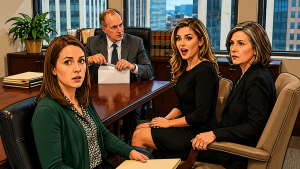
The results meeting was scheduled for the following week in Howard Bennett’s downtown office.
It was all leather chairs, walnut shelves, and wide windows that looked out over a muted ribbon of afternoon traffic.
Vivian arrived dressed in immaculate black, every hair pinned in place.
Alyssa sat beside her, but there was more space between them than usual, as if some instinct had already begun tugging her backward.
I took the seat across from them and placed my father’s letter in my lap under the table.
I wanted the paper touching me when the truth came down.
Howard spoke without flourish.
‘Mr.
Harper amended his will three years ago.
Under the final version, his estate is to be distributed only among his biological children.
All interested parties consented to DNA testing.
The results are here.’
He lifted a sealed envelope.
No one moved.
The room got so quiet I could hear the air conditioner click on and the second hand of Howard’s watch brush forward.
He opened the envelope, scanned the first page, and did not look at me.
He looked at Alyssa.
Then he turned to Vivian and asked, very quietly, ‘Mrs.
Harper, would you like to tell your daughter who her
father is before I do?’
Alyssa actually smiled for half a second, the kind of smile people make when they assume a joke is happening in bad taste.
Then she saw her mother’s face.
The color dropped out of her so fast it was visible.
‘What did he just say?’ she asked.
Vivian stared at Howard as if he had broken into her house.
‘That is absurd.’
Howard slid one paper across the table.
‘The current DNA testing confirms that Candace Harper is Mr.
Harper’s biological child.
It also confirms that Alyssa Harper is not.’
‘No.’ The word cracked out of Alyssa before Vivian could speak.
She snatched up the page, eyes jumping over terms she probably did not understand.
‘No.
This is wrong.’
Howard’s expression did not change.
‘It is not wrong.
And because Mr.
Harper anticipated exactly this challenge, he left a second file to be opened only if anyone attempted to dispute Candace’s paternity.’
From his briefcase he removed another envelope, older and yellowing at the edges, my father’s signature still slashed across the seal.
He opened it carefully and took out a paternity report dated twenty-eight years earlier, along with several notarized statements and copies of correspondence.
Alyssa looked from the documents to her mother like a child who had just discovered the floor could move.
Howard continued in the same measured tone.
‘Mr.
Harper retained this report after confronting Mrs.
Harper about an affair with a man named Daniel Mercer during the period in which Alyssa was conceived.
Testing was conducted in 1998.
Mr.
Harper was excluded as Alyssa’s biological father.’
The room exploded without anyone raising their voice.
It was all breath and silence and disbelief colliding at once.
One cousin covered her mouth.
My grandmother closed her eyes.
Alyssa turned so violently in her chair that one heel scraped the wood floor.
‘Mom?’
Vivian’s jaw locked.
‘Your father is William Harper.
He raised you.
That is what matters.’
‘That’s not what he asked.’ Alyssa’s voice got thinner with every word.
‘Who is Daniel Mercer?’
No one answered for a moment.
Then my grandmother spoke from beside the window, her voice rough with age and old disgust.
‘The man your mother swore she stopped seeing before the wedding.’
Vivian whipped her head toward her.
‘This is not your place.’
‘You made it everyone’s place when you tried to erase my granddaughter with it,’ my grandmother said.
Howard waited until the silence settled again.
‘Mr.
Harper learned the truth when Alyssa was two.
He chose not to expose it publicly.
According to his written statement, he did not want a child punished for an adult betrayal.
He continued to raise Alyssa as his own.
He also chose not to divorce Mrs.
Harper at the time because he believed the scandal would destroy the family and because Candace had already lost enough.’
My throat tightened so hard it hurt.
Even in the explanation there was a wound.
He had known.
He had stayed.
He had still let Vivian use that same lie to cut me apart.
Howard seemed to know exactly what I was thinking, because he unfolded one final sheet and said, ‘Mr.
Harper addresses that as well.’
He read from my father’s statement.
‘I told myself silence would keep peace.
In practice it handed…………..

