Part 1
The first thing I saw on my nineteenth birthday was my dad’s name lighting up the screen like a warning flare.
I’d been half-asleep, one arm flung over my face, trying to pretend the day wasn’t happening. Birthdays in our house were like rainstorms you watched through a window: technically real, but not something you went outside for. If you acted like you expected a cake or a card, you got a lecture about entitlement. If you acted like you didn’t care, you got accused of being ungrateful. So I usually treated my birthday the way you treat a cracked step on your porch: step over it and don’t put weight on it.
My phone buzzed again. A text, then another, like he couldn’t stand waiting for me to read it.
Sold your laptop. Your sister needs a new phone. Be grateful we feed you.
I sat up so fast my head went light. For a second I thought I’d read it wrong, like maybe “sold” was a typo for “fixed” or “found.” But the words didn’t change.
Then another message came in.
Also, you’ll pay her tuition—$6,000 by Friday.
My fingers hovered over the keyboard. I could feel my heartbeat in my wrists. The laptop wasn’t some toy I used to watch videos in bed. It was how I did my online assignments, how I clocked hours for my warehouse job, how I applied for internships, how I worked on the draft of a scholarship essay that still sat open from last week. It was my entire life compressed into plastic and circuits, the only thing in the house that felt like it belonged to me.
And he’d sold it like it was a pair of old shoes.
I slid out of bed and opened my bedroom door. The hallway smelled like fried oil from last night, and the floorboards creaked under my bare feet. From down the hall, I could hear my mom humming with the sink running, the sound she made when she wanted you to believe she was peaceful. It was always loudest when she wasn’t.
I didn’t go out there. I didn’t need to. I already knew how this would play out.
My sister, Delaney, would be at the table scrolling on whatever new phone Dad had bought her the week before. She’d be telling Mom about a class she didn’t study for, and Mom would laugh like it was adorable. Dad would be drinking coffee, watching the morning news, already irritated by the world. Irritated by traffic. Irritated by politics. Irritated by the neighbor’s dog. Irritated by the fact that I existed and had needs.
He’d decided, on my birthday, to remind me that my needs didn’t count.
I went back in my room, shut the door softly, and stared at my phone again. It was so casual. Sold your laptop. Like he’d taken out the trash. Like my work, my school, the little corner of independence I’d carved out, were all disposable.
I typed, No.
Then erased it. It looked too emotional. Too small.
I typed again, No chance.
I hit send.
A minute passed. Two. I watched the little “delivered” checkmark like it was the only proof I hadn’t imagined any of this.
Then his reply came.
Then get out. You’re cut off.
That was it. No discussion. No threat wrapped in concern. Just an order, like I was an employee he’d finally decided to fire.
I should’ve felt anger first. Or panic. Or that hollow fear you get when you’re a kid and you realize the adults don’t love you the way you thought adults loved kids.
Instead, I felt something slower and heavier, like a trapdoor opening in my chest.
Because he didn’t know.
He thought he still had me.
He thought I was stuck.
But I’d been preparing for this for months.
In Alabama, nineteen is the age where the law finally stops calling you a child. My friends from other states had been legally adults since eighteen. I’d still been a minor, still tethered to a house where my parents could sign forms and say they spoke for me. That extra year felt like a chain, and Dad had loved it. He loved anything that gave him authority he didn’t earn.
Six months ago, I’d filed for emancipation. Quietly. Carefully. The way you do when the people you live with treat privacy like a joke. I did it with the help of a counselor at school who never once looked surprised by my story. She handed me a list of resources and told me to take photos of every document I could find. Birth certificate. Social security card. Pay stubs. Proof I could support myself.
I’d worked at the warehouse since I was sixteen, loading trucks until my shoulders burned and my hands blistered. Dad had never asked where the money went. He assumed it went to him, to the household, to “rent,” even though he never charged Delaney for anything. When I started depositing my checks into a separate account at a different bank—an account my parents didn’t know existed—he didn’t notice. He never paid attention to anything that wasn’t directly benefiting him.
The hearing was short. The judge asked me if I understood what I was giving up. If I understood I’d be responsible for myself. If anyone had pressured me.
I looked at the seal on the wall behind him and said, “I’ve been responsible for myself for a long time.”
The judge didn’t smile. He just nodded, like he’d heard that sentence too many times.
When the paperwork went through, I didn’t celebrate. I printed the certificate at school and folded it into my backpack like it was contraband. That document wasn’t a victory. It was an exit sign.
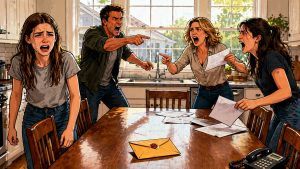
And now Dad had just given me the push.
I opened my closet and pulled out the duffel bag I kept behind the winter coats. It already had a few things in it: spare socks, a toothbrush, the small lockbox where I kept my important papers wrapped in a grocery bag. I’d told myself it was for emergencies.
Turns out, it was for birthdays.
I didn’t slam drawers. I didn’t stomp around. I moved like a ghost, because in our house the quiet kid was always underestimated. They thought quiet meant harmless. Quiet meant obedient.
Quiet, for me, meant I learned to plan without being seen.
I packed two changes of clothes, my work boots, my hoodie with the warehouse logo on the sleeve. I grabbed the envelope tucked under my mattress with the last of the cash I’d been pulling out in small amounts so it wouldn’t show up in any pattern. I unplugged my phone charger and rolled it up tight.
I glanced at the photo on my dresser—a school picture from sophomore year, all stiff posture and forced smile. Mom had insisted we frame it because she liked how it looked on the mantel when guests came over. I’d always wondered what those guests thought of us. If they bought the story of our family. If they saw the way Dad’s jokes always had sharp edges. If they noticed how Delaney’s laughter sounded like permission.
I left the picture where it was.
There was one more thing I needed to do before I walked out.
Two days earlier, at school, I’d printed a folder of documents. Scholarship letters. My job offer for a summer internship that started in May. Bank statements with my name only. Copies of deposits I’d made into that hidden account. A copy of the emancipation certificate with the court stamp still visible.
And a single sheet of paper I’d typed on the library computer, simple and clean.
I am no longer financially or legally tied to you. Do not contact my school, my workplace, or anyone on my behalf. Any attempt to access my information will be documented.
No signature. They knew my handwriting well enough.
I’d tucked the folder into my backpack that day, then brought it home and slid it into the bottom drawer of the kitchen cabinet where we kept the ugly placemats. I told myself it was insurance. Proof, if I ever needed it. Something I could leave behind if I disappeared.
Now I pulled it out.
My hands didn’t shake. That surprised me most.
I stepped into the hallway and listened. The kitchen noises continued—water running, a cabinet door opening, Mom humming louder than necessary. Dad’s voice drifted from the living room, complaining about something on the TV. Delaney laughed, a bright, careless sound.
I walked down the hall with my duffel bag over my shoulder and my backpack on my back.
No one looked up when I passed the kitchen.
Mom glanced at me, her eyes sliding over my bag like it was a coat. “You going somewhere?”
“Work,” I said.
It wasn’t a lie. Work was part of where I was going. It just wasn’t the whole destination.
Dad didn’t even turn his head. “Tell your sister happy birthday,” he called out, not realizing what day it was for me. Or maybe realizing and choosing to be cruel about it.
Delaney didn’t look up from her screen. “Happy birthday,” she said automatically, like reading from a script.
I walked to the front door.
I set the folder on the kitchen table as I passed, right in the center, where Dad liked to put his coffee mug. I didn’t make eye contact with anyone. I didn’t announce myself. I didn’t beg.
I just left.
Outside, the air was cold enough to sting my lungs. The sky was that flat gray that made everything feel muted. I walked to the bus stop two blocks away, sat on the bench, and waited with my hands shoved into my hoodie pocket.
I didn’t know exactly how long it would take for them to find what I left on the table.
But I knew what it would do when they did.
Part 2
The bus ride into town felt unreal, like I’d stepped out of my life and into someone else’s. It was mid-morning, and the seats were filled with people who looked like they belonged to themselves. A woman in scrubs nodded off with her lunch bag on her lap. A guy in a suit scrolled through emails with one earbud in. A kid about Delaney’s age laughed into his phone like he didn’t have to measure every sound.
I watched them and tried to imagine what it felt like to wake up in a home where no one could sell your future for a phone upgrade.
My friend Jordan lived across town, in a small rental duplex he shared with his older cousin. Jordan and I had met in tenth grade because we both stayed late after school. He stayed for basketball practice; I stayed because going home early meant stepping into whatever mood Dad was in. Over time, Jordan realized I always found an excuse to linger. He never asked why in front of anyone. He just started saving me a seat when he saw me in the hallway.
Jordan had this quiet steadiness I envied. He didn’t talk a lot, but when he did, it mattered. When I finally told him, in fragments, that my parents were taking my money and controlling my life, he didn’t do the thing people usually do—didn’t argue, didn’t say “I’m sure they mean well,” didn’t try to make it smaller.
He just said, “If you ever need somewhere to go, you can come to my place. No questions.”
I’d tried not to need that offer.
But need doesn’t care what you try.
When I got off the bus near his neighborhood, my phone buzzed again. I didn’t even have to look to know it was Dad. I kept walking, the duffel strap cutting into my shoulder.
At the corner store, I ducked behind the building, pulled out my phone, and powered it down. Not because I was scared of him finding me through GPS—though that was part of it—but because I needed the silence. I needed a break from the way his words could invade my head.
I’d factory reset the phone later, but right then I just needed it to stop vibrating like a wound.
Jordan opened the door before I even knocked, like he’d been waiting. He took one look at my bag and didn’t ask what happened. He stepped back and let me inside.
His place smelled like laundry detergent and the cinnamon candles his cousin liked. The living room was small but clean, with a futon against one wall and a TV mounted too high. On the coffee table sat an open notebook with scribbles and a half-finished math assignment.
Jordan pointed at the futon. “You can crash there.”
“Thanks,” I said, and my voice cracked on the word like it was heavier than it should’ve been.
He handed me a mug of water before I even sat down. “You hungry?”
I shook my head. My stomach felt tight, like it had locked itself.
Jordan sat across from me on a chair that looked like it had been rescued from the curb. He studied my face for a long moment.
“Your birthday?” he asked softly.
I blinked. “Yeah.”
He nodded once, like confirming something he already knew. “That’s messed up.”
I let out a laugh that wasn’t really a laugh. “They don’t… celebrate me. They celebrate what I can do.”
“Then we’ll celebrate you,” he said, like it was the easiest thing in the world.
I looked down at my hands. My knuckles were raw from work. I’d spent years thinking I didn’t deserve much. Jordan’s simple statement made that belief feel suddenly flimsy.
I unpacked only what I needed—my lockbox, my clean shirt, my toothbrush. I kept the rest zipped, because part of me still didn’t trust that this was real, that I wasn’t going to wake up and find Dad in the doorway.
Jordan’s cousin, Mariah, came home that afternoon and looked at me like she’d known me forever. She didn’t pry. She just said, “Jordan told me you’re staying for a bit. There’s leftovers in the fridge. Don’t touch my fancy yogurt.”
That night, I lay on the futon staring at the ceiling, listening to the hum of the refrigerator in the next room. No shouting. No stomping. No slammed cabinet doors. The silence was so complete it made my ears ring.
That was when the fear finally tried to show up.
Not fear of being alone. Not fear of paying bills.
Fear of what would happen when my family realized they’d lost control.
Dad wasn’t the kind of man who accepted no. He accepted obedience, or he punished you until you gave him what he wanted. And Mom’s version of love was a net: she cast it over you and called it protection, but it was really just a way to keep you from swimming away.
Delaney—sweet, spoiled Delaney—had spent her whole life learning that wanting something meant receiving it. She didn’t see the strings because she was the one holding the scissors.
I imagined them the next morning, walking into the kitchen, seeing the folder.
Dad would reach for his coffee mug. His hand would bump the papers. He’d frown. He’d flip the top page. His face would tighten.
Mom would come in, wiping her hands on a dish towel, and ask what he was doing. He’d snap at her to be quiet.
Delaney would wander in, already complaining about school, and then she’d see the numbers. The scholarship amounts. The bank balance. The words emancipation certificate stamped with a court seal.
The moment would split into chaos.
Sister panicking because her tuition wasn’t magically covered anymore. Mom screaming because her perfect family image was cracking. Dad calling every number he could because he’d realize, all at once, that he couldn’t threaten his way back into control.
The thought didn’t make me smile.
It made me breathe.
Because for the first time, their chaos wasn’t mine to manage.
The next morning, Jordan nudged my foot with his sock. “You’re not gonna believe this,” he said.
I sat up, hair sticking out in every direction. My throat felt dry. “What?”
He held up his phone. The screen showed a list of missed calls from unknown numbers, all with the same area code as my neighborhood. Then a text from someone I recognized—my cousin Lena.
Your dad’s going crazy. What did you do?
Jordan looked at me like he was waiting for permission. “You want me to answer?”
I stared at the screen for a long moment. My heart beat steadily, not like panic. Like a drum.
“No,” I said. “Let them sit in it.”
Jordan nodded, like that made perfect sense. Then he stood and walked toward the kitchen. “Coffee?”
I followed him, still half-asleep, and that’s when my own old habits surprised me. I flinched when a cabinet closed too loudly. I listened for angry footsteps that never came.
Jordan poured coffee into two mugs. “You okay?”
I opened my mouth to say yes, because that was what I always said. But the word felt dishonest.
“I don’t know,” I admitted.
He slid a mug toward me. “That’s okay. You don’t have to know yet.”
I took a sip. It burned my tongue, grounding me.
Then Mariah wandered in, scowling at her phone. “Some man just called me, asking if you were here,” she said to Jordan. “I told him wrong number.”
Jordan’s jaw tightened. “My uncle?”
Mariah shrugged. “Sounded like he had a stick up his—”
“Yeah,” I said quietly. “That’s him.”
Jordan leaned back against the counter. “If he shows up, we call the cops. You hear me?”
I nodded, and something in my chest loosened. Not because I wanted police involved, but because for the first time someone was standing between me and my dad’s wrath.
Later that day, using Jordan’s laptop, I logged into my email through the school’s Wi-Fi. A message from my professor sat at the top of my inbox.
Caleb, your father contacted the department asking about your financial aid. I told him we cannot release any information without your written permission. Please let me know if you’re safe.
I stared at the email until the words blurred. Dad was already trying to pull strings.
He didn’t understand that the strings had been cut.
I opened a new tab and checked my bank account. My balance was still there. My scholarships were still mine. My work schedule still existed. My plans were still intact.
The only thing missing was the laptop he’d sold.
And I could replace a laptop.
I couldn’t replace myself if I stayed in that house.
That afternoon, Lena sent another text to Jordan.
Your mom’s crying. Delaney’s freaking out. Your dad says you stole money and ran. They found some papers. What is going on?
I closed my eyes. Lies, already.
I thought about answering. I thought about defending myself, about explaining everything, about dragging the truth into the light so it could clean the mess.
But I also knew my family. They didn’t use truth. They used stories.
So instead of typing paragraphs, I sent Lena one thing: a screenshot of Dad’s birthday text, the one where he bragged about selling my laptop and demanding $6,000 by Friday.
No commentary. No pleading.
Just his own words.
There was a long pause.
Then Lena replied with three words.
Oh my God. Caleb.
And for the first time since leaving, I felt a small, sharp thing in my chest that might’ve been relief.
Part 3
I didn’t hear the kitchen-table explosion myself, but over the next few days, pieces of it reached me like smoke drifting under a door.
Lena told Jordan first, then Jordan told me while we stood in the parking lot outside my warehouse shift, the night air smelling like diesel and wet pavement.
“Apparently,” Jordan said, “your dad came into the kitchen and saw the folder right where he puts his mug.”
I pictured it so clearly it almost felt like a memory.
Dad’s hand, thick and impatient, pushing aside the paper. His eyebrows pulling together. That small pause he always did when reality didn’t match his expectations.
“What’s this?” he would’ve said, even though no one had asked him to read it.
Jordan continued. “Your mom thought it was junk mail at first. Then she saw the bank statements.”
“And Delaney?” I asked, even though I already knew the answer.
Jordan huffed. “She lost it. Like, full meltdown. She started screaming that you couldn’t leave because you were supposed to pay for her tuition.”
The words hit like a slap, not because they surprised me, but because they confirmed what I’d suspected: Delaney didn’t just benefit from the system. She believed in it.
“She said that?” I asked.
“Lena said she was yelling about the six grand and how Dad promised you’d do it.”
My stomach turned. Dad had promised my money like it was his to give away.
Jordan leaned against his car. “Then your mom started yelling at your dad. Like, for real yelling.”
That part surprised me more. Mom didn’t usually challenge Dad. She preferred to redirect his anger onto me, like handing off a hot pan.
“She blamed him,” Jordan said. “Said he pushed too hard. Said he should’ve waited until after the semester.”
After the semester. Like my life was a harvest they could schedule.
“And your dad?” I asked.
Jordan’s mouth tightened. “He started calling everyone. Your grandparents. Your aunt. The school. Your job, I think. Lena said he tried to make it sound like you were having some kind of episode.”
I stared at the ground. “Of course.”
“Then he found the emancipation paper,” Jordan added. “And that’s when he really freaked out.”
I swallowed hard. That document was the blade I’d hidden in the drawer. I’d left it for a reason: because people like Dad only understand consequences when they see them stamped and official.
“What’d he do?” I asked.
“Started yelling that it wasn’t real. That you couldn’t do that without him knowing. That someone must’ve forged it.” Jordan shook his head. “Which is wild, because there’s a court seal on it.”
I almost laughed. Dad could stare at a stop sign and argue it was a suggestion.
Jordan opened his car door, then paused. “You okay to go into your shift?”
“Yeah,” I said, but my voice came out thin.
He studied me. “You don’t have to do everything alone anymore, you know.”
I nodded and forced my lungs to fill.
Inside the warehouse, the familiar rhythm took over: scanning packages, moving pallets, the beep of machinery. I liked it because it was simple. Work hard, get paid. No mind games. No silent punishments. No surprise texts…………

