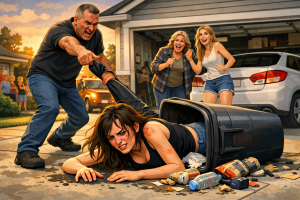
My Dad DRAGGED Me Across The Driveway By My Hair For Blocking My Sister’s Car! Then He KICKED Me Into The Trash Can. “USELESS THINGS BELONG IN THE DUMP!” Dad Laughed. “She Has No Future Anyway.” Mom Said They Had No Idea What I Would Do Next.
Part 1
The gravel bit first.
That was what I remembered later, more than my father’s voice, more than the heat, more than my sister’s laugh. Tiny gray stones ground into my knees and the heels of my palms while I tried to catch myself. The driveway had always been ugly up close, patched with oil stains and glittering shards of old rock salt that never fully washed away after winter. From a distance it looked neat enough, the kind of long suburban drive my mother liked to frame in photos when she posted the house online like it was a bed-and-breakfast instead of a place where people learned how to go quiet.
I had stepped out onto the porch to get a biochem textbook I’d left on the swing. That was all. I was barefoot, hair tied up with a drugstore claw clip, wearing an old college T-shirt with bleach spots near the hem. Lena’s white convertible was angled halfway down the drive, one wheel still turned, the engine already running. She liked to sit in parked cars with the air conditioning on before she left, like the world should pre-cool itself for her.
“Dad,” she called, not even to me, “she’s in the way again.”
There are some families where a sentence has to be explained. In mine, some words were like pulling a fire alarm. Again was one of them. It didn’t matter if it was true. It mattered that Lena said it in that thin, injured voice she used in front of donors, boyfriends, Pilates instructors, and my parents.
My father came out of the garage holding a coil of extension cord. He dropped it when he saw me. His face changed so fast it was like a switch snapping.
“I’m not blocking anything,” I started. “I was just—”
His hand clamped around my wrist before I finished.
There was no pause where a sane person might ask a question. No moment where he looked at the actual driveway and saw that Lena had plenty of room to reverse. He yanked hard enough to twist my shoulder, and I stumbled down the porch steps. My textbook hit the concrete with a wet slap, pages splaying.
“Don’t you ever block your sister’s car again,” he snarled, like I had done something obscene.
“I wasn’t—Dad, stop, you’re hurting me—”
He dragged me anyway.
Gravel tore under my skin. I could smell the hot rubber of Lena’s tires and the sweet fake coconut of my mother’s tanning oil. Somewhere a sprinkler hissed from the Hendersons’ yard next door. Birds kept chirping like none of this counted as weather.
My mother stood on the porch in a pale blue sundress, one hand wrapped around a sweating glass of iced tea. She didn’t move. Her lipstick was the color of bruised roses. She took a sip and watched me skid across the drive like she was waiting for a commercial break.
“She wants to live here for free and take up space?” she called out. “That trashcan’s finally got some use.”
For a second I honestly thought she was joking in that mean, brittle way she liked, the way that left a smear on you even when everyone pretended it was humor. Then my father shoved me sideways so hard I slammed into the tall plastic city trashcan by the garage. The lid banged open. My thigh hit the rim. I folded badly and went in shoulder first.
It smelled like stale soda, coffee grounds, and something rotting under a layer of lemon-scented cleaner. The inside wall was slick. My elbow knocked against a bundle of junk mail and an empty detergent bottle. The lid clapped shut over my head, and for one ridiculous second I was in the dark thinking, This cannot be happening. Not like this. Not while the sun is out. Not while the neighbors are home.
I pushed the lid up and tried to stand, but the angle was wrong and my bare feet kept slipping. I heard Lena’s laugh before I saw her. She was standing by her car in a white sundress with tiny strawberries on it, filming me with her phone held vertically.
“Finally in a place that fits,” she said.
I looked past her at my parents, waiting for somebody to blink first. My father only wiped his hands on his jeans. My mother shook the ice in her glass. Lena smiled into the camera like she was capturing a prank at a bachelorette weekend.
I was twenty-five years old. I had a degree in biochemistry, an inbox full of polite rejections for entry-level research positions, and ninety-three dollars in my bank account. I had moved back into my parents’ basement “for a few weeks” after graduation because the lease in my college town ended before I could find work. That had been three months ago. In my mother’s version of the story, I was a burden. In my father’s, I was lazy. In Lena’s, I was an inconvenience that had somehow kept existing after the credits should have rolled on her life.
When I was younger, none of it had looked this obvious. My father had been stern but decent then. He taught me to change a tire, let me sit on the workbench in the garage, called me “kiddo” when I handed him wrenches. My mother was chilly with everybody, which somehow made it feel less personal. Then Lena turned fifteen and got good at being looked at. Dance intensives. Private coaching. Paris one summer. New costumes in tissue paper boxes. Every sacrifice rearranged itself around her and got renamed as investment.
The year I needed nonslip shoes for a lab internship, my father told me, “Your sister’s summer intensive matters more in the long run.”
I remember staring at my old sneakers with a split sole and realizing long run meant not me.
Somehow, even knowing all that, the trashcan still shocked me. Maybe because humiliation looks sillier than cruelty in daylight. Maybe because some part of me had still believed there was a line. Parents could be selfish, cruel, unfair, vain, obsessed with one child over another. But a line existed. It had to.
Apparently not.
I climbed out by bracing one knee on the rim. Coffee sludge streaked my shirt. Something sticky clung to my forearm. I grabbed my textbook off the ground, although two corners were crushed and the cover had split from the spine.
My father pointed toward the back door. “Get inside.”
Lena finally backed out, still filming. She gave me a bright little wave through the windshield.
My mother said, “And clean up whatever you dragged all over my driveway.”
My driveway, I thought. Even then. Even with blood on my knee and garbage on my shirt.
I went down to the basement because there was nowhere else to go. The room wasn’t really a room. It used to be a storage area before my father threw in a narrow bed, a dented floor lamp, and a dresser that smelled faintly of mildew. One tiny window sat high near the ceiling, level with the grass outside, so when people walked across the yard I could see only their shoes. The light bulb overhead made a constant insect buzz. I sat on the mattress still wearing the trash smell, hands flat on my thighs, and stared at the concrete floor until afternoon turned the window from green to gold to black.
I didn’t go up for dinner.
At eleven, my mother knocked twice with her rings, not gently.
“You going to stay down there and sulk,” she asked through the door, “or are you going to clean up that trash you left all over the driveway?”
I opened it because if I didn’t, she would just keep talking.
She stood in a silk robe, hair in rollers, one hand on a tumbler of something amber and cold. Her expression didn’t change when she saw my swollen wrist.
“You know what you are,” she said, tapping the glass with one nail. “You’re a leech with a fake education. Lena is building something real. You just stink up our space.”
Then she walked off upstairs, slippers whispering over the steps.
The next morning the house was too quiet.
No TV in the kitchen. No blow dryer in Lena’s room. No cabinet doors. On the fridge, held by a magnet shaped like a lemon, was a note in my father’s blocky handwriting.
Road trip with Lena. Gone for the week. Don’t mess up the house.
That was it. No apology. No money. No food instructions. Just a command like I was the house sitter they resented paying.
I stood there barefoot on the cool tile and tried to make a plan with a brain that felt wrapped in cotton. I checked my wallet. Empty except for a student ID that had expired and a coffee punch card with two stamps left. My laptop was upstairs in the office, I thought. My duffel was in the basement. If they were gone a week, maybe I could pack and leave before they got back. Maybe I could call Cassie. Maybe I could—
My phone buzzed.
Lena had texted me a photo.
My suitcase sat at the curb in front of the house, tilted sideways like a drunk. The caption read: Oops. Took a detour. Hope you like the new view.
My lungs went tight. I ran outside so fast I didn’t even grab the screen door. The curb was empty. No suitcase. No duffel. No backpack. The little patch of grass by the mailbox was flattened, like something heavy had sat there for a minute and then vanished.
My phone buzzed again. Dad.
I answered before the first ring finished.
“Where is my stuff?”
“We dropped it off,” he said in the flat voice he used with telemarketers and people he’d already decided weren’t human. Wind rushed on his end. “You’ll find it at 91st Street Shelter in Ashland. Best start learning how the world works.”
Ashland was three hundred miles away.
I thought I had heard him wrong. “What?”
“Let’s see how you survive,” he said.
The line went dead.
For a moment the whole world narrowed to the buzzing in my ear and the white glare of late morning on the street. I turned in a slow circle. The hedges. The mailbox. The porch swing. The stupid welcome mat my mother replaced every season. They had done it. They had actually taken my things, my clothes, my ID, my laptop, my notes, and dumped them hours away at a shelter like they were clearing out an apartment after an eviction.
Something inside me did not shatter the way I would have expected. It went still.
Not calm. Not numb. Just still, like a lake right before ice.
Mrs. Talia lived two houses down in a brick ranch with wind chimes on the porch and marigolds in cracked clay pots. She was the only neighbor who ever asked me about school without making it sound like a hobby. I walked there in my stained shirt and bruised knees and rang the bell.
When she opened the door, her eyes widened behind big square glasses. “Sweetheart,” she said, “what happened to you?”
I could have lied. I could have said I fell. I could have laughed it off the way I’d laughed off years of smaller injuries. Instead I heard myself tell the truth. All of it. The driveway. The trashcan. The suitcase. The call.
She didn’t interrupt. She just listened, mouth thinning more and more with every sentence.
When I finished, she disappeared into the house and came back with forty dollars folded into a tissue and a business card with sawdust smudged across the corner.
“My nephew Malik runs a restoration shop two towns over,” she said. “Call him. He owes me a favor.”
I looked down at the card. Malik Johnson. Hartwell Restoration.
Mrs. Talia closed my fingers around it. “And listen to me. You are not what they called you. But if they’ve decided to throw you away, then let’s make sure they regret where you land.”
I stood there on her porch with blood drying on my knees, the business card damp in my palm, and for the first time since the lid slammed shut over my head, I felt something warmer than rage.
It felt like the first strike of a match.
And when I looked back toward my parents’ house, I noticed the basement window was open just a crack, like someone had left in a hurry. I could see the edge of the bed from here.
My laptop should have been upstairs. So why did I suddenly know it wasn’t there anymore?
Part 2
Malik’s shop smelled like cedar, hot dust, and old rain.
That was the first thing that hit me when he unlocked the side door and waved me in before sunrise the next morning. The building sat behind a row of warehouses on the edge of town, a long corrugated metal structure with faded green paint and windows so high they caught only the top slice of daylight. Somewhere inside, a radio murmured low jazz through static. I heard the hollow knock of wood against wood and the metal clink of tools being set down carefully, not tossed.
I had spent the night on top of the blanket in my basement room, fully dressed, one hand around the business card as if it could disappear if I loosened my grip. I called Malik at six-thirty with a voice that sounded unlike mine. Mrs. Talia must have warned him because he didn’t ask many questions. He only said, “Can you get here by eight?” and gave me directions……………………

