It was a strange, unsettling morning when Mr. Henderson, my grumpy old neighbor, died. His absence was felt immediately, as if the entire street had been waiting for him to disappear. It wasn’t the loss of his presence that made things so odd, but the abrupt quiet that took over the neighborhood. The constant complaints, the slamming of doors, the angry glares from his porch—suddenly, none of it was there. The street felt too empty.
My kids were outside, as usual, trying to soak in the last moments of summer before school started again. Sam, my eldest, was pacing back and forth on the front sidewalk, restless as always. Mia, the ever-optimistic middle child, was bouncing her basketball, her movements light, cautious, as if she feared making a sound that would break the new silence. Leo, my youngest, was sitting on the porch step, legs crossed, a peanut butter sandwich in his hands, but he wasn’t eating. His thoughts seemed far away, as if the death of Mr. Henderson had planted some confusion in his young mind.
The air was thick with the absence of noise. The usually constant hum of everyday life on our block was muted, replaced by the weight of Mr. Henderson’s absence. I tried to shake off the feeling that had settled over me, reminding myself that I should feel relief, but all I could think about was how strange it was that he was gone.
“Is it okay if we bounce the ball now, Mom?” Mia asked, her voice small but steady.
I glanced up from tying Leo’s shoelace, offering her a smile that didn’t quite reach my eyes. “Yes. It’s okay. It’s always been okay, honey,” I replied, but there was something hollow in my words.
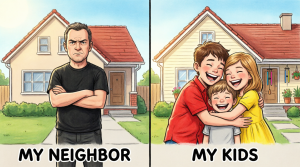
The absence of Mr. Henderson felt like a missing noise we had learned to live with. For ten years, my children had been forced to adjust to the constant barrage of complaints, to the daily tension of avoiding his wrath. We’d learned to walk the long way to the bus stop just to avoid the moments when he’d yell at them for playing too close to his driveway, or worse, when he would snap at them for things they hadn’t even done. I’d even baked him cookies once, hoping it would soften his hard exterior, but he had thrown them straight into the trash, without so much as a glance.
Leo, however, had never been afraid to wave at him every morning, even when all he received in return was a grunt or a door slam. And despite everything, Leo never stopped trying to break through that cold, uncaring wall that Mr. Henderson had built around himself.
As I watched my kids play outside, I couldn’t help but feel a sense of disbelief. For the first time in years, we were free. Free from the worry that he might come out and shout at them for simply existing in his space. Free from the constant tension of trying to avoid him. It should have felt like a victory, but instead, it felt like an eerie calm, the kind you feel before a storm.
That night, the kids stayed outside longer than usual. Mia climbed the tree in our front yard, her laughter ringing through the air. Sam rode his bike in tight circles up and down the street, reclaiming the space that had once been Mr. Henderson’s territory. Leo, as usual, was the most carefree, drawing with sidewalk chalk across both our driveway and the sidewalk in front of Mr. Henderson’s house. He didn’t ask permission. He simply did it, and I didn’t stop him. It was the first time in years that we hadn’t had to look over our shoulders.
The quiet was almost too much to bear.
The next afternoon, the quiet that had settled over the neighborhood began to feel unsettling. I was in the kitchen, washing dishes, when I saw Mrs. Callahan from the HOA standing on the sidewalk. She looked like she had materialized from thin air, suddenly appearing as if she’d been lurking in the shadows, waiting for something. Her arms were folded across her chest, and her sharp eyes scanned the street, catching every detail. Her lips were pursed into a thin line, and there was a sense of triumph in the way she stood, almost as if she were relishing Mr. Henderson’s death, or perhaps something else.
“Well,” Mrs. Callahan said, loud enough for the entire street to hear, “so he finally died.”
I froze for a moment, the words hitting me like a slap in the face. My stomach churned. How could she say something like that out loud? It was cruel, and it felt so wrong to speak about someone’s death so callously, especially when it was someone who had been a part of the neighborhood for so long—grumpy, yes, but still a part of the fabric of this street.
Sam, who had been sitting on the porch, stiffened beside me. His usual laid-back demeanor was replaced with an edge of tension. He’d been the most affected by Mr. Henderson’s constant yelling, always anxious about what might set him off. Mia, who had been quietly bouncing her ball, stopped in her tracks, glancing nervously at me. Even Leo, who had always remained unbothered by the old man’s gruff nature, looked up at the commotion.
“That’s a horrible thing to say,” I responded, trying to keep my voice steady, but the frustration was creeping through.
Mrs. Callahan shrugged nonchalantly, her expression a mix of curiosity and disdain. “I’m just saying what everyone’s thinking,” she said, her voice too loud for my liking. “He complained about your kids for years. Now, I wonder what will happen with all the HOA complaints.”
I didn’t respond. What could I say? Mrs. Callahan had never been a fan of my family. She had been the one to take notes every time my kids played too loudly, too late, or rode their bikes near the sidewalk. The neighborhood had always known her as the one who couldn’t tolerate any noise or disruption. But this? This was beyond the pale.
Before I could say anything else, a black sedan rolled to the curb, drawing my attention. Mrs. Callahan, still standing on the sidewalk, leaned in closer. “You watch,” she muttered with a sly smile. “His family’s going to come after you for all the complaints he made about your kids.”
I wasn’t sure what that meant, but the presence of the sedan was enough to distract me. A woman stepped out of the car, tall and elegant, with sharp features that immediately reminded me of Mr. Henderson. She wore a sleek black suit that spoke of wealth and refinement, a stark contrast to the disheveled house she was walking toward. This had to be his daughter.
She didn’t head toward her father’s house, though. Instead, she walked right up our path, her heels clicking on the concrete like an ominous countdown.
I stepped out onto the porch, wiping my hands on a dish towel. Sam stood beside me, his expression guarded. Instinctively, I rested a hand on his shoulder, trying to reassure him, though I wasn’t sure what was about to happen.
The woman stopped at the bottom of the steps, her sharp eyes scanning me and my children, as though sizing us up.
“Are you the mother of the three rascals that made my father yell?” she asked, her tone almost mocking, but there was something behind it that made my heart beat faster.
I hesitated for a moment. “Depends on who’s asking,” I said cautiously. “I’m Jenelle.”
She raised an eyebrow. “I’m his daughter. Although, I think my face gives that away. I know I look like my father. I’m Andrea.”
Her words hit me like a gust of cold wind. It was her—Mr. Henderson’s daughter. I had never met her, but there was something unsettling about how easily she said it, as if her identity was a badge she wore with little care for the implications.
Leo, who had been standing behind me, stepped forward, his small frame almost lost in the shadow of this woman. He looked at her with a mix of curiosity and caution, unsure how to react to this new presence.
Andrea didn’t wait for me to speak. Instead, she placed a small metal lockbox in front of me, her hands steady despite the tension in the air.
“This is for him,” she said, her voice quiet, almost hesitant, as her gaze fell on Leo.
“For Leo? Why?” I asked, my voice barely above a whisper. The box felt heavy in my hands, as though it carried more than just its physical weight.
Andrea didn’t answer right away. Her lips pressed together in a thin line, her expression unreadable. Finally, she spoke, her voice softer than before.
“Because my father put it in writing,” she said, her eyes flickering with something I couldn’t quite place. “And because I’m tired.”
Before I could respond, she turned and left, her heels clicking sharply on the pavement as she walked back to her car. I watched her go, the strange finality of her presence hanging in the air.
Leo, his eyes wide, climbed onto a chair to get a closer look at the box, his fingers hovering over it as if it might explode if he touched it.
Mia leaned against the kitchen counter, chewing her thumb, waiting for me to open it. Sam stood with his arms crossed, staring at the back door, lost in thought.
I turned the box over in my hands, unsure what I was about to find. But whatever it was, I knew it would change everything.
The box was heavy in my hands, its metal surface smooth and cold, as if it had been untouched for years. I stared at it for a long moment, wondering what could possibly be inside. Andrea’s cryptic words echoed in my mind: “Because my father put it in writing.” What had Mr. Henderson wanted to leave behind for Leo? And why him?
“Well?” Mia asked, breaking the silence. She stood beside me, her excitement palpable. “Are you going to open it, Mom?”
“Yeah,” I said, trying to steady my breath. “Let’s see what this is.”
I carefully turned the lockbox in my hands, but there was no key or obvious way to open it. I set it on the kitchen table and searched the edges for any sort of latch. Leo, ever the curious one, reached for it, but I stopped him with a hand on his shoulder.
“Let me do it, okay?” I said, trying to hide the growing unease that I felt creeping up my spine.
I flipped the box over again and, finally, found a small, hidden latch. I released it, and the top opened with a soft, metallic click. The moment it did, the room seemed to hold its breath.
Inside, there was nothing but a single USB drive, plain and unmarked. No letter, no explanation—just the small device that seemed so ordinary and yet so incredibly out of place in a metal lockbox. My heart raced as I picked it up, the weight of it in my hand suddenly feeling like a thousand pounds.
“That’s it?” Sam asked, squinting his eyes in disbelief. “Just a flash drive?”
I nodded, my stomach twisting in a knot. It didn’t make sense. Why would Mr. Henderson leave a USB drive for Leo? I stared at it for a moment longer, then motioned for Sam to bring me my laptop.
“Maybe there’s something on it,” I said, though my voice trembled slightly.
Sam quickly grabbed my laptop and set it on the table in front of me. I plugged in the USB drive, and the screen went black for a moment, then flickered back to life. The first thing that appeared was an image of Mr. Henderson—his usual scowl replacing the stern, grumpy expression he often wore on his porch. But this time, he wasn’t shouting. He was sitting, looking directly into the camera, his face soft with a quiet sadness that I had never seen before.
His voice came through the speakers, rough, like it hadn’t been used in a long time. “I made myself unbearable on purpose,” he said, his words slow and deliberate, as if they were the heaviest things he’d ever had to say. “I needed to know if anyone could be kind to someone who didn’t deserve it.”
My breath caught in my throat. The image of Mr. Henderson—always so loud, so harsh—was completely different now. This wasn’t the man who had yelled at my kids for years. This wasn’t the neighbor who had made our lives so difficult. This man was broken, vulnerable in a way that felt unfamiliar.
“Why does he look… sad?” Leo asked, his voice small as he peered over my shoulder.
I couldn’t speak. My throat was tight, as if something was lodged there, blocking the words I wanted to say.
“I made myself unbearable on purpose,” the recording continued. “I needed to know if anyone would still be kind to me, even when I didn’t deserve it.”
His voice cracked on the last sentence, and I could hear the pain in it. It was so unlike anything I had ever imagined. The old man who had yelled at my children, the one who had refused every olive branch I’d ever extended, had been suffering. He had wanted kindness, but he had hidden it behind walls of anger.
The camera shifted, and suddenly, there was footage—footage of our porch, taken over the years, captured by Mr. Henderson’s security cameras. I hadn’t even known he had cameras pointed at our house. There were moments I didn’t even remember, and suddenly, I was watching myself through the lens of a man I had always thought of as nothing but cruel.
The first clip was from three years ago. Sam was just a little younger, riding his bike down the street. Mr. Henderson was standing on his porch, eyes narrowed, his lips twisted in disdain as he watched Sam ride by. I could see the way Sam flinched, even though he couldn’t hear Mr. Henderson’s words.
“Stay away from my driveway!” the footage replayed in Mr. Henderson’s voice, his anger unmistakable.
But then the next clip came up, and it was different. The timestamp was three months ago, and it was raining heavily. Mr. Henderson was struggling to bend over and retrieve his cane, cursing under his breath. Leo, just a small figure in a yellow jacket, was walking down the street, his hood slipping off his head.
I froze.
I had seen this moment before. I remembered it so clearly. I had watched Leo walk up to Mr. Henderson that day, the rain pouring down around them. Leo, so small and determined, bent down and picked up Mr. Henderson’s cane, handing it to him without hesitation. He hadn’t run away. He had offered a simple gesture of kindness, one that, in that moment, had seemed so insignificant.
But the footage showed something more. Leo reached into his coat pocket and pulled out something crumpled. A dandelion. He had kept it all day, a flower tucked safely in his pocket, just in case.
The camera focused on Mr. Henderson’s face as Leo held out the flower. “It’s for you. To make you feel better…”
The footage froze on Mr. Henderson’s face—his mouth open in surprise, his eyes wide as if he couldn’t quite believe what he was seeing. And then, his voice came back, quieter this time, almost a whisper.
“I spent eighty years trying to prove that people are only good when it’s easy. That kindness is a reflex, not a choice. But he… he chose it. Every day.”
The footage cut off abruptly, and the screen went black.
None of us spoke. We all sat there in silence, the weight of the moment sinking in.
The doorbell rang, breaking the stillness.
I felt my heart skip a beat. I wasn’t sure I was ready for this next part. Andrea’s voice from the other day echoed in my mind: “I’m tired.” What more could she possibly have to say?
The doorbell rang again, sharp and insistent. I glanced at the kids, whose eyes were wide with uncertainty. Sam had stiffened, standing like a statue near the back door, his arms crossed tightly over his chest. Mia, normally the brave one, was chewing her thumb nervously, the same anxious energy in her eyes. Leo was still staring at the screen, his small finger tracing the edge of the USB drive as if trying to make sense of the images that had just unfolded.
I stood, slowly, my legs unsteady. I wasn’t sure I wanted to face Andrea again. The air in the house was thick with everything that had just happened—the revelation from Mr. Henderson’s video, the unexpected kindness Leo had shown him, and the sudden weight of everything Andrea had left behind. But I couldn’t avoid it forever.
I walked toward the door, my heart pounding in my chest, and opened it.
Andrea stood on the porch again. This time, she looked smaller somehow. The sharp, confident posture she had shown earlier had softened. Her eyes, which had once held a cold, almost calculating look, now held something else—something raw. She wasn’t just the daughter of the man who had tormented my family for years. She was human, carrying her own baggage, her own sorrow.
She stepped inside without waiting for me to invite her, a little hesitant this time, her expression guarded. The door clicked shut behind her, and for a long moment, no one spoke. It felt as though the weight of Mr. Henderson’s death and the truth of his final gift were hanging in the air between us, suffocating us all.
Andrea lowered herself into the chair across from the kitchen table, not looking at me, but at the broken mug lying on the floor, the pieces scattered like shattered memories.
“Is it over now?” she asked softly, her voice heavy with something I couldn’t quite place.
“What do you mean?” I asked, my voice betraying my own uncertainty.
She looked up at me then, her eyes weary. “All of it. The anger, the hurt. Is it done?”
I didn’t know how to answer. For so long, Mr. Henderson had been a constant in our lives—his complaints, his bitterness, his refusals of kindness had become a daily obstacle. It felt like his death had released a strange kind of freedom, but also, it felt like there was something unresolved in the air. Something left unsaid.
Andrea’s gaze softened when it landed on Leo, who was still at the table, his hand running over the small lockbox, as though trying to understand the man who had caused so much pain in our lives.
“I never wanted any of this,” she said quietly, almost to herself. “I spent years trying to get my father to care. To see me. To see my brother. But he never did. He only saw his rules. His control.”
I could hear the bitterness in her voice, the sharp edges of her pain, and suddenly it wasn’t just Mr. Henderson I felt sorry for. Andrea had lived under that same roof, under the same harsh hand of a man who had never shown love, only cold, calculated distance.
“You don’t need to explain it to me,” I said, my voice gentler than I’d intended. “I get it. I see it in the way you’re talking about him.”
She exhaled, the sound heavy with exhaustion. “I wish I had known him the way Leo did. I wish he had softened for me like he did for him.”
I looked at her then, really looked at her. She was still holding onto something—some piece of hope, maybe, that the father she had known could somehow be the man Mr. Henderson had finally become for Leo. The man who had, in his final days, chosen to show kindness. I could see the longing in her eyes, the unspoken desire for a father’s love that she would never get to have.
“Leo didn’t ask for anything,” I said softly. “He just gave. That’s the difference. He didn’t wait for anyone to change. He just… gave.”
Andrea’s eyes flickered, a small, almost imperceptible shift. She nodded slowly, her lips tight, as if struggling to find the words that would make sense of everything.
There was a long silence before she spoke again.
“My father was a hard man,” she began, her voice barely above a whisper. “He didn’t want connection. He wanted control. And when I stopped trying to please him… I think he gave up on me. I know I gave up on him.” She looked down at her hands, picking at the fabric of her sleeve. “But when I saw that video, I couldn’t stop thinking about it. The way Leo just… gave. I don’t know if I’ll ever understand why he did it, but it made my father believe kindness was real. It made him believe that people could change, that love wasn’t just something you used to manipulate others.” She let out a sharp breath, one full of frustration and sadness. “I don’t know if I can ever forgive him. But seeing that… part of him, that soft part, that my children saw… it breaks something in me.”
I didn’t know what to say to that. I didn’t have the answers for Andrea. I didn’t have the answers for myself. But in that moment, I realized something. Maybe it wasn’t about forgiveness. Maybe it wasn’t even about Mr. Henderson anymore. Maybe it was about the future. The future we had, the future Leo had, and the way that kindness—despite everything—could still leave an imprint.
Andrea reached into her bag, pulling out a manila envelope. She set it gently on the table in front of me, her fingers lingering on the edges for a moment before letting it go.
“There’s more,” she said, her voice barely above a murmur. “The house next door… it’s in Leo’s name now.”
I blinked, trying to process her words. “What do you mean?”
She glanced up at me, her eyes searching mine for something—understanding, maybe. “The house. My father left it to Leo. He can keep it, sell it, or whatever he wants to do with it. It’s his.”
I sat back, trying to absorb what she was saying. “But… why Leo?”
“Because your son didn’t ask for anything,” Andrea said, her voice breaking slightly. “He just gave. And my father saw that. And it made him believe in kindness, in something bigger than himself. Something that I had given up on a long time ago.”
I opened the envelope carefully, feeling the weight of it in my hands. Inside was a letter and a document.
The letter was addressed to me, in Mr. Henderson’s handwriting. It read:
To the Mother,
You kept your children kind in a world that tried to harden them. That’s not weakness. That’s brilliance. Thank you for letting Leo wave. Thank you for letting him be… human.
I wiped my eyes, the words blurring in front of me. My hands were shaking as I read them again. This wasn’t just a gift. It was a message—a message from the man who had spent years tormenting us, trying to show us that kindness was something to be feared. And in the end, it was that same kindness that had redeemed him.
“That’s all he left,” Andrea said softly. “He never talked about it, but he cared. And now, this house… and everything he left for Leo, it’s his.”
I nodded, my throat tight with emotion. “Thank you,” I whispered, though I wasn’t sure if I was thanking her or him. Maybe both.
Andrea stood up, a small, sad smile playing on her lips. “I should go.”
“You don’t have to,” I said gently. “You’re not alone in this. You don’t have to carry him alone anymore.”
Andrea smiled, though it was bittersweet. “Yeah. I’d like that.” She looked at Leo, who had been quietly listening to the conversation, his small face brightening a little as he stood up to fetch mugs. “I never thought I’d be here. But somehow… I’m glad I am.”
Leo came back, two mismatched mugs in hand, and for the first time in what felt like forever, we sat together—me, my kids, and Andrea—not as strangers or enemies, but as something new.
Something different.
The silence that settled over the table after Andrea’s departure was not the same as before. It was not cold, not uncomfortable—it was something new, something that felt like an unspoken understanding had taken root. Andrea’s visit had left us with so many questions, but it also gave us a kind of closure, a kind of peace we hadn’t known we were looking for.
I glanced at my children as Leo handed me a mug of hot chocolate, his little hands barely able to hold the large cup. He had no idea how much weight had just been placed on his young shoulders. He had no idea that the house next door, once a source of anger and frustration, was now his responsibility, his gift from a man who had been both his tormentor and, in the end, his greatest lesson.
The warmth of the drink was soothing, and for a moment, it felt like everything had settled into place. But I knew, deep down, it hadn’t. We weren’t done with Mr. Henderson’s legacy—not yet. But now, we could move forward. We could take the lessons he had left behind, the ones he had learned too late, and use them to shape our future.
Mia sat on the couch, her legs crossed, flipping through a book. Sam was leaning against the doorframe, his arms crossed, lost in his thoughts. I could tell that he was still processing everything that had happened, just as I was. Leo, however, seemed unbothered, his wide eyes bright and full of curiosity, as he sipped his hot chocolate.
“You know,” Leo said suddenly, breaking the silence, “I never understood why Mr. Henderson was always so mad. He just seemed angry all the time.”
I looked at him, startled by the insight in his voice. It wasn’t a child’s thought; it was a realization that had come from somewhere deeper, somewhere that he had been hiding beneath the surface.
“Yeah,” Mia added, glancing up from her book. “I used to be scared of him. But I guess he was just… really lonely, huh?”
Sam nodded slowly, his expression thoughtful. “I think he was just sad,” he said quietly. “But he didn’t know how to ask for help. He thought being angry would make him strong.”
Leo smiled softly, his innocent understanding of the world never failing to astound me. “I think it’s kind of like how I always give people flowers,” he said, his voice full of certainty. “You can’t really keep anger inside forever. It makes you feel yucky. Like, what if you just gave someone a dandelion instead? Maybe that’d make them feel better.”
His words were simple, but they were profound. The way he had understood Mr. Henderson’s need for kindness—without even being told, without expecting anything in return—was the kind of wisdom that only came from pure, untainted hearts.
I felt my heart swell with pride. This was my son—the boy who never stopped trying to break through barriers, who never gave up on believing in goodness, even in the face of bitterness.
“I think you’re right, Leo,” I said softly. “Maybe that’s what Mr. Henderson needed. Someone to show him that kindness was stronger than anger. That kindness was the thing that could change him.”
Leo looked up at me with his big brown eyes, full of a wisdom I could barely comprehend. “I’m glad I gave him that dandelion. Even if he didn’t smile or say anything. I think it helped.”
I smiled, reaching over to ruffle his hair. “You made a difference. A big one.”
Mia shifted next to me, her voice quiet but earnest. “Maybe that’s why Mr. Henderson left everything to Leo. He saw that in him. He saw something… good. Something pure.”
“I think you’re right,” I said, my voice thick with emotion. “He saw Leo’s heart, his kindness. And he knew that, despite everything, Leo would carry that with him. He’d never stop giving.”
It was in that moment that I realized the full impact of what had happened. We hadn’t just received a house or a gift from a man who had spent years making our lives difficult. No, what we had received was a lesson—one that I didn’t fully understand at the time, but now, sitting here with my children, I saw it clearly.
Mr. Henderson had been a man who believed kindness was weakness, who had spent a lifetime hiding behind control and anger. But in the end, it was kindness—Leo’s kindness—that had broken through. It had been the only thing that had managed to crack his hard exterior, to make him see the world in a different way. And in doing so, it had unlocked a future for my son that no one had ever expected.
I looked at the letter again, the one that Mr. Henderson had left behind for me, the one that had spoken of kindness, of brilliance, and of the mother who had kept her children kind. It wasn’t just a thank you—it was a reminder. A reminder that, even in a world full of harshness, the greatest strength we could have was the ability to give. To be kind when the world told us it wasn’t worth it.
The letter was Mr. Henderson’s final act of grace, and I would carry it with me, forever grateful for the unexpected way in which it had been delivered.
That night, as the house settled into quiet, I couldn’t help but feel a shift within me. We were moving forward, not because we had to, but because we were ready. The past had been hard, full of struggles and misunderstandings, but it was over now. We were no longer prisoners of Mr. Henderson’s bitterness. We had learned something far more valuable: that kindness, in its simplest form, was the thing that would carry us through whatever came next.
I glanced at Leo, who had fallen asleep on the couch, a smile still on his face. I looked at Sam and Mia, who were both nestled in their own spaces, each one lost in their own thoughts. And for the first time in a long time, I felt something I hadn’t felt in years: peace.
This was our new beginning.
This was the future we had built—together.

