When I got home from a business trip, I found my daughter unconscious by the door. My wife shrugged and said she’d “just disciplined her.” I called an ambulance. But when the paramedic saw my wife, he went pale and whispered, “Sir… is that really your wife? Because actually…”
Part 1
The first thing I noticed when I opened the front door was the silence.
Not the peaceful, end-of-week quiet I’d been looking forward to after three days in a Minneapolis hotel. This silence had weight. It pressed against my ears like cotton, like the house itself was holding its breath.
My suitcase rolled over the threshold with a soft thud. I called out, “Lily? Jen? I’m home!”
No answering footsteps. No excited squeal. No dog nails on hardwood—because we didn’t have a dog anymore. Jennifer said Lily’s “allergies” were getting worse. I’d believed that too.
Then I saw her.
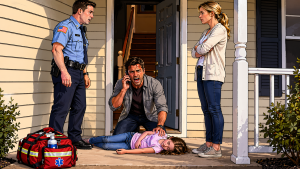
Lily was on the floor by the door, her small body crumpled as if she’d collapsed mid-step and nobody had bothered to move her. One arm was tucked under her chest, the other splayed near the welcome mat. Her hair stuck to her forehead. Her lips had a grayish tint I didn’t like.
For half a second, my brain refused to process it. It tried to make her into something else—maybe a pile of clothes, maybe a blanket.
Then I dropped my suitcase.
“Lily!” I fell to my knees beside her. My hands hovered, terrified to touch her too hard, like she might shatter.
Her skin was cool. Not cold like winter air, but wrong-cool, like the warmth had been siphoned off. I pressed my fingers to her neck the way I’d seen doctors do on TV. Her pulse was there, but thin, fluttery, like a moth trapped in a jar.
Her breathing was shallow. She made a faint sound—almost a sigh—and her eyelids didn’t move.
My throat tightened so hard it felt like swallowing glass. “Hey, baby. Daddy’s here. Wake up, okay? Wake up.”
A bruise bloomed across her cheek, purple and angry. Not the kind of bruise a kid gets from tripping over a toy. This bruise looked like force. Like contact. Like a hand or something harder.
I was gone three days. A sales conference. Minneapolis. Cloud Tech Solutions. Handshakes, presentations, mediocre steak dinners with clients who laughed too loudly. I’d FaceTimed every night. Lily had sounded quiet, but Jennifer had leaned into the frame smiling, brushing Lily’s hair and saying, “She’s just tired. You know how kids get.”
Now my daughter was motionless on the floor.
I scrambled for my phone with shaking fingers and then froze because footsteps finally approached.
Jennifer appeared in the doorway from the kitchen, dish towel in hand, as calm as if I’d asked her where the coffee filters were. Her blonde hair was in a neat ponytail. Her face was composed. Her eyes didn’t dart to Lily with panic. They barely flicked down at her at all.
“Oh,” she said lightly. “You’re home early.”
My voice came out like a roar. “Jennifer! What happened? What did you do?”
She shrugged, a small lift of one shoulder, and it made my stomach twist with a kind of rage I didn’t know I had in me. “She was being dramatic. I disciplined her earlier. She’ll be fine.”
I stared at her, waiting for the moment where she’d break the act and say she was joking or she didn’t realize Lily was actually unconscious.
She didn’t.
“I need you to tell me what you did,” I said, trying to keep my voice from cracking into something useless. “Right now.”
Jennifer’s mouth tightened like I was inconveniencing her. “She was misbehaving. Throwing a tantrum. I gave her some Benadryl to calm her down.”
The world narrowed down to those words.
“How much?” I demanded.
She blinked slowly. “I don’t know. A few pills.”
“A few pills?” My voice broke. “She’s six.”
Jennifer rolled her eyes. “Don’t start. Parents give their kids Benadryl all the time. You’ve been so soft on her since Emily—”
“Stop,” I snapped, and the sound of my first wife’s name in Jennifer’s mouth made me see red. Emily had died when Lily was two. Car accident. A drunk driver ran a red light and erased my life in one impact. I’d spent two years raising Lily alone, stumbling through grief and bedtime stories and daycare pick-ups with a knot in my throat.
When I met Jennifer at a coffee shop downtown, I thought I’d found something like a second chance. She’d been warm, charming, the kind of woman who laughed at my jokes and called me a good father. She’d crouched to Lily’s level and offered her a cookie like it was a sacred peace offering.
Now she stood above Lily’s unconscious body with a dish towel in her hand like this was a minor inconvenience.
I didn’t argue anymore. My fingers dialed 911 before my brain could give me another reason to hesitate.
“911, what’s your emergency?”
“My daughter,” I gasped. “She’s unconscious. Six years old. I think she’s been drugged.”
The operator’s voice stayed calm, professional. “Is she breathing?”
“Yes,” I said. “Barely. Please, hurry.”
“An ambulance is on the way,” she said. “Stay on the line.”
I scooped Lily’s hand into mine. Her fingers were limp, her palm cool. I rubbed her knuckles gently, speaking to her in a low, desperate voice. “Lily, honey, Daddy’s here. You’re okay. You’re okay, okay?”
Jennifer leaned against the wall, arms folded. “You’re overreacting,” she said, like she was watching a stranger make a scene in a grocery store.
I didn’t look at her. I didn’t trust myself not to do something that would complicate Lily getting help.
Eight minutes felt like a year.
When the paramedics burst in, the house filled with motion and command voices and equipment. The lead paramedic had a badge that read Martinez. He dropped to Lily’s side, checking her airway, her pulse, her pupils.
“How long has she been like this?” he asked.
“I just got home,” I said. “Found her like this. Ten minutes ago.”
“Any medical conditions?”
“No,” I said. “She’s healthy.”
Martinez’s eyes flicked to Jennifer as if she was a piece of information he hadn’t accounted for. His face changed. The professional neutrality slid into something else—recognition, then a sharp, contained alarm.
He stood slowly, staring at her.
My stomach sank even further. “What?”
Martinez leaned toward me and spoke low, like he didn’t want her to hear.
“Sir,” he whispered, “is that really your wife?”
“Yes,” I said, confused and furious. “That’s Jennifer. Jennifer Walsh.”
Martinez didn’t blink. His jaw tightened.
“Because actually,” he said, voice even quieter, “I don’t think that’s who she is.”
Part 2
Martinez pulled his phone out with a speed that made my skin prickle. He typed with his thumb, eyes never fully leaving Jennifer. His partner—young, focused—kept working on Lily, slipping an oxygen mask over her face, attaching monitors.
“Ma’am,” Martinez said, voice firm now, “what’s your full name?”
Jennifer’s expression barely shifted. “Jennifer Walsh.”
“And your maiden name?”
“Morrison,” she said smoothly. “Jennifer Morrison. Why?”
Martinez didn’t answer. He turned his phone toward me.
On the screen was a news article. Portland, Oregon. November 2021. The headline made my brain go cold:
Woman arrested in child abuse case; stepson hospitalized with suspicious injuries.
Beneath the headline was a photo.
A woman with blonde hair, sharp cheekbones, and the same cold blue eyes that were watching us right now.
The name under the photo read Sarah Jensen.
I looked at Jennifer. Then at the screen. Then back again.
“That’s…” I started, but the word wouldn’t finish. It was like trying to speak through ice water.
Martinez’s voice was tight. “Sir, that’s her. She was investigated in Oregon. Her stepson was found unresponsive. Bruising. Sedatives in his system. Severe dehydration.”
Jennifer’s mouth curled with annoyance. “This is ridiculous,” she said calmly. “I’ve never been to Oregon. This man is confused.”
Martinez took a step toward her. “I worked that case,” he said, and the hair on my arms rose. “I was the paramedic who responded when the boy was found. I testified. I would recognize you anywhere.”
Jennifer’s eyes narrowed, and for the first time I saw something slip—an impatience that didn’t match the situation.
“You’re mistaken,” she said.
Martinez turned back to his partner. “Load her up. Priority one. Possible overdose and suspected abuse. I’m calling this in.”
Everything moved at once. Lily was strapped onto a gurney, her body swallowed by straps and blankets that made her look even smaller. I stumbled alongside them, my hand gripping the rail like it was the only solid thing left.
“I’m riding with her,” I said.
Martinez nodded. “Follow in your car,” he replied, already speaking into his radio. “We have a possible child abuse situation, suspect at scene, potential ID fraud—”
As they rolled Lily out, I looked back at Jennifer.
She wasn’t crying. She wasn’t pleading. She wasn’t even pretending to be worried.
She was texting.
Like she was rescheduling a dinner reservation.
The ambulance doors slammed. The siren started. Red and blue light washed the street. I stood there for a second, frozen, then forced my body into motion and ran for my car.
The drive behind the ambulance felt like chasing my life down a highway.
At every stoplight, I wanted to get out and bang on the ambulance doors and demand proof my daughter was still breathing. I watched the back doors like they might open and reveal an answer.
At Seattle Children’s Hospital, the emergency entrance swallowed the gurney and the staff like a machine. Nurses took Lily from my sight. A doctor asked me questions I could barely answer. My name. Lily’s age. Any known allergies. What she might have ingested.
“Benadryl,” I said, and the word tasted poisonous.
They put me in a waiting room that smelled like disinfectant and bad coffee. I paced until my knees felt loose. I called my mom. I called my boss and said I was taking leave, I didn’t care what quarter it was, my daughter was in the hospital.
I did not call Jennifer.
Because I didn’t know if she was Jennifer anymore.
Around midnight, a pediatric ER doctor came out. Her badge read Dr. Chen. Her face was steady but grim.
“Mr. Cooper,” she said, “your daughter has diphenhydramine in her system at a level consistent with an adult dosage. It’s dangerous at her size. She’s also dehydrated and showing signs of malnutrition. We found bruising in various stages of healing.”
My legs failed. I sat down hard.
“Malnutrition?” I echoed. “That can’t be right. I feed her.”
Dr. Chen’s expression softened slightly, not with comfort, but with the sadness of a person who has seen this too many times. “These patterns develop over weeks, sometimes months,” she said. “It’s possible it occurred when you were not present.”
I traveled for work. Two to three times a month, three or four days at a time. It had always felt like a reasonable sacrifice for a good salary, for stability.
Now it sounded like a schedule someone could exploit.
A detective arrived not long after. Detective Foster, Seattle PD, Child Abuse Unit. He took my statement carefully, questions precise.
“Did you ever see your wife hurt Lily?” he asked.
“No,” I said, and the truth of it made me nauseous. “Never.”
“Did Lily ever say anything?”
My mind scrambled backward through months. Lily had become quieter, yes. More anxious. She’d started wetting the bed again, which Jennifer said was “attention seeking.” Lily had asked me once, out of nowhere, “Daddy, does Jennifer love me?”
I’d laughed softly and said, “Of course she does.”
Now the memory felt like a trap snapping shut.
Foster nodded slowly. “We need to speak to your wife,” he said. “Where is she now?”
“At home,” I said. “Or… I don’t know. She was at home when the ambulance came.”
Foster’s mouth tightened. “We’ll locate her,” he said. “But we need evidence. We need to build this right.”
Build this right.
All I could think was: my daughter is six. How is “building” even part of this?
At two in the morning, Lily woke up.
Her eyes opened slowly, glassy and confused. When she saw me, her face crumpled.
“I’m sorry,” she whispered, and my heart broke into pieces. “I’m sorry, Daddy. I didn’t mean to be bad.”
I leaned over her bed, careful of tubes and monitors, and kissed her forehead. “Baby,” I said, voice shaking. “You are not bad. You’re not bad at all.”
Tears slid down her cheeks. “Jennifer said I was bad,” she whispered. “She said I deserved it. She said if I told you, nobody would believe me because I’m just a kid and she’s the grown-up.”
I pressed my forehead to her hand and breathed through the rage. “I believe you,” I said. “I believe you completely.”
Outside the room, my phone buzzed.
A text from Jennifer:
Where are you? I’m worried.
I stared at the screen until my vision blurred. Then I blocked the number.
Because whatever her real name was, whatever she’d done before, one thing was suddenly crystal clear.
She wasn’t worried about Lily.
She was worried about herself.
Part 3
At six a.m., I called Marcus Chen.
Marcus wasn’t related to Dr. Chen—different Chen—but in my world “Chen” had always meant competence. Marcus and I were college friends. He’d gone into tech security and digital forensics. The kind of guy who could find the truth inside a mess of lies.
He answered groggy. “Dan? It’s six in the morning. Are you dying?”
“My daughter almost is,” I said. My voice cracked on the words. “I need everything you can find on my wife. Everything. I think she’s using a fake identity.”
Silence on the line. Then Marcus’s tone sharpened. “Tell me what happened.”
I told him. The unconscious body. The Benadryl. The paramedic recognizing her from Oregon. The article. The bruises.
Marcus exhaled slowly. “Okay,” he said. “Give me her full name, date of birth, any previous addresses.”
I did. He hung up and promised to call back.
Two hours later, he did.
“Dude,” Marcus said, “your wife doesn’t exist before 2018.”
“What?” I whispered.
“No credit history,” he said. “No employment records. No social media. Her driver’s license was issued in Washington in 2018. Her Social Security number is real, but there’s no tax history attached to it before 2018. No college transcripts. It’s like she appeared out of thin air.”
My hand clenched around my phone. “How is that possible?”
“Identity laundering,” Marcus said. “Name change, forged documents, shell employment records. Or she stole someone’s identity. Either way, it’s a con.”
My stomach turned. A con that ended with my daughter in a hospital bed.
I sat in the hospital hallway and opened my laptop, fingers shaking as I searched and searched, trying to match the face I’d kissed goodnight for four years to the names in those cases.
Oregon: Sarah Jensen.
Arizona: Rachel Morrison.
Nevada: Julia Martinez.
California: Michelle Chen.
Different names. Same face. Same pattern: stepchildren harmed when fathers were away. Drugs in their system. Bruises that appeared “mysteriously.” Malnutrition described as “picky eating.” Cases falling apart when fathers refused to believe their kids or evidence was mishandled.
The deeper I went, the more I realized the worst part wasn’t that she was cruel.
The worst part was that she was systematic.
She hunted.
I found a civil filing in Arizona that listed a father’s name: Robert Morrison. I tracked him down through old directory listings and left a voicemail.
“Mr. Morrison,” I said, voice tight, “my name is Daniel Cooper. I think my wife might be your ex-wife. Please call me. It’s about my daughter.”
He called back thirty minutes later.
He didn’t ask who I was again. He didn’t challenge me.
His first words were: “Is your daughter alive?”
“She’s going to survive,” I said. “But—”
“She’s a monster,” he finished for me, voice flat with old grief. “Rachel. Sarah. Whatever she’s calling herself. She gets off on it. She finds single dads. Plays perfect. Then she starts testing boundaries.”
My chest tightened. “Why would someone do that?”
“Control,” he said. “Power. She told me kids were manipulative liars who needed to be broken.”
Broken.
That word didn’t belong near my daughter.
Robert described the pattern like he’d rehearsed it in his head for years. Food withheld. Bathroom access restricted. Punishments that escalated. Sleep medication slipped into juice. Allergy pills used like chemical restraints. Always when he was at work or traveling.
“I didn’t believe my daughter at first,” he admitted. “I thought she was jealous. I thought she wanted attention. I thought—” He choked slightly. “I thought the adult was the trustworthy one.”
The shame in his voice matched the shame burning through me.
“How did you prove it?” I asked.
“You don’t,” he said, bitter. “Not easily. The case fell apart when I hesitated. When I tried to keep the family together. She counted on that.”
He took a breath. “Listen. If you’ve got a shot to stop her, you take it. You don’t negotiate. You don’t try to reason. You build a case so airtight she can’t slip out.”
After I hung up, I went into Lily’s room and watched her sleep.
Her face looked too small on the hospital pillow. The bruise on her cheek made her look like someone else’s child, a child in a news story you’d feel sad about for ten seconds before scrolling away.
But she was mine. And I’d brought this into her life.
I leaned close and whispered, “I’m so sorry.”
Lily stirred slightly, then relaxed again. The monitor beeped steadily. The IV drip clicked like a tiny metronome.
And in the quiet, a plan started forming.
Cloud Tech Solutions had its annual charity gala that Saturday at the Fairmont. Two hundred attendees. Clients. Investors. Local media. Big checks. Big smiles. The kind of event Jennifer loved because she loved being seen.
A con artist needs a stage.
So I decided to give her one.
I called Detective Foster. “I can get her to the gala,” I said. “I can get her into a room full of witnesses.”
Foster paused. “Mr. Cooper, you need to be careful. We can’t entrap—”
“This isn’t entrapment,” I said. “It’s exposure. I have contacts in other states. Other fathers. Other victims. This isn’t just Lily.”
Silence.
Then Foster said, “Send me everything.”
I called Marcus. “I need a dossier,” I said. “Every name, every case, every record you can legally pull. I need it organized.”
“Dan,” Marcus said carefully, “you’re talking about taking her down publicly.”
“Yes,” I said. “Because privately, she disappears.”
He exhaled. “Okay. I’m in.”
I called Robert Morrison again. “Can you connect me to anyone else?” I asked.
He did.
Within forty-eight hours, I had three fathers willing to speak. One willing to bring his son. Another willing to testify over video if necessary. All of them carrying the same kind of damage in their voices.
When I finally called Jennifer, my hand shook. Not with fear of her.
With fear of myself—fear of how angry I was, how badly I wanted her to suffer.
She answered sweetly, as if nothing had happened.
“Dan! Oh my God. I’ve been so worried.”
I forced my voice into calm. “The gala is Saturday,” I said. “We need to show stability for the company. Clients are watching.”
A pause. I could hear her calculating.
“You want me there?” she asked, tone smoothing.
“Yes,” I said. “Wear the blue dress.”
She laughed softly. “Of course. We’ll talk then.”
I ended the call and stared at my phone.
Saturday night, she would walk into a room full of witnesses.
And she would not walk out with another new name.
Part 4
The Fairmont lobby glowed with chandeliers and polished marble, the kind of luxury that makes everything feel safer than it is. Guests in black tie drifted past ice sculptures and a string quartet. Servers floated with champagne flutes. The air smelled like expensive perfume and money.
I smiled. I shook hands. I played the part.
Inside, my chest was a tight fist.
Detective Foster was there in plain clothes near the bar, blending in. Another detective I didn’t recognize stood near a side entrance, scanning faces like she was counting exits. Marcus was in the back of the ballroom with a laptop and a projector, pretending he was part of the event’s AV team.
At 7:47 p.m., Jennifer arrived.
Blue dress. Hair perfect. Makeup flawless. She looked like a magazine ad for the devoted wife. She kissed my cheek and whispered, “Thank you for giving us a chance to work this out.”
Her breath smelled like mint.
I introduced her to clients. She charmed them effortlessly, laughing at the right moments, asking about their kids with exactly the right amount of interest. Watching her do it made my skin crawl, because now I could see the performance for what it was: a lure.
At 9:15, my boss, Karen Walsh, stepped onto the stage. “Thank you all for coming,” she said. “Tonight we’ve raised over $300,000 for Seattle Children’s Hospital.”
Applause rolled through the room.
I felt my stomach twist at the hospital’s name. Lily was still there, recovering, watched by my mother and a nurse because I refused to leave her completely unprotected. I hated being here. But I knew why I had to be.
Karen continued, “Child safety is personal to us. Especially this week, for our own Daniel Cooper.”
Jennifer squeezed my hand, smiling at the crowd like she was sharing a tender family moment.
Karen turned toward me. “Dan, would you like to say a few words?”…………………..
Click the button below to read the next part of the story.⏬⏬
PART 2-I Came Home to Find My Daughter Unconscious. My Wife Called It “Discipline.” Then the Paramedic Took One Look at Her and Turned White