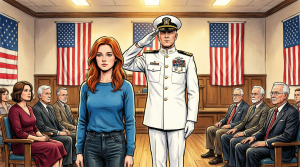
I came home to attend my father’s veterans’ honor ceremony, only to hear the whispers: “She already left the Navy.” My stepmother sneered, “She can’t do anything right.” I stayed silent. I didn’t explain. Then an admiral walked up, shook my hand, and said, “Rear Admiral… you’re here too?” The entire hall, more than two hundred service members, stood up at once and saluted.
I drove back to my hometown for one reason: to sit in the back of my father’s veterans’ honor ceremony and clap like any other daughter. That was the plan.
Then I heard the whisper, soft and smug, like it belonged in that room. She already left the Navy.
My stepmother’s laugh followed me through the house. “She can’t do anything right.”
I didn’t correct her. I didn’t defend myself. I didn’t even flinch, because I hadn’t come home to argue. I’d come home to let them talk, right up until the moment the wrong people said the wrong thing in front of the right uniform.
Virginia looks harmless when you haven’t seen it in years. The same long stretches of highway, the same pine trees, the same lawns cut into perfect stripes. The radio found the local station on its own, like the car remembered where I came from, even if I pretended I didn’t.
“Tonight at the Veterans Hall,” a bright voice announced, “we’ll be honoring longtime community member Thomas Montgomery. Doors open at six. Suggested donation supports the scholarship fund.”
My father’s name sounded clean on someone else’s tongue.
I should have stayed at a hotel. I could have slipped into the hall, sat quietly, and slipped out. But part of coming home is paying the toll. If you want to honor someone, you have to look them in the eye first.
I stopped for coffee on Main Street because I needed something warm in my hands. The little café was the kind of place where everyone knew everyone’s business and called it community. The woman behind the counter stared for a beat too long.
“Clare?” she asked, surprised I was real.
“Hi, Miss Donna.”
Her eyes tracked the way I stood, back still straight, like I was waiting for someone to tell me where to be. Two older men at a corner table paused mid-sentence. One of them muttered, “Heard she quit.”
The other replied, “Couldn’t hack it.”
I didn’t turn around. I didn’t need to. In a town like this, rumors don’t require evidence. They require someone willing to repeat them with confidence. And Evelyn had always been confident.
I paid, left the coffee half-finished, and drove to my father’s house.
Evelyn had the front door propped open like she was expecting an audience. The place smelled like lemon cleaner and something sweet baking, her idea of a patriotic home. She appeared in the hallway the second my tires hit the gravel, smile already in place.
“Clare,” she said, stretching my name. “Well, look who remembered where home is.”
“Morning.”
Her gaze swept over my jeans and sweater. Clean, neutral, not the kind of outfit you could accuse of trying too hard.
“Oh,” she sighed. “That’s what you’re wearing.”
“I just got in.”
“And you’re staying dressed like that?”
She shook her head as if my clothing was a personal insult.
“Tonight is important. Donors, the pastor, Councilman Pierce. Your father wants it perfect.”
There it was. My father’s reputation, held out like a leash.
“I’m not here to ruin anything,” I said.
Evelyn stepped closer, lowering her voice to a weaponized whisper. “Your father is nervous. He’s worked his whole life for this, so I don’t need distractions.”
I set my overnight bag by the stairs. “I’m not a distraction.”
She smiled like she’d won. Then her eyes sharpened.
“I heard you left the Navy.”
I didn’t answer.
She took my silence and filled it for me. “Such a shame. If it’s true, at least the Navy was something you could point to. Something you did that looked respectable.”
Her gaze flicked toward the dining table, where she’d laid out printed programs and place cards like she was planning a wedding.
“But if you’re not in anymore, then it’s just you.”
The old version of me would have argued. The older me had learned something better. Don’t wrestle with someone who lives for the fight.
“I’m going to help,” I said, and walked into the kitchen.
My father stood at the counter with a folder open, checking names on a list. Gray in his hair now. The same squared shoulders. He looked up, and for half a second I saw the father I used to chase for approval. Then his eyes shifted past me toward Evelyn, and his face tightened.
“Clare,” he said.
“Hi, Dad.”
“You made it,” he replied, like he wasn’t sure he should sound relieved. “Good.”
Evelyn leaned in the doorway, arms crossed, supervising the room.
“We’re on a timeline,” she told him. “The hall needs the final seating list by noon.”
My father nodded and kept his attention on the papers, as if they were safer than looking at me.
“You coming tonight?” he asked without lifting his head.
“I’m here, aren’t I?”
His jaw moved. He wanted to say something else. I could see the words forming and dying. My father wasn’t cruel by nature. He was just practiced at avoidance, and Evelyn knew how to use that.
Evelyn cut in, sweet as icing. “Of course she’s coming. She’ll sit quietly in the back. Won’t you, Clare?”
I met her eyes. “I’ll be there.”
“Good,” she said, satisfied. “Then help me with the dishes.”
There were always dishes when Evelyn wanted to feel like a martyr. She liked an audience for her exhaustion. I rolled up my sleeves and started washing. Hot water, soap, silence.
My father’s phone rang. His voice changed when he answered, proud and warmed by admiration.
“Yes, sir. Thank you. We’ll be there early. Family photo. Six sharp.”
Family photo. The phrase sat heavy in my chest.
Evelyn moved closer to me at the sink, speaking low enough that my father wouldn’t have to pretend he didn’t hear.
“You know,” she said, “your dad tells people you’re working up in D.C. now.”
I kept washing. “Okay.”
“That’s his way of making it sound better,” she continued. “Like you didn’t just drift.”
She dried a plate with slow, deliberate strokes.
“People remember things, Clare. They remember when someone leaves. When someone gives up.”
My father stayed on the call, laughing softly at something the person said. He was laughing with a stranger while my stepmother rewrote my life in my ear.
Evelyn tipped her chin toward me. “And don’t wear anything military tonight. It’ll confuse people.”
Confuse them, or remind them of what she’d been trying to erase.
“I understand,” I said.
She waited for more. An argument. A crack. A plea. When she didn’t get it, her eyes narrowed. I turned off the water, dried my hands, and stepped outside for air.
The American flag on the porch moved in the breeze, steady and indifferent. The neighborhood was quiet, the kind of quiet that makes you feel like everyone is watching from behind curtains.
I wasn’t here to win. I wasn’t here to humiliate anyone. I was here to honor my father in the one way I still could, by showing up even when it hurt.
But as I stood on that porch, I felt the rumor pressing at my back like a hand. She left the Navy. She quit. She failed.
I hadn’t told my father details because I couldn’t. Some parts of my work weren’t dinner table conversation, and some parts were simply mine. When I’d said, “I’m reassigned,” he’d heard, “I’m done.” Evelyn had heard opportunity.
In a house like this, the difference between privacy and shame was whatever she decided it was.
Inside, Evelyn laughed again, bright and sharp. My father’s laughter followed, smaller, easier, like he was grateful someone else was steering. I reached into my pocket and touched a plain, unmarked card, smooth, stiff, official. Not a gift. Not an announcement. Just something I carried for situations that went sideways.
I slid it back into my pocket.
Upstairs, the guest room still had the same view of the backyard. I set my bag on the bed and stared at myself in the mirror. My face looked calm. It always did. Calm was a skill I’d paid for.
Downstairs, Evelyn kept talking. She always would. She’d keep shaping the story until she believed it herself. And I would let her, because tonight, in that hall, the story would meet the wrong audience, and my father, who had spent years pretending not to see, would finally have to look.
The Veterans Hall hadn’t changed since I was a kid, which felt appropriate. Some places freeze themselves on purpose. Brick building, low ceiling, flags arranged with careful symmetry. A glass case of medals and photographs that smelled faintly of polish and dust.
By the time we arrived, the parking lot was already filling. Pickup trucks, sedans, a couple of SUVs with military decals fading under the Virginia sun. People my father’s age moved toward the entrance in small clusters. Jackets, pressed shoes, shined conversations, hovering between nostalgia and comparison.
Evelyn stepped out of the car like she owned the evening.
“Remember,” she murmured to me, smoothing an imaginary crease from her coat, “tonight is about your father.”
“I know.”
She gave me a glance sharp enough to imply that my agreement was suspicious.
Inside, the air carried that familiar blend of coffee, old wood, and expectation. A folding table near the entrance held name tags and donation envelopes. A young volunteer smiled mechanically as we passed.
“Oh, Thomas. Evelyn,” someone called.
My father straightened instinctively, his posture shifting into the version reserved for public admiration. Hands reached for him. Voices wrapped him in warmth.
“Congratulations, Tom.”
“Well deserved.”
“Proud night.”
I stepped aside, naturally drifting to the margins. It wasn’t bitterness. It was training and habit. Let the celebrated be celebrated.
Still, I felt the eyes. Recognition, curiosity, judgment disguised as concern. I moved toward the back wall where the light softened and conversations blurred into background noise. From there I could see everything without becoming part of it.
“That’s his daughter, right?”
“Heard she left the Navy.”
“Such a pity. Thomas must’ve taken that hard.”
The words floated casually, like they were discussing weather. I kept my expression neutral.
Across the room, Evelyn laughed too loudly at something a councilman said, her hand resting lightly on my father’s arm. She had mastered the art of proximity, always close enough to be seen as indispensable.
Thomas looked proud. Relaxed, even. It struck me how easily a man could look whole in public while something quieter unraveled at home.
A group of older veterans settled into the front rows. One of them glanced back at me, squinting.
“That Montgomery girl,” he whispered.
Another man nodded. “Yeah. Didn’t stick around long from what I hear.”
“Kids these days,” someone muttered.
I had stayed longer than most. But facts are no match for narrative.
The program began with small-town ceremony precision. The emcee welcomed guests. A local pastor offered a brief invocation. A high school ROTC student recited the pledge, voice trembling with nerves and sincerity.
Evelyn watched everything with hawk-like attention, scanning for imperfections that might reflect poorly on her orchestration.
I remained where I was, invisible, comfortable in invisibility, until Evelyn decided otherwise.
She approached with the soft glide of someone pretending kindness.
“Clare,” she said, already holding a silver tray of drinks. “There you are.”
I turned. Up close, her smile didn’t reach her eyes.
“We’re short on hands,” she continued. “Would you mind?”
The tray hovered between us. On it, plastic cups of iced tea and water, beads of condensation forming slow trails down the sides. A simple request. A deliberate humiliation.
She leaned closer. “If you’re not going to sit with family,” she whispered, “you might as well be useful.”
For a moment, the room seemed to hold its breath. Not because anyone heard, but because something in me did.
Revenge stories love dramatic refusals. Real life rarely offers them.
I took the tray. “Of course.”
Her satisfaction was instantaneous. “Oh, good,” she replied, voice bright again. “I knew you’d understand.”
Understand what? My place. My punishment. My role in her version of the evening.
I moved through the hall slowly, offering drinks. Most people accepted without really looking at me. A few did double takes.
“Oh, thank you, Clare.”
“Right. You’re helping out.”
Helping out.
I nodded politely.
A woman my mother’s age gave me a sympathetic smile. “Your father must be so proud you came.”
“Yes, ma’am.”
“And what are you doing these days, dear?”
There it was. The question Evelyn had carefully primed into the room.
“I work in D.C.,” I replied.
The woman tilted her head. “Oh, with the Navy?”
Her smile flickered, uncertain. I offered the tray again before she could finish.
Across the room, Evelyn was watching. Always watching.
Near the stage, my father laughed at a story someone told, his face lit by admiration. He looked younger when people praised him, lighter. I wondered if he had ever looked at me that way. I wondered if tonight might have been different if I’d explained years ago instead of choosing silence.
But silence had never been the problem. Interpretation was.
I returned to the back of the hall, tray still half full. Evelyn intercepted me again.
“Oh no,” she said lightly. “Not back here.”
“I’m fine.”
“It’ll look odd,” she replied. “Family hiding in shadows.”
Family. She said it like an accusation.
She gently redirected me toward the aisle closest to the stage. Every step forward felt like stepping deeper into someone else’s script.
The emcee cleared his throat. “And now we’d like to recognize a very special guest joining us this evening.”
The doors at the rear of the hall opened.
Late arrival. Heads turned. A ripple moved through the room.
The man entering wasn’t local. That much was obvious. The posture. The uniform. The way conversations died mid-sentence. Dress whites. Rows of ribbons. Presence that altered the air.
Evelyn’s eyes widened, then sharpened. Opportunity.
She adjusted her smile, already preparing to attach herself to the moment.
“Admiral Miller,” the emcee continued, voice tinged with awe.
My father straightened instantly, pride and nerves colliding in his expression.
Admiral Miller began walking down the center aisle, exchanging nods with veterans, offering brief handshakes. Evelyn leaned toward my father.
“Perfect,” she whispered.
But halfway down the aisle, Miller’s pace changed. Slowed. Stopped.
His gaze shifted not toward the stage, not toward Thomas, but toward me.
I stood frozen, tray still in my hands. For a fraction of a second, confusion flickered across Evelyn’s face.
Then Admiral Miller stepped out of the aisle and walked directly toward the back corner of the hall, toward the woman everyone believed had already left the Navy.
The tray suddenly felt heavier. The room quieter. Something irreversible beginning to move.
Admiral Miller didn’t hesitate. That was the first thing I noticed. No polite detour. No glance toward the stage where my father stood glowing under borrowed importance. No acknowledgment of Evelyn, who had already arranged her face into a welcoming expression.
He walked straight toward me through rows of folding chairs, past veterans who instinctively shifted aside, past conversations that collapsed into silence mid-word.
The tray in my hands felt absurd now, a prop from a joke no one understood yet.
For a split second, I considered the possibility that he hadn’t recognized me, that this was coincidence. Then I saw his eyes: locked, certain.
I set the tray down on the nearest table, movements calm, controlled, years of discipline compressing into muscle memory. Stand straight. Shoulders back. Chin level.
Admiral Miller stopped two steps away.
And then he did something that cracked the entire room open.
Click Here to continuous Read Full Ending Story👉 PART 2-“‘She Left the Navy,’ My Stepmother Smirked—Then a Man in Dress Whites Walked Straight Toward Me”

