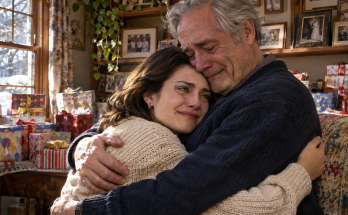
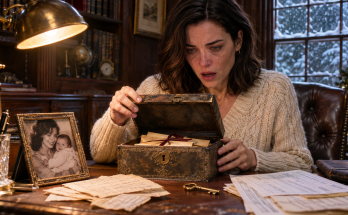
PART 5 — THE CHRISTMAS I FINALLY CHOSE MYSELF (FINAL PART)
The following morning, my father arrived at Rebecca’s office twelve minutes early.
Margaret was beside him, clutching her handbag.
Vanessa sat several chairs away from them.
For the first time in my memory, she wasn’t sitting beside our mother.
Uncle Daniel arrived with me.
When my father saw him, he immediately stood.
“What is he doing here?”
I placed my handbag on the conference table.
“He’s my family.”
My father’s expression hardened.
Daniel remained calm.
“Good morning, Richard.”
My father didn’t respond.
Rebecca entered the room carrying several folders.
Thomas, the financial investigator, followed her.
Everyone took their seats.
I placed Caroline’s photograph directly in front of me.
My biological mother deserved to be present for what happened next.
Even if only through a photograph.
Rebecca looked around the table.
“Before we begin, I want everyone to understand that today’s discussion concerns serious financial and legal matters.”
Margaret shifted nervously.
“We don’t need to make this into something bigger than it already is.”
I looked at her.
“It’s already bigger than you told me.”
She lowered her eyes.
Rebecca opened the first folder.
“Emily has provided us with additional documentation concerning Caroline’s estate, including a statement signed by Richard approximately thirty years ago.”
My father stared at the table.
Vanessa looked confused.
“What statement?”
I reached into my bag and removed the document my father had given me the previous afternoon.
“This one.”
Vanessa leaned forward.
Rebecca carefully unfolded it.
The room became completely silent.
It was a signed acknowledgment that my father had agreed to respect the instructions contained in Caroline’s estate plan.
He had acknowledged that certain assets were intended exclusively for my benefit.
He had also acknowledged Caroline’s request for independent oversight and financial protection.
But there was another attachment.
One that explained why my grandfather had been so determined to uncover the truth.
A second document had been submitted after Caroline’s death.
It purported to authorize financial changes that contradicted her original instructions.
The signature was attributed to Caroline.
But the date was several weeks after she had become physically incapable of signing such a document.
My father had finally admitted that the signature wasn’t genuine.
Rebecca looked directly at him.
“Richard, are you confirming that the signature on this document was not Caroline’s?”
He nodded.
Margaret closed her eyes.
Rebecca waited.
“We need a verbal answer.”
My father’s voice barely rose above a whisper.
“Yes.”
Vanessa gasped.
“Dad!”
He didn’t look at her.
Rebecca continued.
“And did you knowingly submit this document?”
Another long silence.
“Yes.”
I felt as though the air had been knocked from my lungs.
I had already read his confession.
But hearing him admit it aloud was different.
My mother had been dying.
She had trusted him to protect her daughter.
And he had betrayed that trust.
Uncle Daniel gripped the edge of the table.
For thirty years, he had suspected something was terribly wrong.
Now he was sitting across from the man responsible.
“Caroline trusted you,” Daniel said.
My father lowered his head.
“I know.”
“She loved you.”
“I know.”
“She begged you to protect Emily.”
My father’s shoulders began shaking.
“I know.”
Daniel stood abruptly.
For a moment, I thought he might walk out.
Instead, he moved toward the window.
He stared at the city below.
When he finally spoke, his voice was filled with grief.
“My sister spent the last months of her life worried about whether her little girl would be safe.”
He turned around.
“And you made those fears come true.”
My father covered his face.
Nobody tried to comfort him.
Not even Margaret.
Thomas opened another folder.
“Our examination indicates that a substantial portion of the assets originally designated for Emily’s benefit was diverted over the following decades.”
He distributed copies of the preliminary report.
I looked at the numbers.
Documented transfers.
Business expenditures.
Property proceeds.
Unauthorized withdrawals.
There were figures large enough to change entire lives.
“Based on the records currently available,” Thomas continued, “the amount requiring further accounting exceeds $1.3 million.”
Margaret immediately protested.
“That can’t be right!”
Thomas remained professional.
“These are preliminary findings supported by the available documentation.”
“We spent money raising her!”
Rebecca looked at Margaret.
“Reasonable expenses associated with a child’s care are one matter. Unexplained transfers into personal and business accounts are another.”
Margaret shook her head.
“We aren’t criminals.”
I looked at her.
“Then why did you spend thirty years hiding my own mother’s existence from me?”
She opened her mouth.
Nothing came out.
“Why did you tell me there wasn’t enough money for college?”
She stared at the report.
“Why did you make me work two jobs while Vanessa received everything she wanted?”
Vanessa began crying.
“Emily, I didn’t know.”
I turned toward her.
“I believe you didn’t know everything.”
She nodded.
“But you knew how you treated me.”
Her face collapsed.
“Yes.”
“And you knew what you were doing on Christmas Eve.”
“Yes.”
Her voice broke.
“I’m so sorry.”
For the first time, her apology contained no excuses.
No explanation about how I had misunderstood her.
No accusation that I was too sensitive.
Just an apology.
I wasn’t ready to forgive everything.
But I appreciated that she had finally stopped pretending.
Rebecca turned to the documents involving the loans.
“Emily disputes the authenticity and authorization of several financial agreements bearing her name. Those matters will be investigated separately.”
My father looked up.
“Can we deal with all of this privately?”
Rebecca responded calmly.
“That depends on the facts, the institutions involved, and applicable legal obligations.”
He turned toward me.
“Emily, please.”
I looked at him.
“What exactly are you asking me to do?”
“Give me a chance to fix it.”
I thought about every chance Grandpa had given him.
Every letter.
Every warning.
Every opportunity to admit the truth before I discovered it myself.
“How many chances do you think you’ve already had?”
His eyes filled with tears.
“I made mistakes.”
I shook my head.
“A mistake is forgetting someone’s birthday.”
My voice became steadier.
“A mistake is making a wrong turn.”
“You spent thirty years making decisions that benefited you while hurting your daughter.”
He lowered his eyes.
“Those weren’t mistakes, Dad.”
“They were choices.”
Margaret suddenly stood.
“So what happens now?”
Everyone looked at her.
“Are you going to leave us homeless?”
I reached into my bag and removed the original lifetime occupancy agreement I had intended to give them on Christmas Eve.
She recognized it immediately.
Her eyes fixed on the papers.
“You still have it?”
“Yes.”
“Then we can fix this.”
I looked down at the document.
I remembered sitting in Rebecca’s office before Christmas, explaining how I wanted to protect my parents despite everything that had happened.
I remembered insisting that they should never have to worry about losing their home.
I remembered how excited I had been to tell them.
And I remembered the darkness of the porch.
The laughter.
Vanessa’s phone.
Margaret’s voice.
We just wanted to see if you’d still come running.
I folded the agreement.
Then I placed it back in my bag.
“There will be no lifetime occupancy agreement.”
Margaret’s face turned white.
“Emily!”
I raised my hand.
“Let me finish.”
She fell silent.
“I am not throwing you onto the street.”
My father looked up.
“You aren’t?”
“No.”
Rebecca placed another document on the table.
I had spent the previous evening discussing the options with her.
“I will allow a reasonable transition period, under a written arrangement reviewed by our attorneys.”
Margaret looked confused.
“A transition period?”
“Yes.”
“You will have time to make alternative housing arrangements.”
My father stared at me.
“How much time?”
Rebecca explained the proposed arrangement.
They would have several months to relocate, subject to the appropriate legal process and agreed conditions.
They would be responsible for ordinary household expenses.
The property could not be damaged, transferred, or used as collateral.
And they would cooperate with the resolution of the financial disputes.
Margaret began shaking her head.
“You can’t sell our home!”
I answered quietly.
“I haven’t decided whether I’m selling it.”
“Then what are you doing?”
“Taking responsibility for what Grandpa left me.”
She looked around the room desperately.
Nobody came to her defense.
Not Aunt Linda.
Not Vanessa.
Not my father.
For years, Margaret had depended on everyone remaining silent whenever she demanded something.
Now the silence had a different meaning.
People were no longer willing to protect her from the truth.
She looked at me with wet eyes.
“After everything I’ve done for you?”
I sighed.
“Margaret, you raised me.”
“I will always acknowledge that.”
“But raising me did not give you permission to humiliate me, deceive me, or take what my mother intended for my future.”
She sat back down.
For the first time, she looked small.
Not powerful.
Not frightening.
Just a woman facing consequences she had never imagined would reach her.
My father slowly lifted his head.
“Do you hate me?”
The question caught me off guard.
I looked at his face.
I remembered sitting on his shoulders at a summer parade when I was six.
I remembered him teaching me how to ride a bicycle.
I remembered waiting beside the window when he came home from work.
I remembered moments when I had genuinely believed I was safe with him.
And then I remembered everything that followed.
“I don’t know,” I answered honestly.
He began crying.
“But I do know something.”
He looked at me.
“I can’t keep hurting myself just to prove that I love you.”
He pressed a hand against his mouth.
I continued.
“I spent my entire childhood trying to become someone you would be proud of.”
“I spent five years thinking that if I worked hard enough, became successful enough, and stayed patient enough, you might finally want me back.”
“And on Christmas Eve, you showed me that I was still nothing more than someone you believed you could control.”
My father shook his head.
“That’s not true.”
“Then why did you laugh?”
He couldn’t answer.
“Why didn’t you stop them?”
He looked away.
“Why didn’t you put a chair at the table for me?”
His shoulders collapsed.
That question seemed to hurt him more than anything else.
Because there was no complicated financial explanation.
No legal language.
No misunderstanding.
Just an empty place where his daughter should have been sitting.
“I don’t know,” he whispered.
I looked at him for a long moment.
“That’s the saddest part.”
The meeting continued for another two hours.
Rebecca explained the next steps.
The financial investigation would continue.
Relevant institutions would be contacted.
Records would be preserved.
Any proposed settlement would require independent review and would not erase obligations that needed to be addressed through the appropriate authorities.
My father eventually agreed to cooperate.
Margaret resisted until she realized that refusing would not make the documents disappear.
Vanessa agreed to provide everything she knew.
Before we left, my father approached me.
“Emily?”
I stopped.
“I’m sorry.”
I looked at him.
It was the apology I had waited most of my life to hear.
But standing there, I realized something surprising.
An apology could acknowledge the past.
It couldn’t return it.
It couldn’t give me my childhood back.
It couldn’t introduce me to Caroline.
It couldn’t replace thirty years of birthdays with Daniel.
And it couldn’t repair everything simply because the person responsible finally regretted it.
“Thank you for saying that,” I answered.
He looked hopeful.
“Does that mean you forgive me?”
I shook my head gently.
“It means I heard you.”
Then I walked away.
Outside the building, Daniel wrapped his arm around my shoulders.
“How do you feel?”
I looked up at the winter sky.
“Like I finally stopped carrying something that was never mine.”
He smiled.
“Your mother would be proud.”
This time, I didn’t cry.
I smiled.
“I think Grandpa would be, too.”
Over the following months, life changed dramatically.
The investigation continued.
More records emerged.
More explanations were demanded.
Some of my father’s accounts were found to contain assets traceable to transactions connected with Caroline’s estate.
Several financial claims involving my name were formally disputed.
Rebecca helped me navigate the long, complicated process of correcting the damage.
Nothing happened overnight.
Real accountability rarely arrives as quickly as people imagine.
There were meetings.
Documents.
Delays.
Questions.
Painful discoveries.
But slowly, the truth became impossible to deny.
My father eventually agreed to a substantial repayment settlement covering several of the documented financial claims, subject to the remaining legal proceedings.
To meet those obligations, he had to sell investments and other assets.
Margaret sold expensive jewelry.
They gave up their luxury vehicles.
The lifestyle they had spent decades protecting could no longer be sustained.
Vanessa’s involvement in the investigation also clarified something important.
Although she had benefited from the family’s spending, she had not understood the origin of many of those funds.
Certain transactions had been made without her direct involvement.
That did not excuse her cruelty toward me.
But it helped me separate what she had knowingly done from what she had never understood.
One afternoon, she invited me for coffee.
I almost declined.
Then I remembered that people were allowed to change.
They simply weren’t entitled to immediate forgiveness.
She arrived wearing ordinary jeans and a sweater.
No expensive handbag.
No designer sunglasses.
No phone pointed at my face.
She looked nervous.
“Thanks for coming.”
I nodded.
We ordered coffee and sat near the window.
For several minutes, neither of us knew what to say.
Finally, Vanessa spoke.
“I started working.”
I looked surprised.
“Where?”
“At a clothing store.”
She smiled awkwardly.
“Nothing glamorous.”
“Do you like it?”
“Actually, yes.”
She stared into her coffee.
“I never realized how much I expected everyone else to do for me.”
I remained silent.
She continued.
“Mom always told me that I deserved more than other people.”
“Whenever you succeeded, she’d tell me that you were trying to make me look bad.”
“She made everything feel like a competition.”
I looked at her.
“You were still responsible for how you treated me.”
“I know.”
She nodded quickly.
“I’m not trying to blame everything on Mom.”
She reached into her purse and removed a small gift box.
“This is for you.”
I hesitated.
“What is it?”
“Open it.”
Inside was a simple silver bracelet.
A small charm hung from it.
Two tiny stars.
“I bought it with my first paycheck,” she explained.
My throat tightened.
“For me?”
“Yes.”
She looked embarrassed.
“I know it doesn’t fix anything.”
“No,” I answered.
“It doesn’t.”
She nodded.
Then I smiled.
“But it’s a start.”
Tears filled her eyes.
She looked down.
“Do you think we could ever be sisters again?”
I thought carefully before answering.
“We don’t have to pretend nothing happened.”
“I know.”
“And I won’t allow you to treat me the way you used to.”
“I understand.”
“But maybe we can discover what being sisters should have looked like in the first place.”
Vanessa began crying.
This time, I reached across the table and took her hand.
Not because I had forgotten.
Not because I had surrendered.
But because I could see that she was finally trying to become someone different.
Healing did not require me to excuse the past.
It simply required me to decide what I was willing to allow into my future.
Six months after Christmas, my parents moved out of Grandpa’s house.
They had found a modest apartment across town.
It was smaller than the home they had occupied for nearly three decades.
There were no grand staircases.
No expensive chandeliers.
No enormous garden.
But it was safe.
It was comfortable.
And it was something they could afford without depending on me.
On their final afternoon at the house, I arrived to collect the keys.
Most of the furniture had been removed.
The walls were bare.
Margaret stood beside the fireplace.
She looked around the empty living room.
“I never thought I’d leave this place.”
I didn’t respond.
She turned toward me.
“Are you happy now?”
I looked at her.
“No.”
She seemed surprised.
“Then why did you do this?”
“Because keeping things the way they were would have meant pretending nothing was wrong.”
She looked down.
“I suppose you think I was a terrible mother.”
I took a deep breath.
“I think you were someone who made terrible choices.”
She swallowed.
“I did care about you.”
I watched her face.
Perhaps some part of her believed it.
Perhaps some part of her really had loved me.
People could contain affection and cruelty at the same time.
But affection did not cancel cruelty.
“I wish you had shown it differently.”
Her eyes filled with tears.
“I was jealous of Caroline.”
The confession surprised me.
“Why?”
“She had everything.”
Margaret stared toward the empty fireplace.
“A beautiful family. Money. People who adored her. Your father.”
She paused.
“And then she had you.”
I remained silent.
“After she died, everyone still spoke about her like she was perfect.”
Margaret’s voice cracked.
“Every time I looked at you, I saw her.”
I felt an old sadness settle inside my chest.
“I was a child, Margaret.”
“I know.”
“I didn’t do anything to you.”
“I know.”
She began crying.
“I know that now.”
I looked at the woman I had spent thirty-one years calling Mom.
For decades, I had wanted her to understand how much she had hurt me.
Now she finally did.
Or at least she was beginning to.
But understanding came too late to restore the years she had taken.
“I hope you find peace,” I told her.
She wiped her eyes.
“Does that mean you’ll visit?”
I shook my head.
“Not right now.”
She nodded slowly.
For once, she accepted my answer.
My father walked in carrying the last cardboard box.
He placed the house keys in my hand.
“Your grandfather would have known what to do with this place.”
I looked around.
“I think he already did.”
My father smiled sadly.
Then he walked toward the front door.
Before leaving, he turned.
“Emily, I really am proud of you.”
I held his gaze.
“Thank you.”
And for the first time, those words didn’t determine how I felt about myself.
I was already proud of me.
After they left, I stood alone inside the house.
The grandfather clock remained beside the fireplace.
Grandpa’s old armchair stood near the window.
The dining room was empty.
I walked toward the exact place where I had stood on Christmas Eve.
I could almost hear the laughter.
My mother’s voice.
My sister’s mocking words.
Look at her.
She thought we missed her.
But something had changed.
The house no longer frightened me.
It no longer represented rejection.
It no longer felt like a place where I had to beg for permission to belong.
It was simply a house.
A beautiful old house filled with memories.
Some painful.
Some precious.
And I finally knew what I wanted to do with it.
I called Daniel.
“Can you come over?”
“Of course. What’s wrong?”
“Nothing.”
I smiled.
“I have an idea.”
When he arrived, I showed him around the empty rooms.
“Do you remember what Mom wanted me to have?”
Daniel nodded.
“Opportunities.”
“And Grandpa?”
“He wanted you to build a good life.”
I looked toward the dining room.
“What if this house could give other people opportunities, too?”
Daniel smiled.
“What are you thinking?”
Over the following months, we worked with a local nonprofit organization to transform the property into a welcoming center that provided financial education, career guidance, and practical support for young adults facing difficult family circumstances.
We called it The Caroline and Arthur Foundation House.
It carried the names of the two people who had helped give me a future.
Inside, young people could receive guidance about education, budgeting, scholarships, employment, and independent living.
We worked with qualified professionals and community organizations.
We created a small scholarship program.
We offered quiet study spaces.
And in the old dining room, we placed a long wooden table.
There were twenty chairs.
Not nineteen.
Not a table where someone had deliberately been left without a place.
Twenty chairs.
And if more people arrived, we found more chairs.
Nobody would ever stand in that doorway wondering whether they belonged.
On opening day, Daniel gave a short speech.
He spoke about Caroline.
He spoke about Grandpa.
Then he looked at me.
“My niece spent much of her life believing she had to earn her place in this world.”
His voice trembled.
“Today, she has created a place where others can discover that they already have one.”
People applauded.
I looked at the photographs of my mother and grandfather hanging beside the entrance.
I wished they could have been there.
Perhaps, in some way, they were.
A year after that terrible Christmas Eve, snow began falling across the city.
I woke up early and decorated my house.
There were lights around the windows.
Fresh flowers on the table.
Christmas music playing softly in the kitchen.
Daniel arrived carrying a ridiculous number of presents.
Sarah came with her husband and children.
Aunt Linda brought homemade pies.
Vanessa arrived wearing an apron over her winter coat.
“I made dessert,” she announced.
Everyone laughed.
Not at someone.
With someone.
There was a difference.
A beautiful difference.
While we prepared dinner, my phone vibrated.
A message from my father.
Merry Christmas, Emily. I hope you are happy.
I stared at the screen.
Then another message arrived.
This one was from Margaret.
I know I don’t deserve another chance. I just wanted you to know that I’m sorry for last Christmas.
I placed my phone beside my plate.
For a moment, I thought about the woman I had been one year earlier.
The woman standing on a dark porch holding a bottle of wine and hoping her family had finally missed her.
I wished I could travel back in time and put my arms around her.
I wished I could tell her that everything she was about to discover would hurt.
That there would be nights when she couldn’t sleep.
Days when she would cry over photographs.
Moments when she would question her entire childhood.
But I would also tell her something else.
That she would find her mother’s letters.
That she would meet an uncle who had never stopped loving her.
That she would discover friendships stronger than blood.
That she would learn to set boundaries without feeling guilty.
That she would stop measuring her value using the opinions of people who had never understood it.
And that one day, Christmas would become beautiful again.
I replied to my father.
Merry Christmas, Dad. I am happy.
Then I sent Margaret a simple message.
Thank you for apologizing. I hope you find peace.
I didn’t promise to visit.
I didn’t invite them over.
I didn’t offer to pretend the past had never happened.
But I also refused to spend another Christmas consumed by anger.
Their lives were theirs to repair.
Mine was mine to live.
“Emily!”
Daniel called from the dining room.
“Dinner’s ready!”
I walked toward the table.
Everyone was waiting.
Sarah pulled out the chair beside her.
“We saved your seat.”
Those words stopped me.
Exactly one year earlier, she had sent me the same message after my parents humiliated me.
We saved you a seat.
And now here I was.
Standing in a warm room surrounded by people who wanted me there.
Daniel noticed my tears.
“What’s wrong?”
I laughed and wiped my cheeks.
“Nothing.”
I looked around the table.
“Absolutely nothing.”
Before dinner, I stood and raised my glass.
“I’d like to say something.”
Everyone grew quiet.
I looked at Caroline’s photograph on the mantel.
Then at Grandpa’s photograph beside it.
“One year ago, I thought the worst Christmas of my life had just happened.”
I smiled.
“I thought I had lost my family forever.”
Daniel reached for a tissue.
“But I was wrong.”
“I hadn’t lost my family.”
“I had lost the belief that love was something I needed to purchase with my silence, my money, or my obedience.”
I looked toward Vanessa.
“I learned that people can change.”
I looked toward Aunt Linda.
“That courage sometimes arrives later than it should.”
Then toward Sarah.
“That family can be made through kindness.”
Finally, I looked at Daniel.
“And that some people will spend thirty years saving a place for you, even when they don’t know whether you’ll ever find your way home.”
Daniel began crying.
I raised my glass a little higher.
“To Caroline.”
“To Grandpa Arthur.”
“And to everyone who has ever wondered whether they were worthy of being loved.”
My voice trembled.
“You are.”
Everyone raised their glasses.
Later that evening, after the guests had gone home, I stood beside my Christmas tree.
Beneath it sat the little stuffed rabbit Daniel had bought for my fourth birthday.
Beside it were Caroline’s letters.
And hanging from one of the branches was the small silver bracelet Vanessa had purchased with her first paycheck.
Different objects.
Different memories.
Different kinds of love.
I opened my mother’s final letter once more.
There has never been a moment when you were not wanted.
I smiled.
For thirty-one years, I had needed someone else to tell me that.
Now I finally understood it for myself.
I turned off the living room lights.
Outside, snow covered the street.
My porch light remained on.
Warm.
Bright.
Welcoming.
I thought about the dark porch where my story had begun.
My family’s cruel laughter.
The envelope in my coat.
And the words I had never finished saying that night.
Very funny. Because…
If I could return to that moment, I knew exactly how I would finish the sentence.
“Very funny. Because you were never the ones who decided my worth.”
My parents had invited me to Christmas dinner to see whether I would still come running.
They expected the desperate daughter who would sacrifice everything for a little affection.
Instead, they met a woman who had finally learned that love without respect was not enough.
I didn’t destroy their lives.
I stopped allowing them to destroy mine.
I didn’t take revenge.
I reclaimed my future.
And I didn’t lose my family that Christmas.
I finally found it.
Sometimes the greatest victory isn’t making the people who hurt you regret what they did.
It’s reaching the point where their approval no longer matters.
Because the moment you stop begging for a seat at someone else’s table, you become free to build your own.
And at my table, there will always be room for one more.
THE END.