The lid lifted with a soft whisper, as if the air itself were holding its breath. Inside the navy blue box, there were no glittering jewels or expensive watches. It wasn’t a designer handbag, nor an envelope full of banknotes.
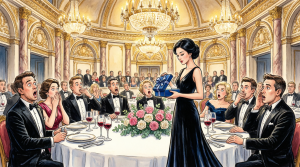
It was something much smaller.
A grey velvet case, about the size of a palm, with a gold seal in the corner: the crest of a university.
The moment they saw it, many people didn’t understand anything. And that was the point. My mother had spent her whole life confusing value with ostentation. If something didn’t shine, it didn’t exist.
Dev leaned over my mother’s shoulder and let out a stifled laugh.
“What’s that?” he muttered, as if it were a joke. “A pin? A fake diploma?”
I didn’t answer him. It wasn’t worth it. Instead, I slowly reached inside the box and, with two fingers, pulled out the velvet case. I placed it in the center of the table, right where Raghav had tried to push my gift out of sight.
Then I took out a second item: a slim, elegant folder with metal corners, closed with a clasp. On top was a name printed in neat letters.
Leena Thornton.
My mother blinked when she saw him. It was a slight blink, almost imperceptible. But I knew it. It was the reaction of a woman who felt on the verge of losing control of her situation.
“What kind of…?” she began, but her voice caught in her throat.
The guests, who had previously been ready to laugh, now leaned forward. The silence grew thick. No one wanted to miss the show.
I straightened my shoulders. The string quartet, in some corner, waited, unsure whether to play. The air smelled of expensive perfume and nerves.
“Inside the case,” I said clearly, “there’s a key.”
Raghav frowned, as if he had heard something offensive.
—A key? To what? To your miserable apartment? —he spat out the word “miserable” like an insult.
I turned towards him, without raising my voice.
—From an office. From a studio. From a place that has my name on the door.
Dev laughed again, but it seemed forced.
—Of course. And I am the president of the country.
My mother pressed her lips together. She was still trying to maintain her mask of superiority.
“Thea, this is ridiculous. Are you… are you going to make a scene?” she said, as if I were ruining her night.
I looked at her with a calmness that, I knew at that moment, frightened her more than any scream.
—No, Mom. You wrote the scene. I just brought the ending.
With two fingers I opened the case and lifted the lid.
Inside was the key: a clean, metal key with a small engraved keyring. But it wasn’t just any key. It wasn’t a house key. It was an office key, the kind handed out with discreet ceremony and professional smiles.
Next to the key was a matte black card with white lettering.
THEA MALHOTRA
Creative Director and Founder
Malhotra Studio — Mumbai
A murmur rippled through the room. Some guests began to exchange glances, as if they had suddenly remembered something.
“Malhotra Studio?” a woman whispered, touching her necklace. “Isn’t it…?”
“The agency that did the campaign for…?” said an older man, with a wrinkled forehead.
I saw their attention shift, like a flashlight turning on in the dark. It was no longer pity on their faces. It was doubt. Curiosity. And something more: a cold, calculating interest.
Raghav swallowed, as if for the first time he was wondering if he had made a mistake.
My mother, on the other hand, remained motionless. Her gaze was fixed on the card as if it were a threat.
“That… that doesn’t prove anything,” he managed to say. “Anyone can print a card.”
I smiled. My smile wasn’t polite. It was genuine.
—That’s why I brought the folder.
I opened the metal clasp and took out the first document. It was a sheet of official letterhead, stamped and signed. Then a second. And a third. I placed them on the table, one by one, like cards on a board.
“This,” I said, “is a letter of recommendation from the creative director of the firm where I was a lead designer. This is my company registration certificate. This is my contract with an international client. And this…”
I lifted the last sheet.
—This is the purchase document for a commercial property in South Mumbai. In the name of Malhotra Studio.
The murmur grew. Some were speechless.
Dev took a step forward, almost too quickly.
“Where did you get that from?” he asked, his voice no longer mocking, but filled with a rising anxiety.
I ignored him.
My mother clenched her jaw.
“What are you doing?” she whispered. “Have you come to humiliate us?”
I leaned forward just enough so that only she could hear the next sentence, but my voice came out clear anyway, because I no longer cared about protecting her.
—No, Mom. You humiliated me when you called me “old history.” When you let them kick me out of the house. When you laughed at my dreams. I only came to remind you that I wasn’t what you said I was.
Raghav slammed his palm against the table.
“This is a lie!” she shouted. “An act to get attention! You’ve always been dramatic!”
And then something beautiful happened: someone laughed. But it wasn’t Dev. Nor was it my mother.
It was a man in the back, wearing a dark blue suit, who had been watching me with a strange expression ever since I came in. I recognized him: he was a local businessman who had crossed paths with me about my work months before.
He approached slowly, with a glass in his hand.
—Raghav —he said in a familiar tone—, seriously, you don’t recognize Malhotra Studio? The company that designed the visual identity for my hotel chain last year?
Raghav froze.
The man extended his hand towards me.
“Thea, it’s so good to see you here.” Then she looked at my mother. “Leena, I didn’t know your daughter was… well, now I see why you didn’t mention it.”
The blow was perfect. Not because of the cruelty of the comment, but because of the truth it contained.
My mother opened her mouth, but no sound came out. Her world, built on appearances, was crumbling before everyone’s eyes.
Dev tried to pull himself together.
“That doesn’t mean that…” he began, but another voice interrupted him.
“Isn’t Malhotra Studio the one that worked with the women entrepreneurs’ foundation?” a young woman exclaimed excitedly. “I saw their talk in Mumbai! It was incredible!”
I nodded, without triumphalism. It wasn’t arrogance. It was reality.
My mother clung to the edge of the table, as if she needed a solid surface to avoid falling.
“Why…?” he stammered. “Why didn’t you tell me?”
The room fell silent again, awaiting the answer. My mother’s question, for the first time in ten years, wasn’t laced with contempt. It was laced with fear.
I breathed slowly.
—Because you didn’t deserve it.
That hurt him more than anything else. I saw it in his eyes: a flash of anger and shame mixed together.
But it wasn’t over.
I took the folder and removed a small, plain white envelope. I placed it in front of her.
“This was the real gift,” I said, and my voice turned firm. “What you rejected without even opening it.”
Raghav tried to snatch it, but I withdrew my hand.
—No. This is for her.
My mother looked at it as if it were a bomb. Her fingers trembled as she touched the envelope.
“What is it?” he whispered.
—Abrela.
The pressure of fifty stares forced her. With clumsy hands, she opened the envelope and took out a single sheet of paper.
It was a short letter. Not long. Not dramatic. Direct, like a sentence.
“Leena, I was contacted by a lawyer who manages a fund set up by my father. There’s a clause: if my mother can prove she supported me throughout my education and early adulthood, the fund can be released for family support. Otherwise, the fund remains solely under my control, with no possibility of reclaiming it.
I offered you the chance to show, at least once, that I was also your priority.
You rejected my gift in front of everyone. With that, the clause is terminated.
The fund is mine. Forever.”
The silence that followed was not an elegant silence. It was a brutal silence. Like a punch to the collective gut.
Dev turned pale.
“Fund? What fund?” he asked, turning to his father. “What are you talking about?”
Raghav stared at him, wide-eyed. It was obvious that Dev didn’t know. Neither did my mother, or at least not in that way.
My mother looked up, and I saw how fear turned into despair.
“Thea…” he said, and his voice broke for the first time in my life. “I… I did what I could.”
I let out a short, joyless laugh.
—No, Mom. You did what you wanted. And what you wanted was to start over… without me.
Raghav took a step forward, this time not with aggression, but with desperate urgency.
—Listen… maybe we were harsh, but… it can be fixed. We’re family.
The word “family” sounded like counterfeit currency to me.
—We’re not family, Raghav. You were my roof over my head for a while. Nothing more.
Dev, who had lived his whole life believing he was the center of attention, approached with moist eyes.
“Thea, wait…” he said. “If that’s true, then… then we can—”
“Can we what?” I interrupted. “Share? Negotiate? Make a plan?”
Dev swallowed hard.
—We can… help each other.
And there it was: the final lie, disguised as good intentions. It wasn’t love. It was opportunity.
I nodded slowly, as if I were considering.
“I’ll tell you what I can do,” I said.
Faces lit up with hope. Even my mother, still holding the letter, lifted her chin slightly.
Then I bowed my head.
—I can leave.
And I did it.
I turned towards the room, towards the guests who now didn’t know whether to keep looking at me or look away.
—Thank you for your attention— I said with impeccable courtesy. —Enjoy the evening.
Someone started to applaud. At first it was just one person, the businessman in the blue suit. Then another. And another. It wasn’t applause to humiliate my mother. It was applause for me. For the version of me that had survived without permission.
My mother stood up abruptly, knocking over a glass. The glass shattered with a sharp sound.
“Don’t go!” he shouted. “Thea, please!”
That word, “please,” pierced me like a distorted memory. I had said “please” hundreds of times in that house. Please help me with college. Please don’t treat me like this. Please look at me.
Nobody had heard it then.
I paused for a second. Not because I doubted. But because I wanted to see her face clearly. I wanted to make sure she understood that this was the moment I had chosen, time and time again, without knowing it.
I turned around.
“Do you want me not to leave?” I asked softly.
She nodded desperately.
“Yes… yes… I beg you. Don’t do this. People…” She looked around, her shame palpable. “This is destroying us.”
That was the truth. She wasn’t worried about losing me. She was worried about being seen.
I nodded, understanding, as if her confession gave me peace.
—So here’s what I’m going to say, just to be clear: I’m not destroying you, Mom. I’m just letting go of the weight of your lies.
Raghav moved closer, lowering his voice.
—Thea, listen, the business… we’re going through a rough patch. If you really have access to that fund… you could help. Just a loan. Just until—
I raised a hand and he stopped as if I had put up an invisible wall.
—No.
It was a small word. But the force with which I said it made the air still.
My fiancé, who had been waiting outside to give me space—because he knew what it meant for me to go in alone—appeared in the doorway. Our eyes met, and I knew he was ready to go, no questions asked.
But before leaving, I did something I hadn’t expected. I went up to my mother. So close that I could smell her perfume, the same one she’d worn for years, the same one that mingled with my memories of cold nights in the cellar.
I handed him the matte black studio card.
“You can keep this,” I said. “Not to show off. To remind yourself that I exist.”
My mother took it with trembling hands.
“Thea…” he whispered. “I… I didn’t know that…”
“That’s the worst part,” I interrupted. “You never wanted to know.”
I walked away.
As I walked towards the door, I heard the beginning of the chaos behind me: guests murmuring, someone asking about the background, Dev arguing with his father, my mother trying to regain control with a fake smile that she could no longer manage.
The string quartet, confused, played a soft melody again, as if the music could glue together the pieces of a broken night.
Outside, the night air hit me with a cool breeze. My hands, which had been steady inside the room, now began to tremble. Not from fear. From liberation.
My fiancé came over and took my hand.
“Are you okay?” he asked, not intrusively, just holding her.
I took a deep breath, as if for the first time in years my lungs had room.
—Yes —I said—. I am… whole.
We walked toward the parking lot. The lights of the country club were left behind, like a scene that no longer belonged to me.
“And the background?” he asked gently. “Are you at peace with that?”
I smiled, looking up at the sky over Gurgaon, which had fewer stars than I remembered, but I still found it beautiful.
“My father left it so I could build the life I deserved. And that’s what I did. I’m not going to turn it into a lifeline for those who ruined me.”
We got into the car. Before starting the engine, I looked one last time at the building. I thought about the little girl who had stayed in a cellar with a small window. I thought about the young woman who had traveled alone to Pune, heartbroken, and had found a wooden box that was, in fact, a door.
And I understood something: my life wasn’t about proving anything to them. It was about ceasing to ask for permission.
My phone vibrated. A new message.
She was my aunt.
“I’m proud of you. Your father would be too.”
I felt a lump in my throat. I didn’t cry at that moment. I just rested my forehead on the steering wheel for a second and let the feeling wash over me like a warm wave.
“Let’s go home,” I said.
My fiancé nodded.
As we drove away, the echo of that room, those stares, that ancient humiliation, faded away. Not because I forgot it, but because it no longer had any power over me.
That night, for the first time since I was sixteen, I dreamed about my father. Not walking out the door, not disappearing, not being a void in my life.
I dreamt of him sitting on a bench, in front of a university campus, the one I had always wanted to visit. He looked at me and smiled, with that peace that only those who leave knowing they left something good behind possess.
“You did it,” he told me.
And when I woke up, with the soft light coming through the curtains of my apartment in Mumbai, I knew that was the real gift.
Not the background. Not the key. Not the scene.
The gift was that, after all, I was still here.
And this time, I closed the door myself.
END.

