At 5:02 that morning, the world I thought I understood was still quiet.
The house hummed with the low, familiar sounds I’d grown up with—the old refrigerator clicking on, the furnace sighing to life, the distant whoosh of a car on wet pavement outside. In the kitchen, a single pendant lamp glowed over the counter, where my mug of coffee waited beside my laptop. Lines of code stared back at me, neat as soldiers, marching toward a solution I’d almost cracked overnight.
I liked mornings like that. They were mine. The rest of the house slept: my father snoring softly down the hall, my mother curled on her side in the room they’d once called the “master suite” before the term fell out of fashion, the empty guest room that still smelled faintly of paint from last year’s touch-up.
I always woke at five. Not because I had to, but because in that quiet, I could think. At five, nobody needed anything from me. Not my coworkers, not my parents, not the string of obligations that came with being the “reliable” child. I could sit in my leggings and hoodie, hair in a messy bun, and just be a brain attached to fingers, typing logic into existence.
That morning, I was debugging a stubborn asynchronous function that refused to behave. My fingers flew, the rest of me on autopilot. Sip coffee. Scroll. Adjust. I vaguely registered the sound of rain starting, tapping against the kitchen window. It made a dotted pattern on the glass, soft and regular, like another line of code.
I did not register—because why would I?—the sound of a car pulling into the driveway.
I heard the front door open, though. A quick, assertive push, the familiar creak of hinges that had needed oiling for months. Then a sharp, high-heeled cadence on the hardwood hallway outside the kitchen. It didn’t fit with the hour. It didn’t fit with this house.
I paused, fingers hovering over the keyboard.
“Mom?” I called, though I knew she wouldn’t be up. “Dad?”
No answer.
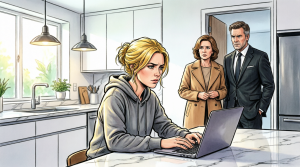
The footsteps came closer. I turned in my chair.
My younger sister, Christina, stepped into the kitchen like she owned it.
She was dressed as if she were about to give a keynote speech—tailored camel coat, slim black trousers, glossy shoulder-length hair blown out in smooth curls that bounced when she moved. Perfect eyeliner, even at five in the morning. Her crossbody designer bag sat on her hip like it had its own security detail.
Behind her, Jonathan followed, closing the front door with a controlled, quiet click. Jonathan always moved like that—precise, calculated, like every motion was a brand decision. His hair was gelled into a neat, immovable wave. The faintest whiff of expensive cologne followed him into the kitchen, cutting through the smell of coffee and toast.
For a moment, my brain refused to reconcile the sight with the time. My cursor blinked on the screen, waiting.
“Michelle,” Christina said, looking around the room with an appraising gaze, like she was standing in a showroom, not the kitchen where we’d eaten cereal as kids. “You’re up.”
“Obviously,” I said, closing my laptop slowly. “It’s five. I’m always up.”
Jonathan checked his watch, as if to verify that time still obeyed him. “Actually,” he said mildly, “it’s 5:06.”
He said it as though it mattered. As though he needed me to know I was already behind schedule.
I looked at them both, the incongruity of their presence settling like a stone in my stomach. Christina hadn’t set foot in the house in years. Literally years. The last time she’d been here was a rushed visit over Christmas, long before pandemics and layoffs and foreclosure threats had rearranged our lives.
“What are you doing here?” I asked, keeping my tone even. “Is something wrong?”
She walked past me, her heels tapping decisively. She touched the back of one of the dining chairs, the edge of the counter, the handle of the refrigerator door as if testing their solidity.
“Actually,” she said, “that’s what we’re here to talk about.”
Jonathan stood just behind her, hands clasped loosely in front of him, the picture of supportive husband. Supportive in that particular way that meant he intended to let her speak while backing her up with carefully-worded statements later.
She took a breath, squared her shoulders, and then said the words that cleaved my life cleanly into Before and After.
“You have forty-eight hours,” she said briskly. “Pack your things and get out. This house belongs to us now.”
For a beat, I honestly thought I’d misheard her. Maybe the early hour distorted her voice. Maybe I’d slipped into some surreal dream, one of those stress dreams where you show up to a math exam naked and holding a toaster.
“Come again?” I said.
She lifted her chin the way she used to when we were kids and she was about to tell on me for some invented offense. “You heard me. Forty-eight hours. We’re moving in. Jonathan and I. Mom and Dad agree it’s the best use of the property. They’ve already signed.”
Jonathan gave a small, practiced smile. “We’ve been discussing this for a while, Michelle. The market is changing. We have an opportunity to turn this place into something that can actually generate value. A proper family home. Christina’s been very clear on the vision. It’s time.”
“That’s right,” Christina added, her eyes sweeping the room again, already rearranging it in her mind. “We’ve been looking at layouts. Maybe open up this wall here, do an island instead of this old table. Take out those hideous curtains—”
I stared at her. “Those hideous curtains you never contributed a cent to,” I said quietly.
She shot me a brief, irritated look, like a fly had landed on her wineglass.
Before she could respond, another voice cut in.
“Michelle.”
My mother stood in the kitchen doorway, robe tied tightly around her, slippers half-crushed at the heel. Her dark hair, now threaded with gray, escaped from a messy clip. She looked smaller than I remembered, or maybe she’d always been that size and I’d only now noticed how much energy she’d been spending trying to fill space.
Her voice was steady, but there was a tremor at the edges of it. “They can make better use of this house,” she said. “You’ve always been… alone. They have a plan.”
The word fell between us, heavy. Plan.
Something inside me didn’t flare. It didn’t explode into righteous fury, as maybe it should have. It froze. Solid. Clear.
“A plan,” I repeated, my voice very calm. “Like the kind where someone else pays off the hundred and fifty thousand dollar mortgage taken out against this house?”
The room went quiet in that specific way that means truth has just entered and kicked over a chair.
Christina’s confidence faltered, minutely, like a light flickering. Jonathan blinked, his mouth tightening for a second before smoothing back into neutrality. My father appeared in the hallway behind my mother and stopped there, his hand on the doorframe, eyes finding an invisible point on the floorboards. He didn’t say anything.
“Michelle,” my mother said sharply, as if I’d just insulted a guest. “This is not the time to bring that up.”
“When is the time?” I asked. “Because I’d love to pencil in ‘being thanked for saving the house’ into my calendar. Unless that slot’s already been taken by ‘getting evicted from it.’”
Jonathan shifted his weight. “This is getting emotional,” he said, with the smooth intolerance of someone who always positioned himself above messy human feelings. “We’re simply talking about allocation of resources. Christina and I are starting a family. We need a place. Your parents are aging. They—”
“They’re right here,” I cut in. “You can say ‘you.’ They’re not an abstract.”
He gave me that patient look he probably used on junior associates. “Of course. My point is, you’re financially independent. You’re thirty, you’re a software engineer, you make good money—”
“Thanks for the biography,” I said. “I was there.”
“You should have your own place by now,” Christina added. “Most people your age do. It’s time to move on. We can’t all just… linger indefinitely.”
The irony of her saying that, having breezed in at dawn after years of absence, was almost funny. Almost.
I remembered, too clearly, the night everything had started. Years earlier. My father’s voice hoarse as he explained how he’d trusted a “friend of a friend” with an investment opportunity that turned out to be a well-packaged scam. How his retirement savings had vanished. How the bank, unimpressed with personal tragedies, had started sniffing around with foreclosure notices.
This house that held every birthday and Christmas and flu recovery and scraped knee was suddenly a line item on some spreadsheet in a lender’s office.
They had come to me then.
“Pay the debt,” my father had said, his eyes wet, his hands twisting in his lap. “Save the house. It’s for the family. For you and Christina. Clear a hundred and fifty thousand in three years or we lose everything.”
I’d postponed buying my own home. I’d skipped vacations I could have easily afforded, said no to impulse purchases, lived frugally in a house that technically didn’t cost me rent but bled me in other ways. Every month, I’d funneled my salary into the mortgage, the repairs, the utilities. I’d bought the new sofa when the old one’s springs gave out, the 65-inch TV that made my father’s eyes light up during football season, the washer and dryer that replaced the ones that finally wheezed their last breath mid-cycle, turning our towels into a sour-smelling heap.
Roof repairs when the shingles cracked. Repainting when the mildew showed. The endless Amazon boxes of small things—new curtains, a better coffeemaker, a toaster that didn’t burn one side and undercook the other.
I had funded the illusion of stability.
And now they were standing in the kitchen telling me I had forty-eight hours to disappear.
I felt something inside me settle into a strange, cold calm. Not numbness. Not exactly. More like the moment before a deployment, when soldiers stop processing the enormity of what’s happening and focus on the next step. The next breath.
I smiled, just barely. “Fine,” I said. “I’ll start preparing.”
Christina exhaled, a tiny puff of relief she probably didn’t realize she’d released. Jonathan’s shoulders relaxed almost imperceptibly. My mother’s eyes darted between us, wary. My father finally looked up, relief and guilt warring in his expression.
They thought it was surrender.
It wasn’t.
It was logistics.
The moment I closed my bedroom door behind me, the operation began.
My room looked just as it had for the last few years—somewhere between a teenager’s refuge and a functional adult’s crash pad. Bookshelves lined one wall, filled with programming manuals, battered paperbacks, and a few framed photos tucked between them. My bed was neatly made, laptop charger wound and clipped at the edge of the desk. On the far wall, the faint pencil marks from my grandfather’s old height chart were still visible, despite repeated paint jobs. He’d refused to let my parents erase them completely.
“History stays,” he’d said when I was nine and my mother tried to roll a fresh coat over my childhood measurements. “This is structural.”
I took a breath, then sat at my desk and opened my laptop again—not to code this time, but to plan.
Portland emergency moving service 24 hours, I typed into the search bar, fingers moving quickly, the mechanical act of it soothing. Names populated the screen—companies with hopeful, energetic titles, promising efficiency and discretion.
I clicked one at random: Green Mountain Movers.
The phone rang twice before a man picked up. His voice was groggy but professional, the way people sound when they’ve had coffee but not enough of it.
“Green Mountain Movers, this is Daniel.”
“Hi, Daniel,” I said. “I need a crew today. Noon, if possible.”
There was a pause. I could almost hear him checking a mental calendar. “Short notice,” he said. “What are we talking, a studio? One bedroom?”
“Single-family house,” I said. “Partial move.”
Another pause, longer. “You know it’s… five in the morning, right?”
“I do.” I looked at the digital clock on my nightstand: 5:14. “Is noon possible?”
He exhaled slowly. “Depends what you mean by ‘partial.’”
I started listing the inventory, my tone going flat and clinical as I went down the mental list. “L-shaped sofa, sectional, gray. Seats five. 65-inch OLED TV mounted on the living room wall. Washer, dryer, both purchased two years ago. Microwave, toaster, coffeemaker, blender. Dining chairs—six of them, upholstered, bought last year. Curtains in the living room and dining room. Area rugs. Some lamps. A few bookcases. I’ll handle my personal things separately.”
His tone shifted. The casual, sleepy cadence sharpened. This wasn’t drama anymore. It was logistics.
“We can do noon,” he said. “Rush fee applies. And we’ll need you to be very clear on what’s going and what’s staying. We don’t do domestic… disputes.”
“That won’t be a problem,” I said. “Everything that’s mine will be clearly labeled.”
“Alright,” he replied. “Text me the address. We’ll be there at twelve on the dot.”
I thanked him and hung up, my heart pounding so hard I could feel it in my fingertips.
For the next few hours, I worked.
If you’d seen me then, moving through the house with a stack of Post-it notes and a folder under my arm, you might have thought I was staging it for an open house. In a way, I was—but not for buyers. I was staging it for extraction.
I pulled open my filing cabinet and took out the folder labeled HOME. Over the years, I’d kept every receipt, every invoice, every email confirming a purchase. Not because I foresaw this exact moment—no one’s paranoia is that accurate—but because I’m the kind of person who documents things. Organized. Logical. The kind of person who wakes at five a.m. to code with coffee.
I spread the papers out on my bed: receipts for the sofa, the TV, the washer and dryer, the set of dining chairs I’d found on sale after spending a week comparing reviews. Printouts of emails about the roof repairs, the repainting, the appliance installs. My name on all of them. My credit card numbers, the last four digits familiar and oddly intimate.
I moved through the house, placing small Post-it notes on everything that fell under the umbrella of “mine.”
Mine on the sofa arm.
Mine on the base of the TV.
Mine on the washer lid, the dryer door.
Mine on the microwave handle, the toaster’s side, the sleek electric kettle Jonathan had once praised as “a decent purchase” in a tone that implied I’d finally done something right.
Mine on the dining chairs, on the living room lamps, on the curtains that softened the harshness of the sunlight in summer.
The house grew a rash of sticky yellow tags, a silent, neon protest.
I left certain things untouched. The dining table, its surface worn but solid, had been my grandfather’s. He’d sanded and refinished it himself before my parents got married, a gift to them and, in his mind, an anchor for the family. That stayed.
The old sideboard in the hallway, its drawers full of mismatched linens and holiday platters, had been my grandmother’s. That stayed too.
But everything else that I’d brought into this house in the last few years—the visible and invisible scaffolding that held my parents’ comfort together—was marked.
At some point around seven, my mother emerged from her room fully dressed, makeup hastily applied. She stopped short when she saw the living room.
“What is this?” she demanded, her eyes darting from Post-it to Post-it. “What are you doing?”
I didn’t look up from the stack of receipts I was sorting at the coffee table. “Labeling the things I paid for,” I said. “So there’s no confusion later.”
Her face tightened. “You’re being petty.”
“Am I?” I held up a receipt, the ink slightly faded. “This is the sofa, Mom. Do you remember when we bought it? The old one had a broken spring that poked Dad in the back every time he sat down. You said you couldn’t afford a new one. I put it on my card. Ten months, zero interest, remember?”
Her gaze flicked to the paper and then away. “We said we’d pay you back.”
“You never did.”
She opened her mouth, closed it, then gestured at the TV. “The television, then. Your father needs that. He loves watching his shows. How is he supposed to—”
“That TV is worth almost two thousand dollars,” I said softly. “That’s ten months of the mortgage payment I made alone when his ‘investment’ went off a cliff. This is not about a man and his shows. This is about values, Mom.”
She flinched at the word, like I’d slapped her.
“Asking me to leave was about values too,” I added. “You made a choice. These are the consequences of that choice.”
Tears sprang to her eyes, angry and quick. “We did it for everyone,” she said. “Christina and Jonathan, they can build a life here. Maybe grandchildren someday. We thought you would understand.”
“They thought,” I said. “You thought. Funny how I wasn’t included in the thinking.”
She stared at me like she didn’t recognize me. Maybe she didn’t. Maybe she was still trying to reconcile the little girl who had once begged to sleep in her bed during thunderstorms with this woman calmly sorting financial paperwork like ammunition.
“Michelle,” she whispered, “you’re going too far.”
I held her gaze. “No,” I said. “For the first time, I’m going exactly as far as you pushed me.”
She left the room without responding.
My father avoided me entirely. I saw him once, in the hallway, hovering by the coat closet like he’d been caught stealing. When our eyes met, he opened his mouth, but whatever words he’d intended evaporated. He shuffled past, his slippers whispering against the floor, and disappeared into the garage.
Christina and Jonathan reappeared around eight, dressed now in more casual clothes—her in jeans and a crisp white blouse, him in a dark polo and chinos. They looked like a couple in a real estate brochure.
Christina took in the Post-its with a frown. “What is all this?” she demanded.
“Labels,” I said. “To make the move efficient.”
“Move?” she repeated, confusion crossing her face.
I met her eyes. “Yes. Mine.”
“You’re not—” She stopped, recalibrating. “You can’t just take everything.”
“I can take everything I bought,” I replied. “Legally, it’s mine. Unless you’d like to go over the receipts with me. I have them all. Color-coded, if that helps.”
Jonathan stepped forward, his tone shifting into lawyer mode. “Now, let’s be reasonable,” he said. “You can’t strip the house bare. Your parents—”
“Are the ones handing it over to you,” I said. “Which is their choice. Just as this is mine.”
He hesitated. I could see the calculations running behind his eyes: Is this bluff? Is she actually going to do it? What’s our exposure?
“Look,” he said finally, spreading his hands in a conciliatory gesture. “We’re trying to keep things amicable. No one wants drama here. If you want to take your bedroom furniture, your personal items, your tech—that’s fine. But gutting the place is—”
“Mine,” I repeated. “Everything with a yellow label leaves at noon. You have until then to take your things out of their path.”
Christina’s eyes flashed. “We’ll see about that,” she said, her voice icy. “Mom! Dad!”
She stomped down the hall in search of allies who, it turned out, were in short supply. No one came back with her.
She returned alone, cheeks flushed. “You’re being vindictive,” she said.
I shrugged. “If you want the house, you can have the shell. That’s what you’ve been treating it as anyway.”
At exactly twelve o’clock, the intercom buzzed.
“Michelle?” The voice crackled through the box. “It’s Daniel, from Green Mountain Movers.”
I walked to the panel, pressed the button, and buzzed them in.
The moving truck looked almost comically large in the driveway, dwarfing my father’s aging sedan. Daniel and his crew stepped out, wearing matching navy t-shirts with the company logo, heavy work gloves tucked into their back pockets.
Daniel himself was in his late thirties, maybe early forties, with the kind of solid build that comes from lifting other people’s lives for a living. He took one look at my expression and didn’t ask any of the questions I could see flickering behind his eyes.
“Afternoon,” he said simply. “You Michelle?”
“I am,” I said. “Thank you for coming.”
He nodded toward the house. “You got everything labeled?”
“Yes.”
He stepped inside, his gaze sliding over the living room. I watched, almost clinically, as his eyes moved from sofa to TV, to the Post-its, to my parents hovering awkwardly by the kitchen doorway.
“Alright, team,” he called over his shoulder. “Everything with a yellow tag. Treat it like glass.”
They moved with calm efficiency. No chatter, no judgment. The sofa went first, its bulk maneuvered through the front door with practiced angles and grunts. Watching it leave, I expected to feel something—sadness, nostalgia, at least a pang. All those imagined family movie nights that never quite materialized, the evenings I’d spent there alone after my parents went to bed, the rare time Christina had sat beside me and actually seemed present.
But I felt… nothing. Or rather, I felt something very specific: closure.
That wasn’t nostalgia leaving the house. It was an invoice fulfilled.
The TV followed, dismounted from the wall with care. One of the movers asked where the box was for it, and I produced it from the garage—of course I’d kept it; of course I knew exactly where it was. The washer and dryer were next, carefully disconnected and wheeled out on dollies. The microwave came down from its perch, the toaster unplugged, the coffeemaker lifted from its spot beside the sink.
Christina watched, aghast.
“You can’t do this,” she muttered, more to herself than to me. “You can’t actually—Mom! Say something!”
My mother sat at the edge of the now-naked dining table, her hands clasped tightly in her lap. She looked as if she’d aged ten years in twelve hours. “She has the receipts,” she said softly. “It’s her right.”
My father said nothing. He stood in the corner, arms crossed, jaw clenched so hard I could see the muscles twitch.
The dining chairs, my carefully chosen modern set, disappeared next. They left the old table standing alone, its mismatched wood stain suddenly more obvious without the distraction of upholstery.
“Table stays?” one mover asked, pausing.
“Yes,” I said. “It was my grandfather’s.”
By two in the afternoon, the house echoed. The curtains were gone, leaving the windows bare and unsoftened. The area rugs had been rolled up and carried out, revealing scuffed hardwood beneath. The hum of the appliances was gone, replaced by a hollow stillness.
The warmth I had financed, the comfort I had curated—all gone.
I photographed the movers’ final receipt with my phone, the paper crisp under my fingers. Documentation mattered. It always had.
“Everything you wanted is loaded,” Daniel said, handing me the original. “We’ll take it to the storage facility address you texted. They’ll be expecting us?”
“Yes,” I said. “Thank you. I’ll meet you there in a bit.”
He nodded once, then glanced back at the house. “Good luck,” he said quietly.
I wasn’t sure which of us he was talking to.
I walked through the house one last time. The living room’s bare walls felt bigger, the nail holes where picture frames had hung now small, accusing eyes. My bedroom, stripped of everything but the built-in closet and the faint height marks on the doorframe, looked like a hotel room between guests.
In the kitchen, the counter was empty, the outlines of the appliances still visible in faint dust lines. The refrigerator remained—an ancient beast my parents had bought before I could walk. It, along with the stove and the dishwasher, had been theirs long before the financial near-collapse. My fingerprints weren’t on those invoices.
On the bare dining table, I placed a single key—the front door key I’d been using for nearly three decades. It looked smaller than I remembered.
I stood there for a moment, listening. No hum of the coffee maker. No murmur of a television. Just the rain tapping on the windows and the faint wheeze of the old refrigerator.
“Michelle,” my mother whispered from the doorway.
I turned.
Her eyes were red-rimmed, mascara smudged. “You don’t have to leave like this,” she said. “We could talk. Work something out.”
“We tried talking,” I said gently. “You talked at me at five this morning. You already made your choice. This is me making mine.”
She flinched as if I’d thrown something. “We’re still your parents,” she said. “We thought you were doing this for the family.”
“I was,” I said. “I just didn’t realize I wasn’t included in your definition of ‘family.’”
She covered her mouth with her hand, shoulders shaking. I felt a flicker of sympathy, but it was distant, as if I were watching someone cry on a screen. I’d spent years feeling guilty on her behalf. It had hollowed me out. There was very little room left for guilt.
“Goodbye, Mom,” I said.
She didn’t answer.
I walked out the front door without looking back.
Forty-eight hours later, my phone exploded.
I’d spent those two days in a strange limbo, shuttling between the storage unit where my possessions now lived in anonymous stacks and the small, temporary apartment I’d rented—a one-bedroom with beige walls and a balcony overlooking a parking lot. It wasn’t much, but it was mine, paid for with money that hadn’t been siphoned off into someone else’s debt.
With the practical chaos handled, my brain had tried to circle back to what had happened, but every time it did, a heavy, exhausted numbness descended. I went through the motions: I answered emails from work, attended Zoom meetings, wrote code. No one on my team knew that in between fixing bugs, I was also uprooting the only home I’d ever known.
Then, on the dot—forty-eight hours after the moment Christina had walked into my kitchen and delivered her ultimatum—my screen lit up with missed calls.
Christina. Mom. Dad. Numbers I didn’t recognize, probably Jonathan’s colleagues or relatives. The voicemail icon grew a little red digit.
I ignored the first few calls. Then, curiosity prying at me, I tapped into the voicemail.
“There’s nothing here,” Christina’s voice cracked through the speaker, pitching high with disbelief. “She took everything. The house is empty. What are we supposed to—how could you do this, Michelle? Call me back. Call me back now.”
Another message from my father followed, his voice resigned and shaky. “Michelle, this… this was too much. You’ve gone too far.”
Too far.
The phrase lodged somewhere deep in my chest and turned slowly, like a piece of glass.
Had I? I had, for once, simply drawn a line at the boundary between my labor and their entitlement and refused to pretend the line didn’t exist.
If that was “too far,” then maybe their map had been upside down all along.
That evening, I sat across from my best friend and attorney, Rebecca, in her glass-walled office downtown. The city sprawled beyond the floor-to-ceiling windows, a grid of lights on wet asphalt. Her office was a study in cool professionalism—dark wood desk, a single potted plant that refused to die, shelves lined with law books and binders labeled with names that weren’t mine.
My receipts, dog-eared and worn, looked almost vulgar spread across her sleek desk. Beside them lay an old photograph of my grandfather, Frank, holding a beer and laughing at some joke I couldn’t remember.
“I don’t want defense,” I said quietly, my fingers tracing the edge of the photograph. “I want offense.”
Rebecca leaned back in her chair, studying me. She was a few years older than me, with sharp eyes and a steady presence, the kind of person you wanted on your side in a storm. We’d met in college—me the logic-driven computer science major, her the philosophy student who loved arguing about ethics late into the night. Somewhere along the way, she’d switched tracks to law school, and I’d gone into software engineering. We’d stayed in each other’s orbits………………….
Click Here to continuous Read Full Ending Story👉 PART 2-“They Came at 5 AM to Take My House—48 Hours Later, Their Lives Collapsed” (Ending)