I came home early from Bible study on a Thursday afternoon and heard my husband laughing in my bedroom with my son-in-law.
For a second, my mind refused to understand what my ears already knew.
The sound came muffled through the half-closed bedroom door upstairs, low male laughter layered over Luther Vandross playing soft and slow. Our song. Mine and Raymond’s. The same song we used to dance to in the kitchen when Nicole was little and asleep in her room and the world still felt holy.
My church purse slipped out of my hand and hit the hardwood floor so hard the clasp snapped open. My keys skittered one way, my reading glasses another. Peppermints rolled in every direction. Lipstick, tissues, offering envelope, all of it scattered across the hallway like somebody had taken the last thirty-eight years of my life and spilled them at my feet.
I dropped to my knees automatically, because that is what women like me do first. We gather. We clean. We steady. We make order while the world breaks around us.
I was there on the floor with my palms flat against the wood, trying to stop my hands from shaking, when I heard Raymond’s voice.
“Nobody’s home till four. We got time.”
Then Brandon, my daughter’s husband, answered in a voice I had never heard him use in my house.
“You sure? I don’t want Evelyn finding out like this.”
Like this.
Not if.
Not maybe.
Not someday.
Like this.
That was the moment the truth walked right up to me, looked me in the face, and sat down in my bones.
My name is Evelyn Marie Parker. I was sixty-two years old that afternoon. I had been married for thirty-eight years. I had raised one daughter, taught third grade for thirty-seven years, buried a sister, survived three miscarriages, a husband’s war nightmares, one mild stroke, too many layoffs, and more quiet sacrifices than anybody ever wrote down. I had integrated a white school when I was six years old with spit on the sidewalk and hate in grown folks’ eyes.
And still, nothing in my life had prepared me for kneeling in my own hallway while my husband betrayed me upstairs with my daughter’s husband.
I did not scream.
That part surprises people when I tell the story now. They always expect drama first. Plates breaking. Doors flying open. A wild woman on a staircase full of rage and mascara and righteous destruction.
But that is television.
Real betrayal is colder than that at first.
Real betrayal sits inside your chest and starts taking inventory.
I picked up my purse.
I collected the peppermints.
I slid my reading glasses back into the case.
I stood up.
Then I walked downstairs, went into my kitchen, put water on for coffee, and sat at my table while the man who had shared my bed for almost four decades carried on with the man who called him Pops at Sunday dinner.
The clock on the wall said 3:40.
I watched the second hand move.
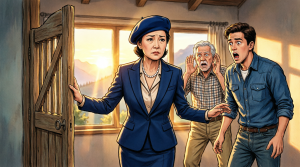
Seven minutes passed like that. Seven minutes of my old life ending and something else being born in its place.
By the time my coffee was ready, I knew two things.
First, if I ran upstairs in anger, I would lose.
Second, nobody was going to disappear me quietly.
That second truth matters. To understand why, you need to understand who I was before I became Mrs. Raymond Parker. Before I became Nicole’s mama. Before I became the woman who made the best sweet potato pie at Greater Hope Baptist and remembered everybody’s birthday and kept my house so clean folks said it looked staged.
You need to know Evelyn Johnson.
I was born in 1962 in New Orleans, Louisiana, to James and Bula Johnson. My daddy worked the docks until his back gave him trouble and then kept working anyway because that is what men of his generation did. My mama cleaned houses in the Garden District for white women who had china cabinets bigger than our kitchen and enough shoes to clothe a small village.
We did not have much, but we had rules.
Hold your head up.
Speak clearly.
Look people in the eye.
Don’t take charity from folks who want to own you through gratitude.
And never, ever let anybody confuse your kindness for weakness.
I grew up in the shadow of history and the teeth of it too. I remember grown folks crying when Dr. King died. I remember my mama sitting at the kitchen table with both hands over her mouth like if she moved them the whole world might split open. I remember separate fountains. Colored school. White school. Colored entrance. White entrance. I remember being six years old and wondering why signs had opinions about who deserved a front door.
In 1968, my parents signed the papers for me to integrate Riverside Elementary.
I was one of five Black children in a school full of white faces and polished lunchboxes and teachers who smiled too tightly. There were mornings when people shouted. Mornings when grown adults looked at children like we were invaders. Mornings when my mama squeezed my hand so hard it almost hurt, then bent down, fixed my collar, and whispered, “You remember who you are, Evelyn Marie. You are not walking in there asking for permission to be human.”
I carried that sentence my whole life.
I graduated at the top of my class, earned a scholarship to Spelman, and studied education because I believed schools could save children if the right adults stood in the gap long enough.
That was where I was headed when I met Raymond Parker.
He was twenty-three. I was twenty. He had come back from Vietnam with Army posture, mechanic’s hands, and eyes that belonged to a much older man. We met at a church picnic in Atlanta. I was serving potato salad in the fellowship yard at Greater Hope Baptist, and he was sitting under a tree like he had misplaced the rest of the world.
There was sadness around him, but also discipline. He looked like somebody holding a door shut with his whole body.
I carried him a plate of food.
“You look hungry,” I said.
He looked up at me and smiled slowly.
“I am,” he said. “Been hungry for a long time.”
We talked for three hours under that tree.
He told me pieces of Vietnam, never the full story, just enough to explain the distance in him. Friends lost. Sleep broken. The strange guilt of surviving when other men did not. I told him about school, about wanting to teach, about my mama and daddy and the life I meant to build with both hands.
When the sun started dropping and church ladies began packing leftovers into foil, he asked if he could see me again.
He did.
Then again.
Then every chance he got.
Six months later, he asked me to marry him on my parents’ front porch in New Orleans. He had a ring he could barely afford and tears in his voice when he told me he didn’t have much, but he would spend every day trying to be worthy of me.
I believed him.
Maybe he believed it too.
That is one of the hardest truths I have learned in old age: people can mean a promise when they make it and still betray it later. Sincerity at the beginning is not protection against cowardice in the middle.
We got married in June of 1985 at Greater Hope Baptist. Potluck reception in the basement. My mama’s wedding dress altered to fit me. Raymond in a Goodwill suit we pressed twice because he was so nervous he kept wrinkling it. Our honeymoon was two nights in Savannah and one thunderstorm that knocked the motel television out.
It was enough.
Back then, almost everything felt like enough.
I loved Raymond with the full, foolish, holy seriousness of a young woman who thought sacrifice was proof of permanence.
When his PTSD got bad and he woke up sweating and shaking, I sat with him.
When he drank too much during those early years, I begged and argued and prayed him back from the edge.
When jobs fell through, I worked more.
When his leg got broken in a shop accident, I picked up tutoring on top of teaching.
When the bills swelled, I stretched groceries.
When he felt like less of a man, I carried enough hope for both of us.
People talk about marriage like it’s candlelight and anniversaries and inside jokes.
Marriage is also standing in a bathroom at 2 a.m. trying not to cry where the other person can hear you.
Marriage is deciding whose dream gets delayed because the rent is due.
Marriage is saying yes to a smaller life now because you believe you are protecting a bigger one later.
I dropped out of Spelman three months before graduating because Raymond was too fragile then and our life too unstable and somebody needed to make sure we survived. I got my degree later through night classes at Georgia State, six years of exhaustion and determination stitched together with library coffee and bus rides and faith.
In 1993, at thirty-one years old, I finally became a teacher.
Washington Elementary in East Atlanta.
Third grade.
Thirty-seven years.
I taught babies who came to school hungry, babies who came to school brilliant, babies who came to school angry, ashamed, underslept, overparented, underloved, and I poured into every single one of them. I bought pencils with my own money. Kept spare snacks in my desk. Stayed late for tutoring. Called mamas who were trying their best and told them, “Your child is not broken. They just need somebody to keep believing in them.”
I believed in children for a living.
And in 1990, after three miscarriages that almost hollowed me out, I had one of my own.
Nicole Marie Parker arrived weighing six pounds, eleven ounces, with her daddy’s eyes and enough hair for two babies.
When the nurse placed her in Raymond’s arms, that man cried so hard I had to laugh.
We did good, baby, he kept whispering.
We did real good.
For years, that was true.
Raymond was a good father.
I will not erase that because of what came later. He was a good father. He changed diapers. Walked the floor during colic. Coached softball. Taught Nicole how to check oil and change a tire. Worked double shifts to pay her college tuition because he was determined she would not start life under a mountain of student debt.
We bought our house on Magnolia Street in 1988 for $67,000. Three bedrooms, modest yard, squeaky hallway floorboard outside the guest room, kitchen too small for holidays and yet somehow the center of our life anyway.
That house saw everything.
First steps.
Prom pictures.
Thanksgiving turkey disasters.
Science fair volcanoes.
Makeup apologies.
Christmas hymns.
Arguments.
Forgiveness.
Years and years of ordinary love.
Or what I thought was ordinary love.
Nicole graduated from Georgia State in 2012 with an accounting degree and honors cords shining against her gown. Raymond squeezed my hand so tight during the ceremony it hurt.
“Our baby’s going to have a better life than we did,” he whispered.
I believed that too.
Nicole met Brandon in 2014.
He told us his name was Brandon Cole. Said he had moved from Chicago to Atlanta to build a business and start fresh. He was handsome, polite, charming in a practiced way that reads as confidence when you want good things for your child.
He brought flowers for me the first time he came to dinner and a bottle of wine for Raymond.
He said ma’am.
Washed dishes without being asked.
Looked Nicole in the eye when she talked.
Called my husband sir for all of two weeks before graduating to Pops, which delighted Raymond more than he admitted.
“He’s respectful,” Raymond said after Brandon left that first Sunday. “That matters.”
It did matter.
Or at least it should have.
Nicole married him in 2016 at Greater Hope Baptist. Another church wedding. Another aisle. Another promise made before God and family. I cried happy tears when Brandon took Nicole’s hands and vowed to honor her. Raymond hugged him after the ceremony and said, “Take care of my baby.”
Brandon answered, “I will, Pops. I promise.”
Years later, I would sit awake at night wondering whether he was already lying in that moment or whether he simply became the kind of man who lies so often he forgets the first place truth left him.
The first few years looked good.
They bought a townhouse in Decatur.
Came to Sunday dinner.
Talked about work and vacations and maybe starting a family after they got more settled.
Life, from the outside, had a settled shine to it. Raymond retired from the auto shop in 2020. Between his pension and mine, we were comfortable. Not rich, but blessed. House paid off. Garden thriving. Daughter employed. Son-in-law growing a business.
Then, like rot behind paint, things started changing where only close eyes would notice.
Nicole came less often.
Raymond started going out more.
Brandon started dropping by in the afternoons when I was at Bible study or volunteering or grocery shopping.
At first, every shift came with an explanation.
Work is busy.
Traffic was bad.
Brandon needed advice.
Raymond’s trying to stay active.
The doctor said he needs to exercise.
Men talk different to each other.
You’re reading too much into things.
That last sentence is the lullaby women get sung while they are being made fools of.
Around 2022, Raymond joined a gym. At sixty-three years old, my husband who had never voluntarily touched a treadmill in his life suddenly cared about his cardio. He started dyeing his hair. Buying fitted shirts. Spraying cologne like he was nineteen and broke with something to prove.
He locked his phone.
He took cash out of our joint account every week.
He started having regular Thursday coffee with “old Army friends,” except none of those friends ever called the house and he never mentioned their names twice the same way.
Meanwhile, Nicole grew brittle.
She snapped when I asked gentle questions. Took private calls. Borrowed $3,000 one month for “car repairs” even though the numbers did not make sense to me. I sent it anyway because mothers are often the last investors in a child’s bad marriage.
Then I found the watch.
A Citizen watch in a Macy’s box in Raymond’s closet with a card tucked underneath that read:
To my Raymond. You make me feel alive again. B.
When I confronted him, he laughed it off.
“From Brandon,” he said. “Birthday gift. Too expensive. Been meaning to return it.”
I remember the relief I felt then.
That is what shame tastes like in hindsight—remembered relief over a lie you would give anything now to have questioned harder.
So by the time I sat in my kitchen after Bible study, listening to my husband and my son-in-law finish whatever they were doing upstairs, I had more than one moment landing on top of me. I had months of wrongness finally forming a shape.
I drank my coffee black because I forgot the cream.
Then I started planning.
That first evening, after Brandon left by the back door and Raymond came downstairs whistling like sin had a soundtrack, I acted normal. I unpacked groceries. Asked him if he wanted fried chicken Sunday or smothered pork chops. Smiled at the right places. Told him Sister Margaret’s pound cake was dry this week.
And all the while, I was watching.
Watching the shower he took too fast.
Watching him avoid my eyes.
Watching the way a man carries false innocence when he thinks he still controls the timing of the truth.
That night he slept next to me and snored like his conscience took sedatives. I lay awake staring at the ceiling until 2:30 in the morning, then slipped out of bed and went downstairs to start becoming dangerous.
There is a kind of fear that paralyzes and another kind that sharpens.
Mine sharpened.
I opened our joint bank account and started scrolling.
$500 cash withdrawal.
Then another.
Then another.
Week after week.
Sixteen thousand dollars gone in four months.
I checked credit card statements.
Steakhouse dinners downtown.
Flowers I never received.
A hotel charge at the Ritz-Carlton.
A Macy’s purchase for $450.
Then I ran a credit report.
And there it was. A joint checking account I knew nothing about.
SunTrust Bank.
Opened eight months earlier.
Co-owner: Brandon M. Cole.
The balance was over $23,000.
I nearly threw up right there in my kitchen.
My husband had taken marital funds—my pension too, not just his—and built a hidden financial life with my daughter’s husband.
I made screenshots of everything.
Downloaded statements.
Saved copies in a folder on my computer labeled Recipes because stupid men never look twice at domestic camouflage.
At five-thirty that morning, my best friend Diane called.
She and I had been close forty years, the kind of close where funerals and births and every middle pain between them had already braided us together.
“Girl, you awake?” she asked.
“Yes.”
“I need to come over.”
When Diane showed up twenty minutes later, she looked guilty in a way I had never seen on her.
“I saw something two weeks ago,” she said. “I didn’t know how to tell you.”
Then she told me she had stopped at a Waffle House after a late hospital shift and found Raymond and Brandon in the back booth holding hands across the table. Not father-son affection. Not mentorship. Something else.
I should have collapsed.
Instead, I felt steadier.
There is relief in being witnessed. Relief in knowing your reality is not madness.
By nine o’clock Monday morning, I had an appointment with Catherine Brooks, one of the most feared divorce attorneys in Atlanta. Black woman. Georgetown degree. High-conflict specialist. Her website said: Protecting what’s yours.
I read that line three times.
When I walked into her office the next day, I was carrying years in my body and screenshots in my purse.
“My husband is having an affair with my son-in-law,” I told her.
Catherine didn’t blink.
That was the first reason I trusted her.
The second was the way she handled evidence. Efficiently. Respectfully. Like my pain mattered but facts mattered more if I wanted to win.
I showed her the bank records, the hidden account, the hotel charges, the gift card, the call logs, the photographs I had already taken of documents from Raymond’s desk and closet.
When she finished reviewing everything, she set my phone down and said, “Mrs. Parker, this is one of the cleanest evidentiary packages I have ever seen from a spouse who just discovered infidelity.”
I almost laughed………………………

