Part 1
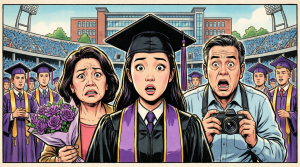
My name is Francis Townsend, and I’m 22 years old. Two weeks ago, I stood on a graduation stage in front of 3,000 people while my parents, the same people who refused to pay for my education because I wasn’t worth the investment, sat in the front row with their faces drained of all color. They came to watch my twin sister graduate. They had no idea I was even there. They certainly didn’t know I’d be the one giving the keynote speech.
But this story doesn’t begin at graduation. It begins four years earlier in my parents’ living room, when my father looked me straight in the eyes and said something I will never forget.
Now, let me take you back to that summer evening in 2021.
The acceptance letters arrived on the same Tuesday afternoon in April. Victoria got into Whitmore University, a prestigious private school with a price tag of $65,000 a year. I got into Eastbrook State, a solid public university, $25,000 annually. Still expensive, but manageable.
That evening, Dad called a family meeting in the living room.
“We need to discuss finances,” he said, settling into his leather armchair like a CEO addressing shareholders.
Mom sat on the couch, hands folded. Victoria stood by the window, already glowing with anticipation. I sat across from Dad, still clutching my acceptance letter.“Victoria,” Dad began, “we’ll cover your full tuition at Whitmore. Room, board, everything.”
Victoria squealed. Mom smiled.
Then Dad turned to me.
“Francis, we’ve decided not to fund your education.”
The words didn’t register at first.
“I’m sorry?”
“Victoria has leadership potential. She networks well. She’ll marry well. Build connections. It’s an investment that makes sense.”
He paused, and what came next felt like a knife sliding between my ribs.
“You’re smart, Francis, but you’re not special. There’s no return on investment with you.”
I looked at Mom. She wouldn’t meet my eyes. I looked at Victoria. She was already texting someone, probably sharing the good news about Whitmore.
“So I just figure it out myself?”
Dad shrugged.
“You’re resourceful. You’ll manage.”
That night, I didn’t cry. I’d cried enough over the years, over missed birthdays, hand-me-down gifts, being cropped out of family photos. Instead, I sat in my room and realized something that changed everything. To my parents, I wasn’t their daughter. I was a bad investment.
But what Dad didn’t know, what nobody in this family knew, was that his decision would alter the course of my entire life. And four years later, he’d face the consequences in front of thousands.
The thing is, this wasn’t new. The favoritism had always been there, woven into the fabric of our family like an ugly pattern everyone pretended not to see. When we turned 16, Victoria got a brand-new Honda Civic with a red bow on top. I got her old laptop, the one with a cracked screen and a battery that lasted 40 minutes.
“We can’t afford two cars,” Mom had said apologetically.
But they could afford Victoria’s ski trips, her designer prom dress, her summer abroad in Spain.
Family vacations were the worst. Victoria always got her own hotel room. I slept on pullout couches in hallways, once even in a closet that the resort called a cozy nook. In every family photo, Victoria stood center frame, glowing. I was always at the edge, sometimes partially cut off like an afterthought.
When I finally asked Mom about it, I was 17, desperate for answers.
She just sighed.
“Sweetheart, you’re imagining things. We love you both the same.”
But actions don’t lie.
A few months before the college decision, I found Mom’s phone unlocked on the kitchen counter. A text thread with Aunt Linda was open. I shouldn’t have read it, but I did.
“Poor Francis,” Mom had written. “But Harold’s right. She doesn’t stand out. We have to be practical.”
I put the phone down and walked away.
That night, I made a decision I told no one about. Not because I wanted revenge, but because I wanted to prove something to myself. I opened my laptop, the cracked one with the dying battery, and typed into the search bar: full scholarships for independent students.
The results loaded slowly, but what I found would change everything.
I did the math at 2 a.m., sitting on my bedroom floor with a notebook and a calculator. Eastbrook State: $25,000 per year. Four years: $100,000. Parents’ contribution: 0. My savings from summer jobs: $2,300.
The gap was staggering.
If I couldn’t close it, I had three options: drop out before I even started, take on six figures of student debt that would follow me for decades, or go part-time, stretching a four-year degree into seven or eight while working full-time. Every path led to the same place, becoming exactly what my father said I was. The failure, the bad investment, the twin who didn’t make it.
I could already hear the family conversations at Thanksgiving.
“Victoria is doing so well at Whitmore. Francis? Oh, she’s still figuring things out.”
But this wasn’t just about proving them wrong. It was about proving myself right.
I scrolled through scholarship databases until my eyes burned. Most required recommendations, essays, proof of financial need. Some were scams. Others had deadlines that had already passed. Then I found something. Eastbrook had a merit scholarship program for first-generation and independent students. Full tuition coverage plus a living stipend. The catch? Only five students per year were selected. The competition was brutal.
I saved the link.
Then I kept scrolling, and that’s when I first saw the name that would eventually change my life.
The Whitfield Scholarship. Full ride, $10,000 annually for living expenses, awarded to only 20 students nationwide.
I laughed out loud. Twenty students in the entire country. What chance did I have?
But I bookmarked it anyway. I had two choices: accept the life my parents designed for me or design my own.
I chose the second.
But to do that, I needed a plan, and I needed it immediately.
Part 2
I filled an entire notebook that summer. Every page was a calculation. Every margin was covered in plans.
Job number one: barista at the Morning Grind, a campus café. Shift: 5 to 8 a.m. Estimated monthly income: $800.
Job number two: cleaning crew for the residence halls, weekends only. $400 a month.
Job number three: teaching assistant for the economics department. If I could land it, another $300.
Total: $1,500 per month, roughly $18,000 a year. Still $7,000 short of tuition.
That gap would have to come from scholarships, merit-based ones. The kind you earn, not the kind you’re handed.
I found the cheapest housing option within walking distance of campus. A tiny room in a house shared with four other students. $300 a month, utilities included. No parking, no AC, no privacy. It would have to do.
My schedule crystallized into something brutal but precise. Five a.m., work at the café. Nine a.m. to five p.m., classes. Six p.m. to ten p.m., study, work, or TA duties. Sleep: 11 p.m. to 4 a.m. Four to five hours a night for four years.
The week before I left for college, Victoria posted photos from her Cancun trip with friends, sunset beaches, margaritas, laughter. I was packing my thrift-store comforter into a secondhand suitcase. Our lives were already diverging, and we hadn’t even started yet.
But here’s what kept me going. Every night before sleep, I’d whisper the same thing to myself.
“This is the price of freedom.”
Freedom from their expectations. Freedom from their judgment. Freedom from needing their approval.
I didn’t know then how right I’d be. And I didn’t know that somewhere on the Eastbrook campus, there was a professor who would see something in me that my own parents never could.
Freshman year, Thanksgiving. I sat alone in my tiny rented room, phone pressed to my ear, listening to the sounds of home. Laughter in the background, the clink of dishes, the warm chaos of a family gathering I wasn’t part of.
“Hello? Francis?”
Mom’s voice was distant, distracted.
“Hi, Mom. Happy Thanksgiving.”
“Oh, yes. Happy Thanksgiving, honey. How are you?”
“I’m okay. Is Dad there? Can I talk to him?”
A pause. Then I heard his voice in the background, muffled but clear.
“Tell her I’m busy.”
The words landed like stones.
Mom’s voice returned, artificially bright.
“Your father’s just in the middle of something. Victoria was telling the funniest story.”
“It’s fine, Mom.”
“Are you eating enough? Do you need anything?”
I looked around my room, at the instant ramen on my desk, at the secondhand blanket, at the textbook I’d borrowed from the library because I couldn’t afford to buy it.
“No, Mom. I don’t need anything.”
“Okay. Well, we love you.”
“Love you, too.”
I hung up.
Then I opened Facebook. The first thing in my feed was a photo Victoria had just posted: Mom, Dad, and Victoria at the dining table. Candles lit. Turkey gleaming.
The caption: Thankful for my amazing family.
My amazing family.
I zoomed in on the photo. Three place settings. Three chairs, not four. They hadn’t even set a place for me.
I sat there for a long time, staring at that image. Something shifted inside me that night. The ache I’d carried for years, the longing for their approval, their attention, their love. It didn’t disappear, but it changed. It hollowed out. And where the pain used to be, there was only quiet emptiness.
Strangely, that emptiness gave me something the pain never had.
Clarity.
Second semester, freshman year. Microeconomics 101.
Dr. Margaret Smith was legendary at Eastbrook. Thirty years of teaching, published in every major journal, terrifying reputation. Students whispered that she hadn’t given an A in five years.
I sat in the third row, took meticulous notes, and turned in my first essay expecting a B-minus at best.
The paper came back with two letters at the top: A+.
Beneath the grade was a note in red ink.
See me after class.
My heart dropped. What did I do wrong?
After the lecture, I approached her desk. Dr. Smith was already packing her bag, silver hair pulled back in a severe bun, reading glasses perched on her nose.
“Francis Townsend.”
“Yes, ma’am.”
“Sit down.”
I sat.
She looked at me over her glasses.
“This essay is one of the best pieces of undergraduate writing I’ve seen in 20 years. Where did you study before this?”
“Nowhere special. Public high school. Nothing advanced.”
“And your family? Academics?”I hesitated.
“My family doesn’t support my education, financially or otherwise.”
The words came out before I could stop them.
Dr. Smith set down her pen.
“Tell me more.”
So I did. For the first time, I told someone the whole story: the favoritism, the rejection, the three jobs, the four hours of sleep, all of it.
When I finished, she was quiet for a long moment. Then she said something that changed my trajectory forever.
“Have you heard of the Whitfield Scholarship?”
I nodded slowly.
“I’ve seen it, but it’s impossible. Twenty students nationwide.”
“Full ride, living stipend, and the recipients at partner schools give the commencement address at graduation,” she said.
She leaned forward.
“Francis, you have potential, extraordinary potential, but potential means nothing if no one sees it. Let me help you be seen.”
Part 3
The next two years blurred into a relentless rhythm. Wake at 4 a.m. Coffee shop by 5. Classes by 9. Library until midnight. Sleep. Repeat.
I missed every party, every football game, every late-night pizza run. While other students built memories, I built a GPA: 4.0, six semesters straight.
There were moments I almost broke. Once, I fainted during a shift at the café.
“Exhaustion,” the doctor said. “Dehydration.”
I was back at work the next day.
Another time, I sat in Rebecca’s car, actually her car, because she’d lent it to me for a job interview, and cried for 20 minutes. Not because anything specific had happened, just because everything had happened all at once for years.
But I kept going.
Junior year, Dr. Smith called me into her office.
“I’m nominating you for the Whitfield.”
I stared at her.
“You’re serious?”
“Ten essays, three rounds of interviews. It’ll be the hardest thing you’ve ever done.”
She paused.
“But you’ve already survived harder.”
The application consumed three months of my life. Essays about resilience, leadership, vision. Phone interviews with panels of professors. Background checks. Reference letters.
Somewhere in the middle of it, Victoria texted me for the first time in months.
“Mom says you don’t come home for Christmas anymore. That’s kind of sad, TBH.”
I read the message. Then I put my phone face down and went back to my essay.
The truth? I couldn’t afford a plane ticket. But even if I could, I wasn’t sure I wanted to go.
That Christmas, I sat alone in my rented room with a cup of instant noodles and a tiny paper Christmas tree Rebecca had made me. No family. No presents. No drama.
It was somehow the most peaceful holiday I’d ever had.
The email arrived at 6:47 a.m. on a Tuesday in September, senior year.
Subject: Whitfield Foundation. Final Round Notification.
My hands were shaking so badly I could barely scroll.
Dear Miss Townsend, congratulations. Out of 200 applicants, you have been selected as one of 50 finalists for the Whitfield Scholarship.
The final round will consist of an in-person interview at our New York headquarters.
Fifty finalists. Twenty winners.
I had a 40% chance if all things were equal. But things were never equal.
The interview was scheduled for a Friday in New York, 800 miles away. I checked my bank account: $847. A last-minute flight would cost $400 minimum. A hotel would eat the rest. And I had rent due in two weeks.
I was about to close the laptop when Rebecca knocked on my door.
“Frankie, you look like you saw a ghost.”
I showed her the email.
She screamed. Literally screamed.
“You’re going,” she said. “End of discussion.”
“Beck, I can’t afford—”
“Bus ticket: $53. Leaves Thursday night, arrives Friday morning. I’ll lend you the money.”
“I can’t ask you to.”
“You’re not asking. I’m telling.”
She grabbed my shoulders.
“Frankie, this is your shot. You don’t get another one.”
So I took the bus. Eight hours overnight, arriving in Manhattan at 5 a.m. with a stiff neck and a borrowed blazer from the thrift store.
The interview waiting room was full of polished candidates, designer bags, parents hovering nearby, easy confidence. I looked down at my secondhand outfit, my scuffed shoes.
I don’t belong here, I thought.
Then I remembered Dr. Smith’s words.
“You don’t need to belong. You need to show them you deserve to.”
Two weeks after the interview, I was walking to my morning shift when my phone buzzed.
Subject: Whitfield Scholarship Decision.
I stopped in the middle of the sidewalk. A cyclist swerved around me, cursing. I didn’t hear him.
I opened the email.
Dear Ms. Townsend, we are pleased to inform you that you have been selected as a Whitfield Scholar for the Class of 2025.
I read it three times, then a fourth. Then I sat down on the curb and cried. Not quiet tears. Ugly, heaving sobs that made strangers stare. Three years of exhaustion, loneliness, and grinding determination poured out of me right there on the sidewalk outside the Morning Grind.
I was a Whitfield Scholar. Full tuition. $10,000 a year for living expenses. And the right to transfer to any partner university in their network.
That night, Dr. Smith called me personally.
“Francis, I just got the notification. I’m so proud of you.”
“Thank you for everything.”
“There’s something else,” she said. “The Whitfield allows you to transfer to a partner school for your final year. Whitmore University is on the list.”
Whitmore. Victoria’s school.
“If you transfer,” Dr. Smith continued, “you’d graduate with their top honors, and the Whitfield Scholar delivers the commencement speech.”
My breath caught.
“Francis, you’d be valedictorian. You’d speak at graduation in front of everyone.”
I thought about my parents, about them sitting in the audience for Victoria’s big day, completely unaware I was there.
“I’m not doing this for revenge,” I said quietly.
“I know.”
“I’m doing it because Whitmore has the better program for my career.”
“I know that, too.”
She paused.
“But if they happen to see you shine, that’s just a bonus.”
I made my decision that night, and I told no one in my family.
Three weeks into my final semester at Whitmore, it happened.
I was in the library, third floor, tucked into a corner carrel with my constitutional law textbook, when I heard a voice that made my stomach drop.
“Oh my God. Francis?”
I looked up………………

