The first big crack in the façade came two years ago at Thanksgiving.
It wasn’t loud. It wasn’t dramatic. It was just a small moment—easy to miss if you weren’t paying attention. But I always paid attention.
We were all at my parents’ house, the same polished dining table, the same rehearsed conversations. My father carving the turkey like it was a ceremony. My mother correcting people’s grammar mid-sentence. Matthew talking about a “major investment opportunity” he barely understood. Clare scrolling her phone, occasionally chiming in just enough to stay adored.
And me—sitting in my usual seat, the one that might as well have had “afterthought” carved into the wood.
“Lucas,” my father said suddenly, not looking at me. “What are you doing these days?”
It was rare enough that the room actually quieted.
“Work,” I said simply.
Matthew smirked. “Yeah, but like… what kind of work?”
“Consulting,” I replied.
“For who?” he pressed.
I shrugged lightly. “Businesses.”
He laughed. “That’s not an answer.”
My father waved a hand dismissively. “If he had something worth mentioning, we’d know about it.”
And just like that, the moment passed. Conversation shifted. Glasses clinked. My existence returned to background noise.
But I remember thinking, very clearly:
You will know. Just not today.
Six months later, Grandma passed.
She was the only one in that house who ever really saw me.
Not in a loud, performative way. She didn’t shower me with praise or make speeches about my potential. She just… listened. Asked questions. Remembered things.
When I told her about my business—quietly, one afternoon in her kitchen while she peeled apples—she didn’t look surprised.
“I wondered,” she said, smiling gently.
“Wondered what?” I asked.
“That you were building something,” she replied. “You always had that look. Like you were waiting for the right time.”
I didn’t ask what she meant by that.
I think part of me already knew.
And now, sitting in that courtroom, watching my family try to erase me again, I realized something else:
They still thought I was waiting.
They had no idea I had already arrived.
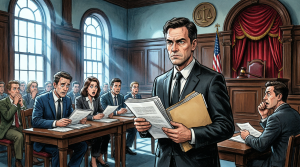
Matthew’s lawyer stood, pacing slowly in front of the judge like he owned the room.
“Your Honor,” he said smoothly, “we have extensive documentation showing that Mr. Hayes manipulated his grandmother in her final months. Emails, financial irregularities, and witness statements that clearly demonstrate a pattern of undue influence.”
He placed a thick stack of papers on the table.
“This,” he added, tapping it, “is just a portion of the evidence.”
Clare dabbed at her eyes with a tissue, perfectly timed.
Matthew leaned closer to me, his voice low and venomous.
“It’s over,” he whispered. “Nobody believes you.”
I didn’t respond.
I didn’t even look at him.
Because I knew something he didn’t.
The judge adjusted his glasses again, still watching me with that same unsettled expression.
“Mr. Hayes,” he said carefully, “do you have representation?”
“I do,” I replied.
And right on cue, the courtroom doors opened again.
A man stepped inside—tall, composed, carrying a leather briefcase and the kind of presence that shifts attention without asking for it.
A few people in the gallery murmured.
The judge went completely still.
“Is that—” someone whispered behind me.
My lawyer walked forward, set his briefcase on the table, and gave a slight nod.
“Your Honor,” he said calmly, “apologies for the delay. Traffic.”
The judge swallowed.
“I… wasn’t aware you were involved in this case.”
“I am now,” my lawyer replied.
Matthew frowned. “Who is that?”
His attorney didn’t answer.
Because he knew.
I finally turned to my family.
For the first time since I walked in, I let them really see me.
Not the quiet middle child.
Not the afterthought.
Not the mistake.
Just me.
“Before we go any further,” I said evenly, “I think it’s important we address the evidence my brother just presented.”
My lawyer opened the briefcase and removed a thin folder.
Not thick.
Not dramatic.
Just precise.
“Every single email in that stack,” I continued, “is fabricated.”
Matthew scoffed. “That’s a bold claim.”
“It’s an accurate one,” my lawyer said.
He slid a document across the table.
“Forensic analysis. Metadata breakdown. Server origin tracing.”
The judge leaned forward.
Matthew’s attorney picked up the document—and went quiet.
Clare’s tissue froze halfway to her face.
“What is this?” she whispered.
“This,” my lawyer said calmly, “is proof that those emails were generated using a private server… registered to an account under Mr. Matthew Hayes.”
The room shifted.
Not loudly.
But unmistakably.
Matthew’s confidence cracked.
“That’s ridiculous,” he snapped. “That’s—”
“Illegal,” my lawyer finished. “Fraud. Perjury. Evidence tampering.”
The judge’s voice cut through the air.
“Mr. Hayes,” he said sharply, looking at Matthew, “is this true?”
Matthew opened his mouth.
Nothing came out.
I leaned back slightly, finally allowing myself a breath.
This was the moment.
The one I had prepared for.
The one they never saw coming.
“Your Honor,” I said, calm and steady, “this case was never about my grandmother’s will.”
The judge looked at me.
“Then what is it about?”
I met his gaze.
“It’s about the fact that for years, my family assumed I was too insignificant to fight back.”
Silence filled the room.
Heavy.
Unavoidable.
“And they were wrong.”
Clare’s voice broke.
“Lucas… we can fix this.”
I looked at her.
Really looked at her.
For the first time, she didn’t look like the untouchable favorite.
She looked small.
“Fix what?” I asked quietly.
No one answered.
Because there was nothing left to fix.
The judge removed his glasses slowly, his expression no longer shocked—but certain.
“This court will take a brief recess,” he said. “And when we return, we will be addressing some very serious matters regarding the authenticity of the submitted evidence.”
The gavel struck.
People started talking.
Whispers. Gasps. Movement.
But at our table, everything was still.
Matthew stared at the documents like they might change if he blinked hard enough.
Clare’s hands trembled.
My father… said nothing.
For once in his life, he had no words.
And as I stood there, gathering my folder, I realized something I hadn’t expected.
This wasn’t about winning anymore.
It wasn’t about proving them wrong.
It was about something much simpler.
For the first time in my life…
They saw me.
And they finally understood—
I had never been invisible.
I had just been waiting for the right moment to step into the light.

