Part 1
McKenzie Davidson learned early that the world loved a simple story.
The loud kid. The tough kid. The born leader. The natural athlete. The legacy admission.
At the United States Naval Academy, people carried those stories around like dog tags. They read your name tape, measured your shoulders, checked the way you ran, and decided what you were worth before you ever opened your mouth. It made life efficient. It made judgment easy.
It also made underestimation a weapon, if you knew how to hold it.
On Induction Day, McKenzie stepped off the bus with a regulation haircut tucked into a tight bun, a stiff new uniform biting at her collarbone, and a face that looked like it belonged on a scholarship brochure. She wasn’t the tallest. She wasn’t the strongest. She wasn’t the kind of girl who walked like she owned the pavement. She moved like she didn’t want to take up space.
And that was exactly the point.
Around her, other plebes did their best impression of confidence, even as they swallowed panic. McKenzie watched them with a quiet kind of focus, the way her mother watched a room before she sat down. She didn’t scan for friends. She scanned for angles, exits, patterns. Voices that rose. Faces that turned away.
A petty officer barked instructions. An upperclassman rolled his eyes and muttered something about “another batch.” McKenzie kept her gaze forward and her expression blank.
Inside her chest, something steadier than fear kept time.
Her father used to call it the metronome.
When Master Sergeant James “Hammer” Davidson taught her to run, he didn’t talk about speed first. He talked about breath. Rhythm. Staying calm while your body begged you to quit. He built obstacle courses behind their base housing on Camp Lejeune like he was building a playground for war. She’d been six years old, knees scabbed, hair in messy braids, and he would crouch beside her at the start line with a grin that made him look younger than the hard years had a right to allow.
“Kenzie,” he’d said, like it was a secret, “everybody gets tired. Not everybody stays smart when they’re tired.”
Her mother, Lieutenant Colonel Sarah Davidson, taught her a different kind of endurance. Sarah spoke softly, asked sharp questions, and never raised her voice when she could lower it instead. In the kitchen, she’d teach McKenzie languages by turning dinner into a game. In the living room, she’d teach her how to spot a lie by watching the spaces between words.
“People think strength is loud,” Sarah told her once, sitting at the edge of McKenzie’s bed while the base was quiet and her father was deployed. “Real strength is decision. It’s discipline. It’s choosing your next move when you have every reason to react.”
McKenzie came to Annapolis with perfect test scores and a valedictorian speech still echoing in her ears. She came without a letter of recommendation bearing a famous name, without a varsity jacket, without the swagger that made other midshipmen slap backs and trade stories about their parents’ rank. She had those things. The name. The rank. The stories. She kept them locked away.
Hammer would have called it camouflage.
On the first week of plebe summer, it started with looks.
Not the normal looks. Not the quick assessments everyone got. These were heavier, sharper, and angled like knives. People noticed she was quiet. People noticed she struggled on runs. They noticed she finished near the back on the O-course, shoulders shaking on the rope climb, palms burning raw.
She could have done better.
She chose not to.
It wasn’t easy pretending to be weak when your muscles remembered something else. On the pull-up bar, she stopped at ten and dropped, even though she could have done forty on a good day. On timed runs, she held back just enough to look like she was fighting for her life. She let her face show strain. She let her lungs sound ragged.
At night, in her bunk, she stared at the underside of the rack above her and wondered if she was already crossing a line between strategy and self-sabotage.
But Hammer’s voice lived in her head as clean as a drill command.
A warrior who advertises is just an entertainer.
A warrior who waits is dangerous.
She didn’t come here to be celebrated for who her parents were. She came here to see what the place did to people who looked like easy targets. She came here to find out what character looked like under pressure, not just in speeches.
She got her answer fast.
It started small, the way rot always does.
A bump in formation that sent her shoulder jarring. A whispered “Watch it, Davidson,” with no apology. Extra gear mysteriously ending up in her pack during a field evolution. A study group that “forgot” to mention they’d moved rooms, leaving her wandering the hall with her notes while laughter leaked through a closed door.
The first time it happened, she blamed miscommunication.
The second time, she blamed the churn of plebe summer.
By the third, she stopped blaming anything except human nature.
There were other women in her company, and some of them were everything the guys respected: Division I athletes, broad-shouldered and loud, the kind who could crush a PT session and still talk trash with a grin. McKenzie admired them, but she wasn’t them. She didn’t want to be.
She wanted to be invisible.
What she didn’t expect was how much some people hated that.
By her second semester, the jokes had a pattern. They always circled back to her body. Her size. Her “frailty.” They joked that the Academy had admitted her to fill a quota, a cardboard cutout in uniform. They said she was too weak to stop anything, too soft to lead anyone, too small to matter.
Sometimes the words were said loud enough for her to hear. Sometimes they were said just under breath, meant to be felt rather than confronted. She let them happen. She filed them away like evidence.
It helped, in a bleak way, that she’d lost her father before she arrived.
Three months before Induction Day, a chaplain had stood in a living room filled with Marine uniforms and the smell of coffee nobody drank. He’d spoken about service, about sacrifice, about honor. McKenzie heard the words, but what she remembered most was her mother’s hand on her shoulder, steady as bedrock.
After the funeral, when the house finally emptied, Sarah led McKenzie to the backyard course Hammer had built. The ropes were still there. The sandbag still hung from the pull-up bar. The wood was sun-bleached. The place smelled like sweat and pine needles and memory.
Sarah looked at her daughter and said, “Your father prepared you. Not for his death. For the world after it.”
McKenzie had nodded, even though her throat hurt.
Now, at the Academy, she began to understand what Sarah meant.
People could smell grief and softness the way sharks smelled blood.
And they could be cruel about it.
By the time she was a third-year, the cruelty had become routine. Not constant. Not dramatic. Routine, like weather. Like a low-grade fever you stopped mentioning because nobody wanted to hear about it.
Then, a month before the mess hall incident, someone duct-taped her to a chair during dinner. They did it laughing, calling it a “team-building prank,” and everybody around them pretended it was funny.
McKenzie sat there, tape pulling at her uniform, wrists numb, jaw locked. She didn’t struggle. She didn’t plead. She simply looked at faces and memorized them.
When they finally cut her free, someone tossed a napkin at her and said, “Lighten up.”
She smiled, small and polite.
Inside, the metronome kept ticking.
Two weeks later, she opened her locker and found rotting fish packed into her folded shirts. The smell hit her like a punch. She stood there while other midshipmen gagged and laughed and walked away.
That night, she scrubbed her locker with bleach until her hands cracked. Alone.
No one stood up.
Not once.
And that, more than the duct tape, more than the fish, more than the jokes, started to harden something in her that had been holding out hope.
She wasn’t just being hazed by a few loud idiots.
She was being tested by an institution that had decided silence was safer than integrity.
McKenzie’s decision formed quietly, the way real decisions do.
If they wanted a strength test, she would give them one.
Not the kind they expected.
The kind that left a mark.
Part 2
The Academy sold a certain myth to the public.
Postcards of white buildings and sharp uniforms. Midshipmen in crisp formation. Sunlight glinting off the Severn River. The promise that everyone here was being shaped into something better.
McKenzie saw the truth in smaller places: in late-night hallways where people laughed at other people’s pain, in group chats where cruelty was a sport, in the way “tradition” could be a polite word for humiliation.
She didn’t hate the Academy. Not exactly.
She hated what it allowed.
The worst part was that some of the men who treated her like a punching bag could also quote honor statements with a straight face. They could talk about leadership and courage in class, then wink at their friends as they shoved her aside in the passageway.
She learned their names the way her mother had taught her to learn details: without emotion, without flinching, as if she were building a map.
Brett Carmichael was the center of it, even before he officially took that role.
He was big, easy-smiling, and built like he’d been drafted by a football team and rerouted into a uniform. People liked him because he was loud in the right ways and confident in the ways that made other men relax around him. He was the kind of guy who took up space and made everyone else feel like they belonged just by being near him.
McKenzie recognized something else.
He liked power. He liked the warm rush of a room’s attention. He liked the feeling of being obeyed.
Those were different things, and he didn’t understand the difference.
His shadow, Jackson Torres, was less charismatic but sharper. Torres watched everyone, always. He didn’t laugh as much. He didn’t need to. When he spoke, other guys listened because his approval felt rare. He was the one who turned Brett’s ideas into plans.
Then there was Mike Sullivan, the loud instigator. He wasn’t the strongest, and he wasn’t the smartest, but he was good at one thing: he could smell insecurity and use it like gasoline.
Sullivan made sure everyone knew McKenzie wasn’t invited. Not to study groups. Not to weekend plans. Not to the unspoken brotherhood that decided who counted.
McKenzie let it happen.
That choice came with a cost.
She lived in a constant state of vigilance, always measuring how much she could endure without snapping. She told herself it was research. Intelligence gathering. Identifying the real threat. Hammer would have approved.
Still, there were nights she lay awake listening to laughter down the hall and felt a pressure behind her eyes that had nothing to do with sleep deprivation.
On those nights, she thought about her father’s hands.
Hammer’s hands had been rough, scarred, and steady. He’d used them to build that backyard course, to tie knots, to patch her scraped knees, to carry her when she fell asleep in the car after long days at the range.
He’d used them in places he never talked about, too.
The day he left for his final deployment, he’d knelt in front of her by the front door. McKenzie had been seventeen, almost grown, angry at how calm he looked.
“You don’t have to be okay with this,” he’d told her.
“I’m not,” she’d snapped.
He’d smiled like she’d said something honest.
“Good. Don’t lie to yourself. But listen.” He tapped her sternum lightly, two knuckles on her chest. “In here, there’s a switch. Everybody has it. The moment comes when you either flip it, or the world flips it for you. When that moment comes, you choose what kind of dangerous you are.”
She’d swallowed hard. “What kind should I be?”
He’d looked at her like she was already an adult. “The kind that protects people. The kind that doesn’t need applause.”
Now, in Annapolis, McKenzie tested that promise against reality.
She saw people get bullied for being awkward, for being poor, for being different. She saw underclassmen take abuse because they thought that was the price of admission. She saw a few good people try to speak up, then get shut down with jokes and threats until they learned to stay quiet.
Silence became a culture.
And culture, she realized, was the real chain of command.
The “strength test” started as a rumor.
McKenzie heard about it in the hallway outside a classroom when Sullivan was talking too loudly, trying to impress a group of third-years.
“Davidson’s been skating,” he said. “She’s always last. She’s always whining. She thinks she can just… exist here.”
One of the guys snorted. “What’s your plan, Sully?”
Sullivan grinned. “Carmichael’s got an idea. A tradition. You know, like the old days.”
McKenzie kept walking, face calm, like she didn’t hear.
Her pulse didn’t change.
That was the thing about having been trained since childhood: adrenaline didn’t feel like panic. It felt like information.
That afternoon, Torres cornered her near the stairwell, just far enough from traffic that his friends could gather without looking obvious.
“Davidson,” he said, and his voice had that casual edge people used when they wanted you to know you were beneath them.
“Yes?” McKenzie answered, polite.
Torres tilted his head. “Dinner tonight. Be in the mess hall. Center floor.”
McKenzie blinked slowly. “Why?”
Sullivan laughed behind him. “Because we’re gonna see what you’re made of.”
McKenzie let a small, uncertain frown crease her forehead. She did the weak thing, the predictable thing.
“I have watch,” she said.
Torres shrugged. “You’ll make it work.”
McKenzie’s gaze flicked to the side, like she was looking for help. Like she hoped someone would step in.
Nobody did.
Not the midshipman who passed them and kept walking. Not the guy leaning against the wall who pretended he didn’t hear. Not the female cadet at the end of the hall who looked away and moved faster.
That was her answer again.
McKenzie nodded, as if resigning herself. “Okay.”
Torres smiled, satisfied. “Good girl.”
When they left, she stood alone for a moment, letting their footsteps fade.
Then she took out her phone and opened a note she kept hidden inside an innocuous file labeled Chemistry Lab.
It contained names and dates. Incidents and witnesses. Patterns.
She added a new line: Strength test. Mess hall. Carmichael.
She didn’t plan to report it yet.
Not because she was afraid.
Because she was done guessing.
If they wanted to show her what kind of place this was, she would let them.
And then she would show them what kind of woman she was.
At dinner, the mess hall looked normal until you stood still long enough to notice the tension.
Clusters of male cadets gathered in places they didn’t usually gather. A few phones were out, held low, screens glowing. Laughter came too quickly, the kind that was already anticipating something.
McKenzie took her tray and walked to the center, exactly as instructed. She didn’t hesitate. Hesitation fed predators.
She felt eyes on her from every angle.
Some were excited.
Some were uncomfortable.
A handful were curious in a way that felt almost guilty.
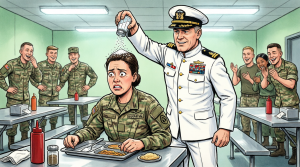
Brett Carmichael stepped forward carrying a plastic bottle, empty, the kind you got from the vending machine.
He held it up like a prop in a show. “Davidson,” he called. “You ready to prove you belong?”
McKenzie stood still, hands at her sides.
She let her shoulders slope slightly. Let her stance look uncertain. Let her face look tired.
Carmichael tossed the plastic bottle at her chest.
It hit with a dull thud and fell to the floor. Laughter erupted.
McKenzie didn’t flinch.
Another plastic bottle. Another laugh.
Then someone brought glass.
McKenzie knew the moment the room shifted, because even the air seemed to tighten. The sound changed, too. Plastic made harmless noises. Glass made a sharper, more serious sound when it clinked.
Carmichael’s grin widened when he lifted the first empty glass bottle.
“Now we’re getting real,” he said.
McKenzie looked at the bottle, then at his face.
She saw what he wanted: fear. Tears. A reaction that would prove he had power over her.
She gave him nothing.
The bottle hit her shoulder and shattered against the floor, sending shards skittering. The crowd cheered like it was a sporting event.
McKenzie’s skin stung where glass grazed. She felt the warmth of a shallow cut.
She stood still.
Inside her head, her father’s metronome ticked.
And she began counting.
Part 3
The first glass bottle didn’t explode against her skull.
It exploded against the floor at her feet, because Carmichael’s aim was sloppy and his confidence was built on the assumption that she’d dodge or cower. When she didn’t, the bottle struck low, shattered, and sent a spray of glass outward like confetti.
The second bottle hit her temple.
That one woke up the room in a different way.
There was a wet crack, sharp enough that even some of the cheering faltered, and McKenzie’s vision sparkled at the edges for half a second. Beer ran down her hairline, cold and sticky, slipping into her eyebrow. Laughter spiked again, louder, covering the moment of discomfort like people were trying to drown out their own conscience.
“Let’s see how tough you really are, Davidson!”
Someone shoved another bottle into Carmichael’s hand.
McKenzie stood in the center of it all like she was a post hammered into the deck of a ship. Her hands clenched and unclenched once, slowly.
She didn’t cry.
She didn’t scream.
She didn’t run.
That was what they couldn’t understand about her: she wasn’t enduring because she didn’t have options. She was enduring because she was collecting data.
She tracked the angles. The distances. The way Torres leaned forward each time, hungry for the next impact. The way Sullivan raised his phone higher, ensuring the video caught her face. The way the quiet ones stayed in the back, pretending their stillness was neutrality.
In her mind, names clicked into place with photographic clarity.
Brett Carmichael: ringleader. Four throws.
Jackson Torres: organizer. Three throws. Multiple incitements.
Mike Sullivan: videographer. Lead chanter. Social media distribution.
Seventeen active participants.
Twenty-three witnesses.
Zero interveners.
Her stomach rolled once, not from fear but from the realization that she was watching an entire system reveal itself in real time. This wasn’t boys being boys. This was a culture rehearsing cruelty and calling it tradition.
A senior officer walked through the mess hall doors at one point, drawn by the noise.
McKenzie saw him in her peripheral vision: khaki uniform, brisk stride, the authority that made some heads snap around. For half a heartbeat, hope flickered in the room, not because people wanted rescue, but because they feared consequences.
The officer’s eyes met Carmichael’s.
Then the officer kept walking.
McKenzie felt something inside her settle into place, cold and final.
It wasn’t just about her.
It never had been.
Carmichael grabbed another bottle, and this time it was full. The weight changed his posture. He rolled his shoulder like a pitcher warming up.
“Come on,” he said, loud enough that the room pressed in closer. “You wanted to be one of us, right? Prove women can handle it. Show us your strength.”
The crowd took the cue like a chant at a game.
“Do it! Do it! Do it!”
McKenzie tasted blood where she’d bitten the inside of her cheek without realizing it. Her ears rang softly, an internal alarm that she recognized from training: concussion risk climbing.
The smart move, the “normal” move, would have been to step away. Refuse. Report. Pull rank.
But she was past normal.
She was past hoping.
She was at the moment her father had described: the switch.
Carmichael lifted the bottle, aiming higher, meaner.
“Last chance to quit,” he said. “Ring out now, Davidson, or take it like—”
“Throw it.”
Her voice wasn’t loud.
It didn’t need to be.
It sliced through the chant like a blade through rope. The room’s noise died, not because people suddenly developed respect, but because they heard something they didn’t know how to label.
Calm. Cold. Controlled.
Carmichael blinked, thrown off script. “What?”
McKenzie raised her chin slightly. Beer dripped from her hair onto her collar. Glass crunched under her shoes.
“I said throw it,” she repeated. “Let’s see if your aim is as good as your mouth.”
A nervous laugh sputtered from someone in the back, then died when nobody joined in.
Carmichael’s face flushed red, the kind of red that came from being challenged in public.
“You think this is a joke?”
“I think you’re stalling,” McKenzie said.
He bristled, because he could feel the room’s attention shifting. His performance depended on her being afraid. Her calm was stealing his spotlight.
McKenzie tilted her head, just slightly. “Throw the bottle, Cadet Carmichael. Or are you scared?”
Masculine pride was predictable. Hammer used to say that, too, with the same dry tone he used when explaining why certain Marines picked fights they couldn’t win.
Carmichael snarled and hurled the bottle.
It cut through the air fast, full and heavy, aimed at her face with the kind of force that would have broken bones on impact.
McKenzie moved.
Not in a flashy way. Not with unnecessary motion. Just enough.
Her hand snapped up, precise and clean, and caught the bottle midair.
The room gasped like a single organism. A few people actually stepped back, because their brains finally caught up with what their eyes had seen: a full glass bottle, thrown hard, stopped as if gravity had paused.
McKenzie held the bottle for a moment, fingers steady around the slick glass.
Then she set it down gently on the nearest table, like she was placing a delicate instrument.
She looked at Carmichael.
In the sudden silence, her voice sounded almost conversational.
“That,” she said, “is assault with intent to cause bodily harm.”
Carmichael’s mouth opened. Nothing came out.
McKenzie’s gaze moved across the room, scanning faces like a camera.
“I count four other throws at similar velocity,” she continued. “That’s five separate incidents.”
Torres took a step forward, trying to reclaim control with sarcasm. “You can’t prove—”
“Six security cameras in this mess hall,” McKenzie said, cutting him off. “Plus at least twelve phones recording.”
Her eyes landed on Sullivan.
“Including yours,” she added. “You posted it to your Instagram story four minutes ago.”
Sullivan’s face drained. His hand flew to his pocket, fumbling for his phone like it might save him.
McKenzie didn’t raise her voice. She didn’t need to. She was the calm center of a storm that suddenly realized it had consequences.
“I also count seventeen participants,” she said, “and twenty-three witnesses who failed to intervene. This violates Academy hazing policy, the honor concept, and UCMJ Article 93: cruelty and maltreatment.”
Carmichael recovered enough to laugh, brittle and forced. “It was a tradition. A test. You’re overreacting.”
“A test?” McKenzie stepped forward, and the room seemed to shrink around her. Glass popped under her boot.
“You wanted to test me,” she said. “Okay.”
She stopped in front of him, close enough that he could see the steadiness in her eyes.
“Let’s test something real.”
Carmichael’s bravado wavered. “What are you talking about?”
McKenzie spoke as if she were reading from a checklist.
“Hand-to-hand,” she said. “Right now.”
A ripple of shock ran through the crowd. It was the kind of challenge that didn’t belong in their script. Women didn’t challenge men like this here. Not publicly. Not without permission. Not without consequences.
McKenzie held his gaze.
“You win,” she said, “I drop everything. No report. No charges. No board.”
Carmichael swallowed.
“And if I win,” McKenzie finished, “you face a conduct hearing, and so does everyone who touched a bottle.”
The room waited, holding its breath.
Carmichael looked around at his friends.
He couldn’t back down.
That was the trap, and McKenzie had set it with a calm smile.
“Fine,” he snapped. “But when I drop you, Davidson, you leave this Academy tonight.”
McKenzie nodded once.
“Deal.”
They squared up on the slick floor, beer and soda making the tiles shine under the fluorescent lights. Carmichael’s size dwarfed her. His shoulders were broad. His hands were thick.
People whispered like they were watching a live feed they couldn’t believe.
McKenzie felt her father’s metronome click into a faster rhythm, not from panic, but from readiness.
Carmichael swung first, a big looping punch that carried all his anger and none of his skill.
McKenzie didn’t flinch.
She stepped, turned, and the world changed direction around her.
Part 4
Carmichael hit the floor hard enough that the sound traveled through the mess hall like a warning shot.
It wasn’t the kind of fall you see in movies, where someone tumbles gracefully. It was sudden, ugly, and absolute, the body’s certainty replaced by gravity in a single blink. Air burst out of his lungs in a shocked grunt, and for half a second he lay there staring at the ceiling like it had betrayed him.
McKenzie stood over him, breathing steady.
The room didn’t cheer now.
It didn’t know what to do.
Carmichael scrambled up, face twisted with humiliation, and charged again. He came at her like he could bulldoze physics into giving him his dignity back.
McKenzie moved with the economy of someone who’d done this a thousand times in a backyard under a Marine’s watchful eye. She didn’t trade punches. She didn’t try to “win” the way people expected.
She made him miss, and made him pay for missing.
In a blur of controlled motion, Carmichael ended up on the floor again, this time with his arm trapped in a position that turned his strength into a liability. He hissed, pain cutting through his anger.
“Yield,” McKenzie said, voice even, “or you’ll lose the use of that shoulder for a month.”
His jaw clenched. He tried to twist out, realized he couldn’t, then spat the word like poison.
“I yield.”
McKenzie released him and stepped back, giving him space to stand without losing what little face he had left. She wasn’t interested in breaking him. She was interested in proving something.
Carmichael staggered up, clutching his arm.
Torres stepped forward, his own face red now, not with pity but with the panic of a plan going off the rails.
“That was luck,” Torres snapped. “Try me.”
McKenzie’s eyes slid to him like a spotlight.
“Both of you,” she said.
A sound went through the crowd, half laugh, half disbelief.
Torres hesitated, because this wasn’t his fantasy anymore. It wasn’t a safe little ritual of humiliating the weak. This was a fight, and the weak girl wasn’t playing weak.
But Carmichael was watching, and the room was watching, and Torres lived on being the guy who never backed down.
He nodded once.
They came at her together.
Most people in the mess hall expected chaos: two men overwhelming one smaller woman with brute force. They expected a quick end, a lesson about “reality,” a return to the familiar hierarchy.
Instead, they saw something colder.
McKenzie didn’t rush. She didn’t spin wildly. She let them commit to their momentum. She shifted, redirected, and let their aggression collide with each other’s angles. It was less like a brawl and more like watching someone solve a problem in real time.
Torres reached for her, and McKenzie moved so his grasp caught Carmichael’s sleeve instead. Carmichael swung, and McKenzie wasn’t there. Torres stumbled, overcompensated, and the second he tried to correct his balance, McKenzie stepped in and took it from him.
Both men ended up down.
Carmichael lay on his side clutching his ribs, stunned and furious. Torres sat back on the floor, cradling his elbow, the shock on his face louder than any scream.
McKenzie stood upright, barely winded, eyes scanning the room.
“Anyone else want to test my strength?” she asked.
Nobody moved.
Sullivan’s phone slipped from his fingers and clattered against the tile. The sound was absurdly loud in the silence.
Then the mess hall doors slammed open.
A voice cut through the stunned air like a command on a firing line.
“Attention on deck!”
Every cadet snapped upright, reflex taking over. Even Carmichael and Torres tried, grimacing as they pushed themselves up. McKenzie turned and saw a man in khakis storming across the floor, jaw tight, eyes sharp.
Captain Wade Harrison.
He was the kind of officer people whispered about. Former operator, rumored background in communities that didn’t advertise. The instructors joked that he could smell laziness through walls. Midshipmen treated him like weather: unavoidable and dangerous if you disrespected it.
McKenzie had seen him from a distance before.
Now he was close enough that she could see the lines at the corners of his eyes, the marks of someone who’d lived hard and paid attention.
His gaze swept the scene: broken glass, sticky beer, a few cadets holding injuries, dozens of faces frozen in guilt.
His eyes landed on McKenzie’s forehead, where blood had dried in a thin line through beer foam.
“Someone,” Harrison said, voice low and furious, “is going to explain what the hell happened in my mess hall.”
Carmichael stepped forward, desperation making him brave. “Sir, Davidson attacked us. We were just—”
“Quiet,” Harrison snapped, and Carmichael’s voice died like a switch had been flipped.
Harrison looked at McKenzie.
“Cadet Davidson,” he said. “Explain.”
McKenzie stood at attention, posture straight despite the ache pulsing behind her eyes.
“Sir,” she said evenly, “I was subjected to hazing by members of my company. Cadet Carmichael escalated to physical assault using glass bottles. I defended myself and offered a fair fight. He accepted.”
Harrison’s gaze sharpened. “Hazing.”
“Yes, sir.”
“How long?”
McKenzie’s jaw tightened, not with fear, but with the weight of the answer.
“Three years, sir.”
A murmur ran through the room, quickly swallowed by silence.
Harrison’s expression didn’t soften. If anything, it grew more controlled, more dangerous.
“And you didn’t report it.”
“No, sir.”
Harrison’s eyes didn’t leave hers. “Why not?”
McKenzie hesitated for half a heartbeat, then told the truth.
“I wanted to see who would stand up without me having to ask, sir.”
The room felt like it stopped breathing.
Harrison turned slowly, scanning the faces lined up in front of him.
“How many did?” he asked.
McKenzie’s voice stayed steady.
“Zero, sir.”
Harrison’s jaw tightened. He nodded once, like the answer confirmed something he’d hoped wasn’t true.
Then he walked straight to Carmichael.
“You threw bottles at another cadet’s head,” Harrison said.
Carmichael’s voice cracked. “Sir, it was just a tradition, we were just—”
Harrison leaned in slightly, and his voice dropped to something colder.
“Are you stupid,” he asked, “or just criminal?”
Carmichael went pale.
Harrison straightened and looked at the crowd.
“Anyone who participated,” he said, “you’re on report. Anyone who watched and did nothing, you’re on report. Conduct hearing Monday.”
A few cadets swallowed hard. A few looked like they might vomit.
Harrison’s eyes flicked to Sullivan. “You,” he said. “Give me your phone.”
Sullivan’s hands trembled as he picked it up.
Harrison didn’t even glance at the screen for long. He just looked at the posting time and the view count, then looked back up at the room.
“This,” he said, “is evidence.”
He turned back to Carmichael, Torres, and Sullivan.
“Medical bay. Now,” Harrison ordered. “Then pack your bags. You’re facing expulsion recommendations.”
Carmichael’s face collapsed. “Sir, please—”
Harrison’s gaze didn’t budge.
“You should have thought about your career,” he said, “before you tried to end someone else’s.”
The room scattered like a shaken hive, cadets moving fast, avoiding eye contact, trying to disappear into the architecture.
McKenzie remained at attention, blood drying on her skin.
Harrison watched her for a moment, longer than necessary.
Then his voice changed, almost imperceptibly, from fury to something like recognition.
“That technique,” he said quietly. “That wasn’t Academy training.”
“No, sir.”
Harrison’s eyes narrowed. “Where’d you learn it?”
McKenzie’s chest tightened.
“Sir,” she said, “my father taught me.”
Harrison blinked once. “Name.”
“Master Sergeant James Davidson,” McKenzie said. “Force Recon.”
Harrison’s face shifted, shock slicing through his hard control.
“Hammer Davidson,” he said, almost to himself.
McKenzie swallowed.
“Yes, sir.”
Harrison’s gaze held hers, and for the first time, McKenzie saw something behind the officer’s stern mask: memory.
Then Harrison exhaled, slow and heavy.
“I served with your father,” he said, voice softer now. “Fallujah. Two thousand six.”
McKenzie didn’t move, but her throat tightened again.
“He saved my life,” Harrison added.
The mess hall felt quieter than it ever had.
Harrison looked down at the broken glass, then back up at McKenzie’s face.
“These idiots,” he said, voice like steel wrapped in restraint, “hazed the daughter of the toughest Marine I’ve ever met.”
McKenzie held her posture.
Harrison’s eyes sharpened again, but now the edge was aimed outward, not at her.
“Davidson,” he said, “you’re coming with me.”
Part 5
The medical bay smelled like disinfectant and quiet humiliation.
McKenzie sat on the edge of an exam table while a corpsman cleaned the cut above her eyebrow and checked her pupils. The corpsman’s hands were careful, professional, and his eyes kept flicking to her face like he couldn’t reconcile the rumors already spreading with the woman in front of him.
“Any nausea?” he asked.
“No,” McKenzie replied.
“Headache?”
“Yes.”
He nodded, scribbling notes. “You’re probably concussed. I’m going to recommend you stay overnight for observation.”
McKenzie didn’t argue. She had nothing left to prove to a corpsman.
Captain Harrison waited outside the curtain, arms folded, posture rigid. Every time a passerby glanced at him, they looked away fast. He radiated consequence.
When the corpsman finished, Harrison stepped in and spoke quietly.
“You’re going to the Commandant’s office in the morning,” he told her. “Admiral Chen wants you there.”
McKenzie’s stomach tightened. Not fear. Just awareness. This was the part where the institution decided what story it wanted to tell about what happened.
“Yes, sir,” she said.
Harrison studied her face, then her posture.
“You’ve been letting them do this for three years,” he said, not as a question.
McKenzie held his gaze. “Yes, sir.”
“Why?” he pressed.
McKenzie’s voice stayed level. “Because I needed to know who I was serving with.”
Harrison’s jaw flexed. “You found out.”
“Yes, sir.”
For a moment, Harrison looked like he wanted to say something else. Then he nodded once and left.
McKenzie lay in the observation room that night, staring at the ceiling tiles as her headache pulsed in slow waves. Her phone was confiscated for evidence review, so she couldn’t distract herself with messages or noise.
In the quiet, the memory of the mess hall replayed with surgical clarity: the bottle leaving Carmichael’s hand, the weight of it in her grip, the room’s breath catching.
She didn’t regret what she did.
She regretted how long it had taken to do it.
Because in the seconds after Harrison’s arrival, she’d seen faces she’d never forget: the cadets who looked ashamed, the ones who looked angry at being caught, the ones who looked like they were already rewriting the story in their heads so they wouldn’t feel like cowards.
McKenzie knew that most of them would wake up tomorrow and tell themselves they were good people.
She knew the institution would want them to believe that, too.
In the morning, she walked into the Commandant’s office with dried blood still faintly stained at her hairline and her uniform freshly pressed. The headache was still there, a dull throb that made the light feel too bright.
Rear Admiral Patricia Chen sat behind a broad desk, her expression controlled. She wasn’t tall, but she had the kind of presence that didn’t need height. Her eyes were sharp, the kind that made people answer questions honestly by instinct.
Captain Harrison stood to the side, hands clasped behind his back.
Chen slid a folder across the desk toward McKenzie.
“Cadet Davidson,” she said, “we reviewed the footage.”
McKenzie didn’t touch the folder yet. “Yes, ma’am.”
Chen’s voice was calm, but it carried weight.
“Seventeen midshipmen are being charged with honor concept violations and hazing policy violations,” she said. “Carmichael, Torres, and Sullivan are being recommended for separation.”
McKenzie let the words land without reacting. She’d learned long ago that emotional displays could be used as leverage.
Chen watched her anyway, as if measuring what kind of leader sat in front of her.
“We also reviewed your file,” Chen continued. “In full. Your father was Master Sergeant James Davidson. Your mother is Lieutenant Colonel Sarah Davidson.”
McKenzie’s jaw tightened slightly. “Yes, ma’am.”
“And you deliberately underperformed,” Chen said, not accusing, simply stating. “You hid your capability.”
McKenzie inhaled once, controlled. “Yes, ma’am.”
Chen leaned back, folding her hands.
“Explain,” she said.
McKenzie met her gaze. “Ma’am, I wanted to see what the Academy really was. Not the polished version for tours. The real culture. What happens to people who look weak. Who gets protected, and who gets left alone.”
Chen’s expression didn’t change, but her eyes sharpened.
“And what did you find?” she asked.
McKenzie didn’t hesitate.
“I found that strength of character is rarer than physical strength,” she said. “I found that most people will watch injustice happen and do nothing. And I found that being underestimated is its own kind of power.”
Harrison’s gaze flicked to her, quick and unreadable.
Chen was quiet for a moment, then nodded slowly.
“You’re not wrong,” she said. “And that’s a leadership lesson most officers never learn.”
McKenzie’s heartbeat stayed steady. The metronome.
Chen opened the folder and pulled out a document.
“I’m assigning you as acting Company Honor Chair,” Chen said. “Effective immediately.”
McKenzie’s eyes widened, just slightly. “Ma’am?”
“You will work with Captain Harrison and the ethics office to investigate hazing patterns across your company,” Chen said. “And you will help design preventative measures. Your experience makes you uniquely qualified.”
McKenzie felt the weight of it instantly.
“With respect, ma’am,” she said carefully, “the company already hates me.”
Chen’s mouth twitched, almost a smile.
“Probably,” she agreed.
McKenzie held her posture. “This will make it worse.”
Chen’s gaze stayed steady.
“But you can handle it,” she said. “And if you can’t, then none of this means anything.”
McKenzie understood what Chen was doing. This wasn’t just a reward. It was a test of a different kind. A challenge to see if McKenzie would shrink when the battlefield changed from fists to politics.
McKenzie thought about her father’s words: choose what kind of dangerous you are.
“Yes, ma’am,” she said. “I can handle it.”
Chen nodded once, satisfied.
“Good,” she said. “Because the footage is already spreading.”
McKenzie’s stomach tightened again.
“Someone saved it before we confiscated phones,” Chen continued. “It hit social media last night. It’s being reposted. Commentators are already taking sides.”
McKenzie understood that, too. Institutions hated being embarrassed. People would try to make her the problem because it was easier than admitting the culture was rotten.
Chen leaned forward slightly.
“You are not to retaliate,” Chen said. “You are not to escalate. You will document. You will investigate. You will act within the system.”
McKenzie nodded. “Yes, ma’am.”
Captain Harrison finally spoke, voice low.
“Davidson,” he said, “you did something last night most people don’t do in their whole careers.”
McKenzie looked at him.
“You didn’t just survive,” Harrison said. “You forced the truth into the light.”
McKenzie didn’t smile.
“Truth doesn’t always change things,” she said quietly.
Harrison held her gaze. “It can,” he replied. “If the right people refuse to let it die.”
McKenzie left the office and stepped into the bright Annapolis morning feeling like the ground beneath her had shifted. Cadets passed her in the hallways. Some nodded, quickly, respectful. Some glared like she’d betrayed them. Some looked away, guilty.
The air around her felt different now.
She wasn’t invisible anymore.
And that meant she would need allies.
She found them in an unexpected place: three female underclassmen who approached her near the library, eyes nervous, voices low.
“Ma’am,” one of them said, then corrected herself quickly, “I mean… Davidson.”
McKenzie waited.
The girl swallowed. “Can you teach us?” she asked. “Not like… fighting for a show. Just… how to not feel helpless.”
McKenzie’s chest tightened. She thought about duct tape. Rotten fish. Silence.
She thought about the mess hall, the bottles, the way nobody moved.
Then she thought about what kind of dangerous her father had wanted her to be.
“Yes,” McKenzie said.
The girl’s eyes widened. “Really?”
McKenzie nodded once. “Really.”
That week, she started an unofficial class in a quiet corner of the gym at odd hours. No flyers. No announcements. Just word of mouth.
Twelve women showed up the first time.
Twenty-six showed up the next.
McKenzie didn’t teach them to be bullies. She taught them to stand. To breathe. To set boundaries with their posture before they ever had to set them with their hands.
And every time she watched a new cadet straighten their shoulders, something inside her eased.
She couldn’t change everything at once.
But she could make sure nobody stood alone again.
Not on her watch.
Part 6
The backlash arrived the way storms do: first as a shift in pressure, then as thunder.
McKenzie’s name became shorthand in conversations that stopped when she entered a room. People didn’t argue about what happened. The video did that for them. Instead, they argued about what it meant.
Some called her brave. Some called her manipulative. Some said she should have reported sooner. Some said she should have taken the hits and kept quiet, because that’s what “team players” did.
A few, louder than the rest, called her a traitor.
McKenzie learned quickly that exposing rot didn’t make you popular. It made you dangerous in a way people resented.
She kept her face neutral and her voice steady, the way her mother had taught her to handle rooms full of people who wanted you to flinch. She went to classes. She did her duties. She ran her unofficial training sessions with a calm focus.
And she documented everything.
As Honor Chair, she sat in meetings with cadets who suddenly claimed they’d had no idea hazing was happening, even as their faces appeared in the background of videos, smiling. She listened to excuses dressed as traditions. She watched people try to rewrite events in real time.
McKenzie didn’t argue.
She asked questions.
Who started it?
Who participated?
Who recorded?
Who left?
Who walked in and walked out?
That last question haunted her more than the rest.
Because the deeper she looked, the more she realized the mess hall incident wasn’t an anomaly. It was a symptom.
Harrison worked with her quietly. He didn’t hover, but he made sure doors opened when they tried to close. He also did something else: he watched her like he was checking for fractures.
One afternoon, weeks after the incident, he stopped her outside a classroom.
“You’re carrying this,” he said.
McKenzie didn’t pretend not to understand. “Yes, sir.”
Harrison’s gaze was sharp. “You don’t have to carry it alone.”
McKenzie’s mouth tightened. “Nobody else did before.”
Harrison’s voice softened, almost imperceptibly. “I’m here now.”
McKenzie wanted to believe him. She didn’t let herself.
Instead, she nodded once and kept moving.
The unofficial self-defense program grew fast, partly because women wanted skills and partly because the idea of it felt like defiance. McKenzie kept it grounded. She taught control. De-escalation. Awareness. The kind of readiness that didn’t require you to look for a fight.
And she made one rule clear from day one.
“This isn’t to win arguments,” she told them. “This is to survive people who don’t respect your no.”
The women listened with the kind of fierce attention that came from having been dismissed.
McKenzie saw herself in them, and it both hurt and steadied her.
Then the threats started.
Not dramatic threats. Not movie threats. The kind people thought they could get away with.
A note slipped under her door: You got lucky. Won’t happen again.
A rumor spread that she’d been “trained by special forces” and therefore “shouldn’t count” as a normal woman, as if that made the bottles acceptable.
A fake account popped up online reposting the video with edited captions that painted Carmichael as the victim.
McKenzie took each incident and added it to her file.
Then she did what her mother had always taught her to do when someone tried to control the narrative: she followed the pattern.
The fake account’s posting times lined up with watch schedules.
The language in the captions matched phrases she’d heard in the hall.
The account’s creation date matched a specific weekend when a group of midshipmen had been restricted to campus.
She cross-referenced everything quietly, and when she was sure, she walked into Harrison’s office and placed a sheet of paper on his desk.
Harrison glanced down, then up. “What is this?”
“Names,” McKenzie said. “The ones running the smear campaign. They’re not the same ones who threw bottles. They’re smarter. They’re trying to protect the culture by making me the problem.”
Harrison’s eyes tightened. “How do you know?”
McKenzie tapped the paper lightly. “Because they’re sloppy. And because I’ve been paying attention for three years.”
Harrison held her gaze for a moment.
“You ever think about intelligence?” he asked.
McKenzie didn’t react. “I have.”
Harrison nodded slowly. “You’ve got the mindset.”
McKenzie’s voice stayed level. “I have the scars, too.”
Harrison’s expression shifted, guilt and anger mixing. “Yeah,” he said quietly. “You do.”
The Academy’s formal response came faster than McKenzie expected, not because it wanted to, but because the public pressure was building. The video had reached alumni groups. Parents. Media outlets hungry for scandal.
Rear Admiral Chen ordered a culture review.
Panels formed. Surveys circulated. New reporting channels were announced.
Some people celebrated.
Others rolled their eyes and called it performative.
McKenzie stayed focused on what mattered: making sure the women in her program didn’t have to gamble their safety on whether someone felt brave that day.
On a Sunday evening, she finally got her phone back. The evidence had been copied. The case was moving forward.
Her notifications were a mess of messages: some supportive, some furious, some from people she barely knew telling her she’d “ruined things.”
One message stood out because it didn’t have drama in it.
It was from her mother.
Proud of you. Call me when you can breathe.
McKenzie stared at it for a long moment before the tightness in her chest loosened.
She called.
Sarah picked up on the second ring.
“You okay?” Sarah asked immediately.
McKenzie exhaled, and it came out shaky despite her best efforts. “I don’t know.”
Sarah was quiet for a beat. “That means you’re honest,” she said. “Tell me what happened.”
McKenzie told her, not as a viral clip, but as it had felt: the weight of glass, the laughter, the silence, the moment her calm turned into a knife.
When she finished, there was a long pause.
Then Sarah spoke softly.
“Your father would have hated that you got hurt,” she said. “But he would have been proud of why you waited.”
McKenzie’s throat tightened. “I miss him.”
“I know,” Sarah said. “But listen to me, Kenzie. You did the right thing. Not because you fought. Because you showed everyone what they were willing to allow.”
McKenzie swallowed. “And what if it doesn’t change?”
Sarah’s voice sharpened, just slightly. “Then you change what you can,” she said. “One person, one policy, one moment at a time.”
McKenzie stared at the window, at the dark Academy grounds beyond it.
“And what if they come for me harder?” she asked.
Sarah’s answer came without hesitation.
“Let them,” she said. “You are not alone. And you are not weak. They just built their courage on the assumption you’d stay quiet.”
McKenzie felt something settle again, not cold this time, but steady.
When the call ended, she opened a file on her laptop and began drafting a proposal to formalize the self-defense program. Not as a club. Not as a secret. As an institution-supported requirement.
She knew people would fight it.
She knew some would call it divisive.
But she also knew something else now.
Power hated sunlight.
And she had become very good at turning on the lights.
Part 7
By spring, the Academy felt like it was holding two realities at once.
In one reality, everything was normal. Classes continued. Sports games drew crowds. Midshipmen marched in formation under bright skies, shining shoes and sharp salutes.
In the other reality, people spoke carefully in hallways. Cadets checked doors before admitting what they’d seen. Some upperclassmen moved like they were afraid of being recorded at any moment, because now they understood what McKenzie had understood for years: evidence was a weapon.
Carmichael’s conduct hearing was closed to most of the Brigade, but the outcome spread anyway, whispered and confirmed and repeated until it became fact.
He was gone.
Torres and Sullivan didn’t disappear as cleanly. Their families had money. Influence. Lawyers. Their case dragged into appeals and procedural battles.
McKenzie watched the system try to protect itself, and she didn’t let the fatigue show.
She made herself a rule: never let anger steer the ship. Anger burned fuel. It didn’t chart courses.
Instead, she did what she always did.
She prepared.
Her proposal for the self-defense program went through five revisions. She gathered testimonials from women who’d been targeted. She collected data on reporting rates. She framed it in the language institutions respected: readiness, resilience, risk mitigation.
Captain Harrison helped, quietly. He didn’t slap his name on it. He didn’t make it about himself. He just made sure the right people read it before they could dismiss it.
Rear Admiral Chen didn’t smile when she approved the pilot program, but her eyes held something like satisfaction.
“Make it work,” Chen told McKenzie. “Make it undeniable.”
McKenzie did.
By the time graduation season approached, her program was no longer unofficial. It was part of training blocks. It had instructors. It had oversight. It had a curriculum McKenzie designed with a relentless focus on practicality and dignity.
She watched first-years learn how to plant their feet and use their voice. She watched women who used to speak softly begin to speak clearly. She watched male cadets attend mixed sessions and, for some of them, experience a quiet shock: competence didn’t look the way they expected.
McKenzie didn’t care about shocking them.
She cared about changing what happened when someone tried to break a person in public.
The culture review produced new policies, too: clearer reporting channels, anonymous options that actually stayed anonymous, accountability for witnesses who chose silence. People complained, of course. They called it overcorrection. They called it weakness.
McKenzie listened and kept working.
Because she knew what real weakness looked like.
It looked like a room full of future officers laughing while glass broke against someone’s head.
As graduation neared, the attention on her didn’t fade. If anything, it sharpened into something stranger: respect braided with fear. Some midshipmen treated her like a symbol. Some treated her like a threat. Some treated her like a rumor that could ruin your career if you crossed it.
McKenzie didn’t seek any of it.
She sought competence. She sought a commission earned the hard way.
And she kept one private ritual.
On nights when the pressure felt too heavy, she walked to the memorial wall and traced the engraved names with her fingertips until she found the one she always found.
James “Hammer” Davidson.
She didn’t speak out loud. She didn’t perform grief.
She just stood there and let the metronome in her chest slow down.
One evening near the end of her final year, Captain Harrison joined her at the wall. He didn’t announce himself. He just stopped beside her, silent.
After a moment, Harrison cleared his throat quietly.
“He used to tell the worst jokes,” Harrison said.
McKenzie’s mouth twitched. “He did.”
Harrison’s gaze stayed on the wall. “We were pinned down behind a burned-out car,” he said. “Rounds cracking. Dust everywhere. And your dad looks at me and says, ‘Harrison, when this is over, I’m switching branches. Navy’s got better hotels.’”
McKenzie let out a small laugh that surprised her.
Harrison glanced at her, and something softened.
“He’d be proud of you,” Harrison said.
McKenzie’s smile faded into something more honest.
“I keep wondering if I did it right,” she admitted quietly. “If I waited too long.”
Harrison was quiet for a moment. Then he said, “You did what you thought you needed to do to see the truth.”
McKenzie’s eyes stayed on her father’s name. “And the truth was uglier than I thought.”
Harrison nodded once. “Yeah.”
McKenzie exhaled slowly. “What if it happens again after I leave?”
Harrison’s gaze sharpened, but this time it wasn’t anger. It was resolve.
“Then we make sure it doesn’t,” he said.
McKenzie looked at him. “How?”
Harrison’s voice was steady. “By raising officers who don’t confuse cruelty with toughness,” he said. “By punishing the ones who do. By refusing to let silence be the default.”
McKenzie felt the weight of that, and the strange comfort in it.
She’d spent years thinking nobody would stand up unless forced.
Maybe that wasn’t completely true.
Maybe some people just needed the first person to break the pattern.
Graduation arrived with bright sunlight and polished shoes. McKenzie stood in line with her class, uniform immaculate, bearing steady. Her mother sat in the stands, posture straight, eyes proud but controlled.
When McKenzie received her diploma, the applause felt distant, like noise in another room. The commission oath, though, landed in her chest with real weight.
This was the part that mattered.
Not the video.
Not the rumors.
The oath.
After the ceremony, Sarah pulled her into a hug that was tight and brief, as if they both understood that long emotional displays weren’t their family’s style.
“You did it,” Sarah said simply.
McKenzie swallowed. “I did.”
Sarah leaned back and studied her daughter’s face. “You look like him,” she said softly.
McKenzie’s chest tightened again. “I know.”
Sarah reached into her bag and handed McKenzie a small envelope, sealed, the paper worn at the edges like it had been carried for a long time.
McKenzie frowned. “What is this?”
Sarah’s eyes held something unreadable.
“It’s from your father,” she said.
McKenzie’s breath caught. “That’s impossible.”
Sarah’s voice stayed calm. “He wrote it before he left,” she said. “He told me to give it to you when you earned your commission. Not before.”
McKenzie stared at the envelope like it might explode.
Her fingers trembled slightly as she took it.
On the front, in familiar handwriting, was her nickname.
Kenzie.
McKenzie swallowed hard. “Why didn’t you give it to me sooner?”
Sarah’s answer was quiet.
“Because you weren’t ready,” she said. “And he knew you’d need it when you stepped into the bigger world.”
McKenzie held the envelope like it was something fragile and dangerous.
She didn’t open it yet.
Not there, in the middle of applause and photos and strangers.
She waited until night, until she was alone, sitting on the edge of her bed with the Academy lights glowing outside the window.
Then she broke the seal.
And her father’s voice, in ink, met her like a hand on her sternum, right where the switch lived….To be continued in C0mments 👇

