My name is Diana Meyers. I’m twenty-eight years old, and fifteen years ago my own parents threw me out of the house when I was just thirteen. Last week, they showed up at my uncle Harold’s will reading—the man who had raised me for the past fifteen years—with confident smiles and a private attorney, absolutely certain they’d walk out with millions. But when attorney Margaret Morrison opened that sealed envelope and began reading, those smiles vanished. And when she reached Clause Seven, my mother—the woman who had once declared that I was no longer her daughter—shot to her feet, her face chalk-white, her mouth hanging open in disbelief. Before I tell you what happened next, if you enjoy stories about justice and family boundaries, take a second to like and subscribe, but only if you genuinely connect with this story. Where are you watching from right now? And what time is it there? Drop a comment and let me know. To understand why my mother reacted that way, I need to take you back to the summer of 2010, when I was a thirteen-year-old girl who believed she was the root cause of every problem in her family. Growing up in a modest house in Southeast Portland, I learned early that love in our family wasn’t distributed equally. My father, Richard Meyers, worked as an auto mechanic at a shop downtown. He was a man of few words, and most of those words agreed with whatever my mother said. My mother, Sandra, worked the checkout line at a grocery store and ran our household with the precision of someone who always knew exactly who deserved what. My sister Tiffany was two years older than me. She had Mom’s golden-blonde hair, Mom’s bright blue eyes, Mom’s easy laugh. Everyone said so. Tiffany looks just like you did at her age, Sandra. And Mom would beam. I looked like our late grandmother—Dad’s mother. Brown hair, brown eyes, a quiet disposition. Mom never said that was a bad thing. She just never said much about me at all. The differences showed up everywhere. For Tiffany’s fifteenth birthday, Mom threw a party with fifteen guests, a three-tier cake from the bakery on Hawthorne, and a karaoke machine rental. For my thirteenth birthday, three months later, it was the four of us around the kitchen table with a marked-down cake from the grocery store where Mom worked. The frosting said Happy Birthday with no name, a generic leftover from someone else’s canceled order. I didn’t realize what was happening until I was twelve. That was when I discovered Tiffany had a college savings account that had been opened when she was five years old. Eight years of deposits. Thousands of dollars. I asked Mom why I didn’t have one. She looked at me like the question surprised her.
“Tiffany needs money for college,” she said. “You’ll figure something out. You’re good at adapting.”
That was the first time I understood my place in this family. I was the spare child, kept around but never truly wanted. The summer of 2010 changed everything. In April of that year, I applied for the Oregon STEM Summer Academy at Oregon State University. It was a six-week residential program for students who showed exceptional promise in science and mathematics. The scholarship covered everything—tuition, room and board, materials. Total value: $4,200. I didn’t tell anyone I had applied. I’d learned not to get my hopes up out loud in that house. On May 15, the acceptance letter arrived. Out of more than two thousand applicants from across Oregon, fifty students had been selected. I was one of them. For exactly one afternoon, I felt like I mattered. Then Tiffany found out about a performing arts camp in California that her drama teacher had mentioned. Three weeks. No scholarship. Price tag: $3,800. That night at dinner, Mom announced the solution she had already worked out in her head. Diana, you’ll decline that science thing. We can’t afford to send both of you to summer programs, and Tiffany’s camp will help her college applications. She said it like she was discussing meal planning, not crushing someone’s dreams. I stared at my plate. The words came out before I could stop them.
“No.”
The whole table went silent. Even the refrigerator seemed to stop humming.
“Excuse me?”
Mom’s voice dropped to that dangerous register I had heard her use on store customers who tried to use expired coupons.
“This scholarship isn’t your money to redirect,” I said, my voice shaking but clear. “I earned this. It’s mine.”
Mom looked at me as if I had transformed into a stranger right in front of her eyes.
“If you can’t sacrifice for this family,” she said slowly, “then you’re not part of this family.”
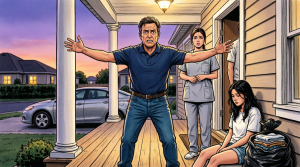
At thirteen, I thought she was just angry. I didn’t realize she meant it literally. Three days after that dinner, I came home from the public library to find my belongings packed into two black garbage bags sitting on the front porch. My mother stood in the doorway, arms crossed. She didn’t look angry anymore. She looked resolved, like someone who had just finished an unpleasant chore.
“I called Harold,” she said. “He’ll be here to pick you up. From now on, you’re his problem.”
I stood there on the porch I had known my entire life, trying to process what was happening. Behind Mom, I could see Dad in the hallway. He didn’t look at me. He didn’t say anything. I glanced up at the second-floor window. Tiffany was watching from behind the curtain. When our eyes met, she stepped back into the shadows of her room. She didn’t come down. I waited on that porch from six in the evening until ten at night. Four hours. My mother went back inside after the first five minutes. The porch light never came on. Uncle Harold lived in Seattle, three hours away. He drove through the night to get to me. When his gray Honda pulled into the driveway, I was still sitting on those garbage bags, my knees pulled to my chest. He got out without saying anything at first, just walked up, looked at me, and wrapped me in a hug so tight I couldn’t breathe.
“From now on,” he said quietly, “you have a home.”
That night, as we drove north through the darkness toward Seattle, I didn’t know that my mother had signed a document before Uncle Harold left. I didn’t know what it meant. I was just a scared kid staring out the window, wondering what I had done wrong. It would take fifteen years for that document to resurface. And when it did, it would change everything. Uncle Harold’s house in Seattle’s Ballard neighborhood wasn’t large, but it felt enormous compared with the cramped space I had occupied in my family’s home. For the first time in my life, I had a room that was entirely mine. More importantly, I had someone who believed in me. Uncle Harold had built Meyers Property Holdings from scratch, a commercial real estate company he’d started with a single small office building he’d purchased after working double shifts for six years. By 2010, he owned eight properties across the Seattle metro area. He never married, never had children. When I arrived on his doorstep with nothing but two garbage bags, he didn’t just take me in. He invested in me. Over the next four years, I poured myself into school. I graduated from Ballard High in 2014 as class valedictorian, president of the math club, with a 4.0 unweighted GPA. The University of Washington offered me admission with a partial scholarship to its Foster School of Business. By 2018, I had my bachelor’s degree in finance, graduating summa cum laude with a 3.94 GPA. Uncle Harold had given me internship opportunities at Meyers Property Holdings starting my sophomore year. I learned the business from the ground up—data entry, lease analysis, tenant relations, property assessments. In 2019, after eighteen months at a Big Four–style accounting firm called Mitchell & Partners, I earned my CPA certification. One year later, Uncle Harold offered me a position as controller. By 2021, I was CFO. On my twenty-sixth birthday, I managed a portfolio of twelve commercial properties with a combined value of $23.7 million. Uncle Harold sent me an email that day. I still have it saved. The subject line read: To My Daughter. The message was simple. You don’t need to prove anything to the people who abandoned you, but you do need to prove to yourself that you’re worthy. You have. Happy birthday, Diana.
In fifteen years, my biological family reached out exactly three times. The first was in 2012. My mother called Uncle Harold’s phone, not mine, to ask for $5,000. Dad had lost his job at the auto shop. Times were hard. Surely Harold could help his own brother. Uncle Harold declined. He told me about the call afterward, his jaw tight.
“They haven’t asked about you once,” he said. “Not how you’re doing in school, not if you’re okay. They just want money.”
The second contact came in 2016. Tiffany mailed me a wedding invitation. No personal note. No I hope you’re well. Just the formal printed card with my name and Uncle Harold’s Seattle address. I didn’t attend. I didn’t send a gift. I didn’t respond at all. The third was in 2020. My mother sent me an email, the first direct contact she had initiated since throwing me out. The subject line was Checking In. The message mentioned that she had seen an article in the Seattle Business Journal about Meyers Property Holdings expanding into the Eastside market. She hoped I was doing well and suggested we should catch up sometime. I deleted the email without responding. I wasn’t holding grudges. I had simply built a life that didn’t include them, and I saw no reason to change that. In the summer of 2024, Uncle Harold received a diagnosis that changed everything: advanced-stage congestive heart failure. The doctors gave him twelve to eighteen months. He lasted eight. During those final months, Uncle Harold met with his estate attorney multiple times. He updated his will in June 2024, six months before he passed. When I asked him about it, he just smiled.
“Everything’s taken care of,” he said. “You focus on the business. I’ve handled the rest.”
I didn’t know what he had written. I didn’t know about the clauses. I trusted him completely. I had no idea what was coming. Uncle Harold passed away on February 28, 2025. He went peacefully in his sleep at Swedish Medical Center with me holding his hand. One week later, on March 7, I was in my office at Meyers Property Holdings when my phone buzzed with an unknown Portland number. I almost didn’t answer.
“Diana.”
The voice was immediately recognizable. Fifteen years hadn’t changed my mother’s particular way of saying my name, as if she were tasting something she wasn’t sure she wanted to swallow.
“Sandra.”
I kept my voice neutral. Not Mom. Just her name. A brief pause. I could almost hear her recalibrating.
“I heard about Harold,” she said. “I’m so sorry for your loss. I was thinking I should come up for the memorial service. Pay my respects.”
“The memorial was three days ago.”
Another pause.
“Oh. Well, I also heard there’s a will reading coming up. Family has a right to attend these things, you know, especially when it involves a brother’s estate.”
There it was. The real reason for the call.
“How did you find out about the will reading?”
“I have an attorney, Victor Harrington. He made some calls.”
The name sparked a faint memory. Uncle Harold had mentioned a Victor Harrington once—an attorney he had consulted years ago and decided not to work with. I spoke to Margaret Morrison, Uncle Harold’s estate attorney, the next morning. She confirmed my suspicions. Sandra had hired Victor Harrington to file a claim challenging the will. Their grounds: undue influence, alleging that I had manipulated a sick man in his final months. They were also demanding to attend the will reading as immediate family members of the deceased. I stared at the photo of Uncle Harold on my desk. In the picture, he was smiling, almost like he had known this would happen, almost like he had planned for it. Margaret Morrison’s office occupied the forty-seventh floor of Columbia Center, Seattle’s tallest building. Through the floor-to-ceiling windows, you could see all the way to Mount Rainier on a clear day. March 10 wasn’t clear. Rain streaked the glass as Margaret laid out the situation.
“Victor Harrington filed a formal challenge to the will on behalf of Richard and Sandra Meyers,” she said, sliding a document across her desk. “The claim alleges undue influence. They’re arguing that you isolated Harold from his family during his illness and pressured him to change his estate plan.”
I read through the filing, my stomach tightening with each paragraph.
“They’re demanding fifty percent of the estate,” Margaret continued. “Their legal theory is that, as Harold’s only surviving sibling, Richard should be entitled to inherit under intestacy rules or at minimum receive a significant share that reflects the natural bonds of brotherhood.”
“Natural bonds?” I repeated. “Richard and Harold hadn’t spoken in eight years before I came to live with Uncle Harold. Did you know that?”
Margaret nodded.
“I’m aware. Harold told me the whole history. But that’s not what concerns me about this filing.”
She pulled another page from her folder.
“They don’t need to win this case. If this goes to litigation, the estate could be frozen for twelve to eighteen months during discovery and trial. Meanwhile, the properties need management. Tenants need attention. Bills need to be paid. A protracted legal battle could cost hundreds of thousands in legal fees and potentially devalue the entire portfolio.”
“So they’re betting I’ll pay them off to make them go away.”
“That’s the strategy,” Margaret agreed. “It’s not unusual in estate disputes.”
I looked down at the challenge filing. In the section describing our family history, Sandra had written that I had abandoned my family and exploited Harold’s loneliness. The woman who had thrown me out was claiming I had abandoned her.
“Do you have any documentation about your circumstances in 2010?” Margaret asked. “Anything that establishes what actually happened when you went to live with Harold?”
I thought back to that night on the porch, the garbage bags, the four-hour wait, Uncle Harold arriving in the darkness.
“I was thirteen,” I said. “I didn’t exactly keep records.”
“Harold did.”
Margaret was already reaching for her phone. She dialed her assistant and asked for a specific file number from the archives. Twenty minutes later, her assistant returned with a yellowed folder. Margaret opened it carefully, scanning the contents. Then she looked up at me with an expression I couldn’t quite read.
“Diana, did you know about this?”
She slid the document across the desk. The header read: Voluntary Relinquishment of Parental Rights and Transfer of Guardianship, dated July 15, 2010. The document stated that Richard James Meyers and Sandra Ellen Meyers, being of sound mind, voluntarily relinquished all parental rights and responsibilities for their minor daughter, Diana Marie Meyers, and transferred full legal guardianship to Harold Raymond Meyers. At the bottom were four signatures: my mother’s, my father’s, Uncle Harold’s, and a notary public from King County, Washington. File number 2010 GH5847.
“They didn’t just kick you out,” Margaret said quietly. “They legally gave you up. They signed away their parental rights. As far as the law is concerned, Sandra and Richard Meyers stopped being your parents the moment they signed this document.”
My hands were trembling. I had been thirteen years old, sitting on a porch in the dark. I had no idea my mother had been signing papers inside the house.
“What does this mean for their claim?”
Margaret’s expression shifted.
“It means Richard has no standing to claim inheritance through familial relationship. Legally, he’s not your parent. He severed that connection himself in writing, with witnesses, fifteen years ago.”
Margaret offered me two paths forward.
“Option one, we negotiate,” she said. “I reach out to Harrington, explain that their legal position is weaker than they realize, and offer a settlement—five hundred thousand to one million dollars—in exchange for them withdrawing their challenge and signing a waiver of any future claims. It’s faster, cleaner, and avoids any public spectacle.”
“And option two?”
“We proceed with the will reading as scheduled. They’ve demanded to attend as family members. We let them. Then we present the evidence—the guardianship transfer document, the full history, everything Harold wanted disclosed in the event of a challenge.”
She paused.
“Harold anticipated this, Diana. He left specific instructions for how to handle exactly this scenario. He wanted the truth on the record.”
I went home that night and couldn’t sleep. I sat in the living room of the house Uncle Harold had left me, staring at the family photos on the mantel. There were pictures of me at every stage—high school graduation, college commencement, the day I got my CPA license, my first day as CFO. In every photo, Uncle Harold was beaming beside me. There were no photos of Richard or Sandra. Not one. I thought about Uncle Harold’s words from that email years ago: You don’t owe them anything, but you owe yourself the truth. At seven the next morning, I called Margaret.
“I want the will reading to proceed,” I said. “No settlement. No buyout. If they want to be present for this, let them. But we’re not hiding anything.”
“Are you sure? Once this becomes public—”
“They chose to make this public when they filed their challenge. I’m just respecting their choice.”
The will reading was scheduled for Friday, March 14, 2025, at 2:00 p.m. in the Morrison & Associates conference room, five days away. The next few days were a blur of preparation. My best friend, Elena Torres—we had met when she joined Meyers Property Holdings as HR director three years earlier—helped me organize the documentation. She was the only person besides Margaret who knew the full story of my childhood.
“Forty-seven emails,” Elena said, looking up from her laptop in my office on Wednesday evening. “Forty-seven emails from Harold to you over ten years documenting his relationship with you and his reasons for estranging himself from Richard.”
The emails painted a clear picture. In 2002, Richard had borrowed $80,000 from Harold with a promise to repay it within five years. Twenty-three years later, not a single dollar had been returned. That broken promise had fractured their relationship. My arrival in 2010 had nothing to do with their estrangement. It had already been festering for eight years. Elena also pulled the financial reports from my three years as CFO. Under my leadership, the Meyers Property Holdings portfolio had grown from $17.7 million to $23.7 million, a thirty-four percent increase in value. Occupancy rates averaged ninety-six percent. Tenant satisfaction scores were the highest in the company’s history. On Thursday evening, I met with Dr. Lauren Hayes, the therapist I had been seeing since my early twenties.
“Remember why you’re doing this,” she said. “You’re not seeking revenge. You’re closing a chapter. There’s a difference.”
“What if I feel satisfaction when they realize they’ve lost?”
Dr. Hayes smiled gently.
“That’s called justice, Diana. Feeling validated when the truth comes out isn’t the same as cruelty. The question is what you do afterward.”
I drove home that night through Seattle’s rain-slicked streets, thinking about her words. I looked at myself in the bathroom mirror before bed.
“She has no power over you anymore,” I told my reflection. “Only you get to decide your story now.”
Friday was coming, and I was ready. Okay, let me pause here for a second. If you’ve made it this far and you’re wondering how I handled what came next, drop a comment with your prediction. What do you think Sandra did at the will reading? And if this story resonates with you, if you’ve ever had to set boundaries with family, don’t forget to subscribe. We’re just getting to the part you’ve been waiting for. Now back to that Friday afternoon. The Morrison & Associates conference room occupied a corner of the forty-seventh floor with floor-to-ceiling windows offering panoramic views of Elliott Bay and the Olympic Mountains beyond. On a clear day, it would have been breathtaking. On March 14, 2025, the sky was overcast, the water a steel gray that matched my mood. I arrived fifteen minutes early, at 1:45 p.m. I wore a navy blue tailored suit—professional, understated. My hair was pulled back in a simple bun. I had learned from Uncle Harold that the most powerful people in the room never needed to announce themselves. The conference room could seat twenty at the main table with additional chairs arranged along the walls. When I entered, fourteen people were already present. Margaret Morrison sat at the head of the table with two junior associates. Thomas Graham, the senior auditor from Mitchell & Partners who had handled Uncle Harold’s accounts for a decade, occupied a seat near the window. Representatives from three charitable organizations filled several chairs: Seattle Children’s Hospital, Habitat for Humanity Northwest, and the Olympic National Park Foundation. Uncle Harold had been a significant donor to all three for more than twenty years. Five senior staff members from Meyers Property Holdings sat together near the door. They had worked with Uncle Harold for years and had known me since my intern days. Margaret caught my eye and nodded toward a seat at the center of the table directly across from where she would be reading the will. I took my place, arranging the folder of documents Elena had prepared in front of me. Through the glass wall of the conference room, I could see the elevator lobby. At 2:03 p.m., the elevator doors opened. My mother stepped out first. Even from across the floor, I could see she had dressed for the occasion. Black dress. Pearl necklace. Full makeup. Behind her came my father, my sister, and a man in an expensive suit carrying a Montblanc briefcase. The show was about to begin. Sandra Meyers entered the conference room like she owned it. That was always her way—projecting confidence she hadn’t earned, claiming space she hadn’t been given. She wore a black dress that looked new, and her pearl necklace caught the overhead lights as she surveyed the room with a practiced expression of dignified grief. Behind her, my father, Richard, shuffled in wearing a gray suit that didn’t quite fit anymore. He had gained weight in the years since I had seen him. His eyes found me briefly, then darted away. He had always been good at looking away. Tiffany followed in a pastel pink dress, an odd choice for a will reading, like she had gotten confused about what event she was attending. At thirty, she looked tired in a way that had nothing to do with the early morning flight from Portland. Their attorney, Victor Harrington, brought up the rear. He was tall, silver-haired, with the kind of polished confidence that came from decades of high-stakes litigation. His Montblanc briefcase probably cost more than my first month’s salary at Mitchell & Partners. Sandra’s gaze swept the room until it landed on me.
“Ah,” she said, her voice carrying in that way she had perfected. “You’re here already.”
I didn’t stand.
“Sandra.”
The single word—her name, not Mom—made her pause midstride. Something flickered across her face. Then she recovered.
“I was hoping we could speak privately before this starts. Family matters should be handled by family.”
“The proceedings begin in two minutes,” I said. “I’m sure whatever you have to say can wait.”
Margaret Morrison rose from her seat.
“Mrs. Meyers, Mr. Meyers, Ms. Meyers, Mr. Harrington. There are seats arranged for attending parties along the wall. The main table is reserved for beneficiaries and estate representatives.”
Sandra’s jaw tightened visibly. She had expected a seat at the center of things. Instead, she was being directed to the margins. She wasn’t even at the table. Sandra didn’t take her seat quietly. Instead, she detoured past the representatives from Seattle Children’s Hospital, pausing to introduce herself with an expression of practiced sorrow.
“I’m Sandra Meyers,” she said, loud enough for most of the room to hear. “Harold’s sister-in-law. We were quite close for many years before this unfortunate estrangement.”
She glanced meaningfully in my direction. The hospital representative, a woman in her fifties named Dr. Patricia Wells, nodded politely but said nothing. Sandra continued undeterred.
“It’s so tragic how some people come into a family and create division. Harold was such a generous man, so trusting. Perhaps too trusting.”
I kept my eyes on my folder. I didn’t respond. I had learned long ago that Sandra fed on reactions. Tiffany, settling into a chair against the wall, added her piece.
“Uncle Harold used to visit us in Portland all the time when we were kids. I don’t understand why she gets to sit up there and we’re back here.”
Victor Harrington was already taking notes, his pen moving across a legal pad, documenting everything, building their case, looking for any reaction he could twist. I gave him nothing. Sandra took her seat beside Tiffany, but she wasn’t finished. As Margaret organized her papers at the head of the table, Sandra’s voice cut through the quiet room once more.
“A child who’s been rejected by her parents usually has a reason. I just wish Harold had seen through her the way we did. A mother always knows.”
The words hung in the air. Several people in the room shifted uncomfortably. Thomas Graham, the auditor, was staring at Sandra with open disbelief. I looked at her—really looked at her—for the first time in fifteen years. She hadn’t changed at all. The same certainty. The same need to control the narrative. The same absolute conviction that she was the victim. Margaret cleared her throat.
“It’s 2:10. We’ll begin.”
Margaret Morrison broke the seal on a large envelope with the careful precision of someone who had performed this ritual hundreds of times.
“This is the Last Will and Testament of Harold Raymond Meyers,” she began, her voice carrying the formal weight the moment demanded. “Born July 4, 1953, deceased February 28, 2025. This document was executed on June 18, 2024, and represents the final expression of Mr. Meyers’s wishes regarding the disposition of his estate.”
Sandra sat forward slightly, her pearl necklace catching the light. Margaret continued reading the preliminary sections. Article One confirmed Harold’s identity and residence. Article Two declared him to be of sound mind. Margaret noted that a psychiatric evaluation had been conducted by Dr. Steven Park on June 10, 2024, eight days before the will was signed. The evaluation confirmed that Mr. Meyers possessed full testamentary capacity and was under no undue influence at the time of execution. I caught Sandra exchanging a glance with Victor Harrington. They had been banking on challenging Harold’s mental state. This documentation complicated their strategy. Article Three revoked all prior wills and codicils. Then Margaret turned to Article Four, the inventory of assets.
“At the time of death, Mr. Meyers’s estate included the following: twelve commercial properties located throughout King County and Snohomish County, with a combined assessed value of $18.2 million; investment accounts containing diversified equity holdings valued at approximately $4.1 million; and cash and liquid assets totaling $1.4 million.”
I heard Tiffany whisper to Sandra.
“That’s almost twenty-four million.”…………………