The sickening crack of my spine against the basement stairs echoed through the house, but it was nothing compared to the cold silence that followed. I lay there sprawled at the bottom, staring up at my brother Jake’s smirking face. My sixteenth birthday cake for him lay splattered beside me, blue frosting smeared across the concrete like evidence of something broken beyond repair.
My father loomed at the top of the stairs, his face twisting with familiar disappointment.
“Walk it off. Stop being a baby,” he barked as I tried and failed to move my legs.
My mother appeared beside him, her eyes narrowing with accusation.
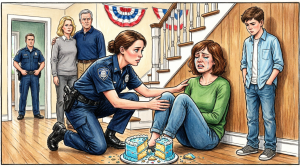
“India, how could you ruin Jake’s special day with your dramatics?”
But when paramedic Tara saw I couldn’t move my legs, she immediately called for police backup. The MRI would reveal the truth they had spent years hiding.
My name is India Carson, and for twenty-eight years I’ve lived in the shadow of my little brother Jake. Our family home in suburban Atlanta was a showcase of perfection from the outside. Pristine landscaping, matching rocking chairs on the wraparound porch, and family photos displaying four smiling faces in perfect coordination.
But houses hide things.
Ours concealed the truth about who Jake really was and how far my parents would go to protect their golden child.
That day was supposed to be a simple celebration, Jake’s sixteenth birthday. A milestone I almost didn’t attend, but Grandmother Elaine had called me the night before, her voice trembling with that familiar plea.
“India, honey, I know things haven’t been easy, but your brother is turning sixteen. Family should be together for these moments.”
What Grandma Elaine didn’t say, but I knew she thought, was that Jake was getting worse. The signs were there, and she was one of the few who noticed them. She’d been watching with concerned eyes for years, witnessing small cruelties that my parents dismissed.
The dead bird she found in her purse after scolding Jake.
The way neighborhood pets avoided our yard.
The broken wrist I suffered when I was fourteen, after Jake “accidentally” knocked me off my bike.
“I’ll think about it,” I had promised her, though I had already decided to go. Not for Jake, but for her. And maybe, secretly, to see if anything had changed.
I worked as a physical therapist at Atlanta Memorial, helping people recover from injuries. The irony wasn’t lost on me that I spent my days healing others while carrying my own invisible wounds. My apartment across town was my sanctuary, the distance from my family home a boundary I maintained for sanity.
My co-workers knew nothing of my family dynamics. To them, I was just India—dedicated, compassionate, perhaps a bit guarded.
The morning of Jake’s birthday, I arrived early to help with preparations. My mother, Heather, greeted me with surprised eyes and a stiff hug.
“You’re actually here,” she said, as if my presence was both unexpected and slightly inconvenient. “Jake will be so pleased.”
He wouldn’t be. We both knew that. But the lie hung between us, comfortable in its familiarity.
My father, Tom, was in the backyard setting up the grill, his broad shoulders carrying the weight of his successful construction business and family pride. He nodded when he saw me, a gesture that passed for affection in our household.
“India. Good of you to make time.”
His words carried a subtle dig about my absence from recent family gatherings.
“Wouldn’t miss it, Dad.”
Another comfortable lie.
Jake appeared around noon, sleeping in as teenagers do. But there was nothing typical about the way his eyes narrowed when he saw me standing in the kitchen arranging fruit on a platter.
“Well, look who decided to show up,” he said, voice dripping with disdain that only I seemed to hear.
My mother smiled indulgently at her son, ruffling his hair as if he were still seven instead of sixteen.
“Be nice, Jake. Your sister took time off work for you.”
Jake’s smile didn’t reach his eyes.
“How generous of her.”
The afternoon progressed with calculated pleasantries. Neighbors and family friends arrived bearing gifts and admiration for Jake—star athlete, honor student, the perfect son. Nobody saw how he deliberately bumped my arm when I was carrying drinks, causing me to spill on myself. Nobody noticed when he interrupted every conversation I tried to have.
These were old patterns, invisible to everyone but me.
Dr. Marcus Allen, my father’s longtime friend and golf partner, arrived with his wife. He’d known our family for years, had treated both Jake and me for various childhood injuries. He gave me a long look when Jake playfully shoved me aside to greet him.
“How are you really doing, India?” he asked quietly when we had a moment alone.
“I’m fine,” I said automatically, the answer expected of me.
He nodded, but something in his expression told me he wasn’t convinced.
“You know, I’ve always thought you were the strong one in this family.”
Before I could respond, it was time for cake. My mother had been fussing over the three-tiered blue monstrosity all day. Jake’s favorite color, Jake’s favorite flavor.
I volunteered to retrieve it from the basement refrigerator where it had been chilling.
The basement stairs were steep, poorly lit. I carefully descended, found the cake, and began the slow journey back up, balancing the heavy platter. I was three steps from the top when I felt Jake’s presence behind me. He had silently followed me down.
“Need help, sis?” he asked, his voice unnervingly soft.
“I’ve got it, thanks,” I replied, not turning around, focusing on the remaining steps.
I felt his breath on my neck as he leaned close and whispered,
“Oops.”
His hands pressed against my back with startling force.
In that suspended moment before falling, I caught Dr. Marcus’s horrified expression at the top of the stairs. He had seen everything. But as I tumbled backward, the cake flying from my hands, I watched him step back, his face clouding with the same willful blindness I’d seen in so many adults throughout my childhood.
The fall itself was a blur of motion and sharp pain. I remember thinking how strange it was that I could count each step as my body crashed against it. One. Two. Three.
Until something in my lower back made a sound no human body should make.
When I landed at the bottom, sprawled among smashed cake and broken glass from the platter, the world went silent except for the high-pitched ringing in my ears.
I tried to move my legs. Nothing happened.
I tried again, concentrating all my mental energy on the simple act of bending my knee. My legs lay there, unresponsive, as though they belonged to someone else.
Jake stood at the bottom of the stairs, his face a mask of fake concern as footsteps thundered above.
“Dad!” he called out. “India fell. I think she did it on purpose.”
The last thing I saw before my family crowded around was Dr. Marcus’s face staring down from the top of the stairs, his eyes filled with knowledge he would pretend not to have.
Like everyone else who had witnessed Jake’s cruelty over the years, he would choose silence. Because in our family, protecting Jake was the unwritten rule that trumped everything else.
“India, India, can you hear me?”
My father’s voice boomed above me, more annoyed than concerned. The basement ceiling spun in lazy circles as I tried to focus on his face.
“I can’t move my legs,” I whispered, terror rising in my chest. “Dad, I can’t feel anything below my waist.”
His expression darkened, the familiar shadow of disbelief crossing his features.
“You’re fine. Just had the wind knocked out of you.”
My mother appeared beside him, hands fluttering nervously around her face.
“The cake is ruined,” she said, as if this were the real tragedy unfolding. “Everyone’s waiting.”
Jake stood behind them, his face carefully arranged into a mask of brotherly concern. But I caught the slight twitch at the corner of his mouth, almost a smile.
“She just fell, Mom,” he said, his voice perfectly calibrated to sound innocent. “I tried to catch her, but she was going too fast.”
The lie slid easily from his lips, as it had countless times before.
I wanted to scream the truth, but pain shot through my spine like electricity, stealing my breath and blurring my vision.
“Walk it off. Stop being a baby,” my father repeated, reaching down to grip my arm.
When he tried to pull me up, the pain exploded into something unbearable, and my scream finally silenced the room.
“Tom, maybe we should…” my mother began uncertainly.
“She’s doing this for attention,” my father cut her off. “You know how she gets around Jake’s birthdays.”
Through tears, I saw my grandmother Elaine push through the small crowd that had gathered at the top of the stairs.
“What happened? Let me through.”
Before anyone could answer, the doorbell rang.
My mother looked relieved at the interruption.
“That must be Fiona with Jake’s gift. I’ll get it.”
Fiona Walsh was our neighbor, a nurse at Grady Memorial, who had recently moved to the neighborhood. I had spoken with her only a few times, but she had struck me as perceptive and kind—qualities in short supply in my family’s social circle.
What happened next changed everything.
I heard Fiona’s voice before I saw her, the professional edge cutting through the murmured concerns of party guests.
“Excuse me, I’m a nurse. Let me through, please.”
She appeared at the bottom of the stairs, still wearing scrubs from her shift, her red hair pulled back in a practical ponytail. She took one look at me, and her entire demeanor changed.
“Nobody move her,” she commanded, kneeling beside me. Her hands were gentle but efficient as she checked my pulse and looked into my eyes. “India, can you tell me what happened?”
“I fell down the stairs,” I said, aware of my family watching. “I can’t move my legs.”
Fiona’s eyes narrowed slightly as she performed a quick neurological assessment, running her fingernail along the bottom of my foot. I watched her do it, but felt nothing.
“Can you feel that?” she asked.
I shook my head, panic rising.
“I’m calling 911,” she said, pulling out her phone.
My father stepped forward.
“That’s not necessary. This is a family matter, and India has always been prone to dramatics.”
Fiona stood, her five-foot-four frame somehow towering as she faced my six-foot father.
“Sir, your daughter has signs of possible spinal trauma. She needs immediate medical attention.”
“You’re overreacting,” my mother interjected. “It’s Jake’s birthday. We have guests.”
Something flashed in Fiona’s eyes. Recognition, perhaps, of a dynamic she’d seen before.
She stepped away from my parents, phone already at her ear.
“This is Fiona Walsh, RN, from Grady Memorial. I need an ambulance at 427 Oakwood Drive. Possible spinal injury. Adult female, approximately twenty-eight years old.”
What followed was a blur of activity. Guests were ushered out, the party effectively over. Jake performed his disappointment perfectly, accepting sympathetic pats and promises of rain checks with practiced humility.
Through it all, I lay on the cold basement floor, pain radiating through my body in waves, terrified by the silence of my lower limbs.
The paramedics arrived within minutes, a blessing of suburban emergency response times. The lead paramedic introduced herself as Tara as she knelt beside me, her dark brown eyes assessing me professionally.
“India, I’m going to help you, but I need you to stay very still,” she said calmly. “Can you tell me exactly what happened?”
Before I could answer, my father interrupted.
“She was carrying the cake, lost her balance. Simple accident.”
Tara didn’t look up from her assessment.
“I need to hear from the patient, sir.”
I felt a sudden, desperate courage.
“I was pushed,” I said, my voice barely audible.
The room went deadly silent.
“What was that?” Tara asked, leaning closer.
“I was pushed,” I repeated, louder this time. “Jake pushed me.”
“That’s a lie,” Jake shouted, his careful mask slipping momentarily. “Why would I do that?”
My mother rushed to his side.
“India, how could you? Haven’t you ruined enough of Jake’s special day?”
Tara exchanged a look with her partner, a stocky man named Steve, who was preparing a backboard. Something unspoken passed between them.
“Sir, ma’am, I need everyone to step back and give us room to work,” Tara said firmly.
As she and Steve stabilized my neck and prepared to transfer me to the backboard, she leaned down and whispered,
“Squeeze my hand if you’re afraid in this house.”
I squeezed her hand so hard my knuckles turned white.
What I didn’t know then was that Tara had noticed several things in quick succession: the defensive posture of my family, the inconsistency in their story, the old bruises on my arms that I’d become adept at hiding, and the clinical signs of severe spinal trauma inconsistent with a simple fall.
As they loaded me onto the stretcher, I heard Tara speaking quietly into her radio.
“Dispatch, requesting police presence at our location. Situation Code Four.”
Code Four, I would later learn, was their shorthand for suspected abuse.
Detective Laura Sanders arrived as they were loading me into the ambulance. She was plain-clothed, but unmistakably law enforcement. Something in the way she carried herself—observant and slightly apart from the chaos.
“I need statements from everyone,” she announced, producing a small notebook. “Starting with the injured party, if possible.”
“This is ridiculous,” my father blustered. “My daughter had an accident. We don’t need police involvement.”
Detective Sanders smiled thinly.
“Standard procedure when paramedics call us in, sir. Nothing to worry about if it was just an accident.”
As the ambulance doors closed, I caught a glimpse of my family standing in the driveway—my parents, tight-lipped and angry; Jake, looking uncertain for the first time; and Grandmother Elaine, watching with tears streaming down her lined face.
What happened over the next few hours was a whirlwind of separate questionings and medical assessments. I learned later that Detective Sanders had interviewed Jake alone, away from my parents’ influence, and something in that conversation had cracked his carefully constructed facade.
“It was just a joke,” he reportedly said, breaking down when pressed. “I didn’t mean for her to fall that far. She’s always so uptight, especially around my birthdays. I just wanted her to loosen up.”
But the most damning evidence came from my medical evaluation.
As doctors assessed me in the emergency room, their findings painted a disturbing picture—not just the fresh spinal trauma, but evidence of multiple previous injuries that had never been properly treated. A poorly healed wrist fracture from three years ago. Rib injuries consistent with impact trauma. Shoulder damage suggesting repeated strain.
“India,” the emergency doctor said gently, “these injuries tell a story of long-term physical trauma. Is there something you want to tell us?”
For the first time in my life, protected by the sterile walls of the hospital and the presence of objective witnesses, I told the truth about growing up with Jake. About the “accidents” that were never accidents. About parents who saw only what they wanted to see. About a lifetime of being told I was oversensitive, dramatic, jealous of my golden brother.
And for the first time in my life, someone believed me.
The MRI machine hummed around me, a technological cocoon that would reveal what I already felt in the terrifying silence of my lower body. I lay perfectly still, fighting the claustrophobia and the panic that threatened to overwhelm me. The technician’s voice came through the speaker, professionally detached but not unkind.
“Just a few more minutes, Miss Carson. You’re doing great.”
I closed my eyes and tried to center myself in the chaos of the past few hours. The emergency room had been a blur of nurses, doctors, and police officers. Questions asked and repeated, forms signed.
My family, conspicuously absent after Detective Sanders had separated us.
When they finally rolled me out of the MRI chamber, Dr. Allison Reed was waiting. She was a neurosurgeon in her forties with prematurely silver hair and eyes that missed nothing.
“India,” she said, pulling up a chair beside my gurney. “I have your results.”
The clinical language she used—compression fracture, spinal cord trauma, L1 vertebra—washed over me like waves, the meaning clear despite the medical terminology. My spine was damaged. The question wasn’t if I needed surgery, but how soon, and how extensive the damage might be.
“Will I walk again?” I interrupted her explanation, needing the bottom line.
Dr. Reed paused, her expression carefully neutral.
“There’s reason for optimism. The cord isn’t completely severed, which is good news. But I need to be honest with you. Recovery from this kind of injury is unpredictable. We won’t know the full extent until after surgery and through your rehabilitation.”
“So, it’s possible I won’t walk again,” I pressed.
“It’s possible,” she acknowledged. “But it’s also possible you’ll make a full recovery with proper treatment and therapy. What I can promise you is that we’re going to do everything we can.”
As she explained the surgical procedures scheduled for the following morning, I noticed my parents hovering in the doorway, their faces set in identical expressions of concerned parenthood—the masks they wore so well in public.
“There she is,” my mother said, rushing to my side as if we were close, as if she hadn’t accused me of ruining Jake’s birthday while I lay paralyzed on the basement floor. “We’ve been so worried.”
My father stood at the foot of the bed, clearing his throat.
“The police have been asking a lot of unnecessary questions. Jake is very upset.”
Dr. Reed watched this interaction with narrowed eyes.
“Mr. and Mrs. Carson, I was just explaining to India the seriousness of her injury and the surgery we’ll be performing tomorrow.”
“Surgery?” My mother’s hand flew to her throat. “Is that really necessary? India has always had a low pain threshold. Perhaps with some rest—”
“Mrs. Carson,” Dr. Reed cut in, her voice cooling several degrees, “your daughter has sustained a severe spinal injury that requires immediate surgical intervention. This is not about pain tolerance. Without surgery, she risks permanent paralysis.”
My father shifted uncomfortably.
“Of course we want what’s best for India. We’re just concerned about rushing into something so drastic.”
The look Dr. Reed gave him could have frozen fire.
“I understand you’re in shock, but this isn’t elective surgery. It’s necessary and time-sensitive.”
A knock at the door interrupted the tense conversation.
Payton Lewis, my best friend since college, stood in the doorway, her eyes wide with worry. We had been scheduled to meet for coffee the next day, and when I didn’t show up or answer texts, she had called the hospital on a hunch.
“India.” Her voice broke as she took in the scene—me, immobilized on the gurney; my parents hovering; the doctor’s protective stance. “What happened?”
Before anyone could answer, a hospital social worker named Megan appeared behind Payton.
“Dr. Reed, could I speak with you and the patient privately?”
My parents bristled at the implication that they should leave.
“We’re her family,” my father stated flatly.
“And India is an adult patient entitled to privacy during her medical consultations,” Megan countered smoothly. “Hospital policy.”
There was no arguing with hospital policy—that nebulous authority that even my father’s considerable influence couldn’t overcome. With reluctance, my parents stepped out, promising to return soon.
Payton stayed, moving to my side and taking my hand.
Dr. Reed nodded at Megan to continue.
“India,” Megan began gently, “the police have requested access to your previous medical records as part of their investigation. As an adult, you have the right to consent or decline.”
“Investigation into what?” I asked, though I knew the answer.
“The circumstances of your injury,” she replied carefully. “Detective Sanders has reason to believe this may not have been an accident.”
I felt Payton’s hand tighten around mine. She had never met my family, had known only the vague outlines of our dysfunction. I had kept her separate from that part of my life—ashamed, perhaps, or protective of the one relationship untainted by the Carson family dynamic.
“What will they find in my records?” I asked Dr. Reed.
She hesitated, exchanging a glance with Megan.
“I’ve reviewed your file from previous admissions to this hospital. There’s a pattern, India. Multiple injuries over the years, all explained as accidents, but many consistent with…”
She paused, choosing her words carefully.
“Consistent with interpersonal trauma.”
“You mean consistent with someone hurting me?” I clarified, a strange calm settling over me. “Consistent with my brother hurting me and my parents covering it up.”
The words hung in the air, undeniable once spoken aloud.
“Yes,” Dr. Reed confirmed simply.
Payton’s face reflected shock, then a dawning understanding.
“The wrist injury last year. You said you fell while hiking.”
I couldn’t meet her eyes.
“I’m sorry I lied.”
“Don’t you dare apologize,” she said fiercely. “Not for what they did to you.”
Megan stepped forward.
“India, I want you to know that whatever you decide about your records, you’re not alone. We have resources, support systems—”
“I consent,” I interrupted. “They can have all my records. And I want to make a formal statement about what happened today.”
As if summoned by my decision, Detective Sanders appeared in the doorway.
“I can take that statement now if you’re up to it.”
What followed was the most honest conversation I had ever had about my family. I told Detective Sanders everything—not just about today’s “accident,” but about a lifetime of incidents carefully explained away.
Jake breaking my finger when I was nine, claiming I had shut it in the car door.
The time he pushed me down the porch steps when I was twelve, resulting in a concussion my parents dismissed as clumsiness.
The countless small cruelties that never left physical evidence but accumulated like poison in my system.
As I spoke, a commotion erupted in the hallway. Through the open door, I saw my grandmother, Elaine, arguing with my parents.
“You can’t keep me from seeing her,” she insisted, her voice carrying clearly. “I’ve been silent too long because of you two.”
She pushed past them and into my room, her small frame vibrating with a fury I had never seen in her. She took one look at me and burst into tears.
“I’m so sorry, India. I knew. I knew. And I didn’t do enough.”……………………………………..