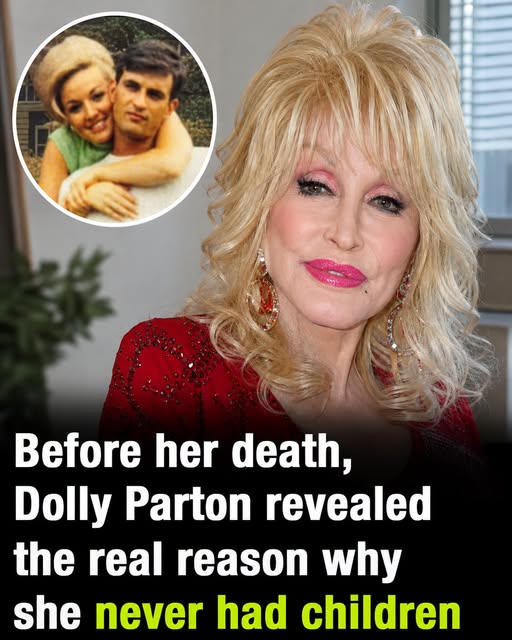
Dolly Parton Explained Why She and Carl Dean Never Had Children
A Marriage That Lasted Nearly Six Decades
Dolly Parton and Carl Dean built one of the longest and most private marriages connected to American entertainment.
They married in 1966, long before Dolly became an international superstar.
The relationship lasted for almost six decades until Carl’s death in March 2025.
Throughout that time, one question followed them repeatedly.
Why did they never have children?
Dolly answered that question more than once over the years, and her explanation was far more thoughtful than many people expected.
They Did Think About Becoming Parents
Dolly never suggested that motherhood was something she had always rejected.
She spoke publicly about imagining what children with Carl might have been like.
Like many couples, they considered the possibility.
But life moved in another direction.
Her career expanded rapidly.
Recording sessions became tours.
Tours became films, television appearances, businesses, and philanthropic projects.
Over time, Dolly came to believe that her life had followed the path it was supposed to follow.
A Medical Turning Point Changed What Was Possible
During the 1980s, Dolly underwent a partial hysterectomy after experiencing significant health problems.
The procedure meant she would no longer be able to have biological children.
She later spoke openly about how difficult that period was emotionally.
It came during a time when she was dealing with several personal pressures and questioning parts of her life.
Eventually, however, she began viewing the experience differently.
Rather than defining her life by what had not happened, she focused on what she could still give.
She Believed Her Life Had a Different Purpose
Dolly was deeply religious throughout her life.
Faith shaped how she understood success, hardship, marriage, and family.
As the years passed, she increasingly described not having children as part of a larger plan.
She believed that if she had become a mother, her priorities would have been different.
She might have traveled less.
She might have accepted fewer professional opportunities.
And she believed she would have devoted enormous energy to raising her own family.
Instead, she was able to spread that energy across music, charitable work, and projects serving children around the world.
She Said Children Would Have Changed Her Career
Dolly was unusually candid about the practical reality.
She believed that having children probably would have changed the scale of her career.
That was not because she viewed motherhood negatively.
Quite the opposite.
She believed she would have taken it extremely seriously.
Dolly understood herself well enough to know that she would have wanted to be fully present for her children.
She doubted she could have pursued the same relentless professional schedule while giving motherhood the attention she believed it deserved.
Her Career Required Enormous Freedom
Dolly’s professional life eventually stretched across several industries.
She wrote and recorded hundreds of songs.
She toured internationally.
She appeared in films.
She built businesses.
She launched charitable initiatives.
And even late in life, she continued developing new projects.
That level of activity required extraordinary flexibility.
Dolly eventually recognized that not having children gave her freedom that would have been much harder to maintain otherwise.
Carl Dean Preferred a Very Different Life
While Dolly became one of the most recognizable entertainers in the world, Carl Dean preferred privacy.
He rarely attended red-carpet events.
He generally stayed away from the entertainment industry.
That contrast became one of the defining features of their marriage.
Dolly could spend months surrounded by cameras and audiences, then return to a husband who had little interest in celebrity life.
She often said that arrangement worked well for both of them.
Their Marriage Did Not Depend on Having Children
For some couples, children become the center of family life.
Dolly and Carl built their relationship differently.
Their bond centered on companionship, humor, independence, and mutual understanding.
Dolly often spoke affectionately about Carl while respecting his wish to remain out of the spotlight.
The fact that they did not become parents did not prevent them from creating a long-lasting partnership.
Their marriage endured through extraordinary changes in Dolly’s career and public life.
Dolly Still Had a Strong Maternal Side
Not having biological children did not mean Dolly lacked nurturing relationships.
She came from a large family and remained close to nieces, nephews, and younger relatives.
She was also famously Miley Cyrus’s godmother.
Younger family members and performers often described Dolly as encouraging, protective, and generous.
Those relationships allowed her to express a caring side of herself without becoming a traditional parent.
She Often Said She Felt Connected to All Children
One of Dolly’s most memorable explanations was that perhaps she had been meant to belong to more than one family.
She believed that not having her own children gave her the ability to focus on children more broadly.
That idea became especially visible through her charitable work.
The clearest example was the Imagination Library.
The Imagination Library Became One of Her Greatest Legacies
Dolly launched the Imagination Library in 1995.
The original goal was simple.
She wanted children in her home county in Tennessee to receive free books from birth until they entered school.
The inspiration came from her father, Robert Lee Parton.
He was intelligent and hardworking but never learned to read or write.
Dolly believed that inability had limited some of the opportunities available to him.
She wanted other children to have a different start.
The Program Grew Far Beyond Tennessee
What began as a local literacy project eventually expanded internationally.
The Imagination Library began mailing free books to millions of children across several countries.
Families did not need to demonstrate financial hardship to participate in areas where the program operated.
The goal was simply to help children grow up surrounded by books.
Dolly repeatedly said the project was among the accomplishments that made her proudest.
Her Father Inspired the Mission
Dolly often explained that her father’s experience gave the literacy project special meaning.
She considered him one of the smartest people she had ever known.
But because he could not read, she believed some dreams had remained beyond his reach.
Helping children develop a love of books became her way of honoring him.
Her father reportedly told her before his death that he considered the Imagination Library one of the most important things she had ever done.
Her Influence Reached Millions of Families
By the end of Dolly’s life, the Imagination Library had distributed hundreds of millions of books.
The program expanded across the United States and internationally.
For Dolly, those books represented more than literacy.
They represented possibility.
A child opening a book might discover an idea, profession, place, or dream they had never encountered before.
That belief connected directly to Dolly’s own childhood.
She grew up in rural East Tennessee with very little money but an enormous imagination.
She Never Described Herself as Missing a Complete Life
Dolly’s comments about children were generally not framed as regret.
She acknowledged that there had been moments when she wondered what motherhood might have been like.
But she ultimately described herself as content with the life she lived.
She believed one path had closed while another expanded.
Rather than viewing herself as someone who lacked children, she often focused on the enormous number of young people she had been able to reach.
Her Faith Helped Her Accept the Path
Dolly frequently returned to faith when discussing major turning points.
She believed difficult events sometimes made sense only years later.
The fact that she never became a mother was one example.
When she was younger, she could not necessarily see how that choice and circumstance would shape her future.
Later, she viewed it as something that allowed her to fulfill a broader calling.
She Had Space to Give Everything to Her Work
Dolly’s work ethic became legendary.
She wrote constantly.
She recorded.
She performed.
She developed businesses.
She worked on charitable programs.
She remained creatively active even at an age when many performers would have retired.
Not having children meant she could organize her life around those ambitions in a way that would have been more complicated otherwise.
Her Relationship With Younger Relatives Mattered Deeply
Dolly’s extended family remained important throughout her life.
Nieces, nephews, great-nieces, and great-nephews knew a much more private version of her than fans did.
She helped relatives pursue education and creative ambitions.
She offered advice.
She encouraged younger family members.
Those relationships demonstrated that parenthood is not the only way someone can become an important adult in a child’s life.
She Became a “Fairy Godmother” Figure
Dolly often embraced the idea of being a kind of fairy godmother.
That description fit both her public personality and the relationships she developed with younger people.
She could be playful and glamorous while also offering practical support.
For many fans, the term became a useful way to understand the nurturing role she occupied without being a mother herself.
Her Marriage Survived an Extraordinary Career
Dolly and Carl’s relationship lasted through dramatic changes in fame, wealth, and public attention.
When they married, there was no guarantee Dolly would become internationally famous.
Over time, her career became larger than either could have imagined.
Carl continued living largely outside the public spotlight.
Dolly frequently credited that independence with helping their marriage endure.
Carl’s Death Changed Her Final Years
Carl Dean died in March 2025 at age 82.
Dolly openly acknowledged the difficulty of losing the person who had been beside her for almost six decades.
She continued working and leaned heavily on faith, family, and memories of their life together.
The loss marked one of the most personal transitions of her final years.
Dolly Continued Thinking About Children Until the End
Even late in life, Dolly’s literacy mission remained central to her identity.
The Imagination Library continued expanding.
She regularly encouraged children to read, dream, and believe that their circumstances did not have to determine their future.
That message came directly from her own life story.
She had grown up in poverty and understood how powerful imagination could be.
Her Choice Was Never Simply About Career
It would be too simple to say Dolly never had children because she wanted fame.
Her explanation included health, circumstance, faith, personality, and a clear understanding of the sacrifices parenthood would have required.
She recognized that she had been able to build an unusually large career partly because she did not have responsibilities to children at home.
She also came to believe that the freedom allowed her to serve children in another way.
A Different Definition of Motherhood
Dolly never claimed that philanthropy was the same experience as raising a child.
But she understood that care can take many forms.
People can influence children as parents.
As relatives.
As teachers.
As mentors.
Or as people who create opportunities for children they may never meet.
Her own life became an unusually large example of that idea.
Her Legacy Reaches Far Beyond Music
When people remember Dolly Parton, songs such as “Jolene,” “Coat of Many Colors,” and “I Will Always Love You” will remain central to her legacy.
But the millions of books sent to children represent another side of her life.
The girl who never became a mother built a program designed to place stories in the hands of children around the world.
That was not a substitute for the family she never had.
It was simply the form her own life eventually took.
Why Dolly Said She Had No Regrets
Looking back, Dolly repeatedly expressed gratitude rather than bitterness.
She had an extraordinary marriage.
She built the career she dreamed about as a child.
She remained close to a large extended family.
And she used her success to support children on a scale few individuals ever achieve.
That perspective explains why her answer to the question of motherhood was ultimately peaceful.
She did not believe she had missed the life she was supposed to have.
She believed she had lived it.
The Family She Built Looked Different
Dolly and Carl never became parents in the traditional sense.
But their nearly 60-year marriage created a stable partnership at the center of an otherwise extraordinary life.
Around that partnership grew a much larger circle.
Relatives.
Friends.
Artists.
Employees.
Fans.
And millions of children whose homes received books bearing Dolly’s name.
That was the family Dolly eventually described as part of her purpose.
Her Answer Became Clearer With Time
When Dolly was young, she could not have known where the decision not to have children would eventually lead.
Decades later, she could look back and see the connection.
Without children of her own, she had more freedom to pursue a career that reached nearly every corner of popular culture.
That success then gave her the resources to create opportunities for millions of other children.
For Dolly, that became the answer.
Motherhood was not part of her personal journey.
But caring about children remained one of the defining themes of her life.

