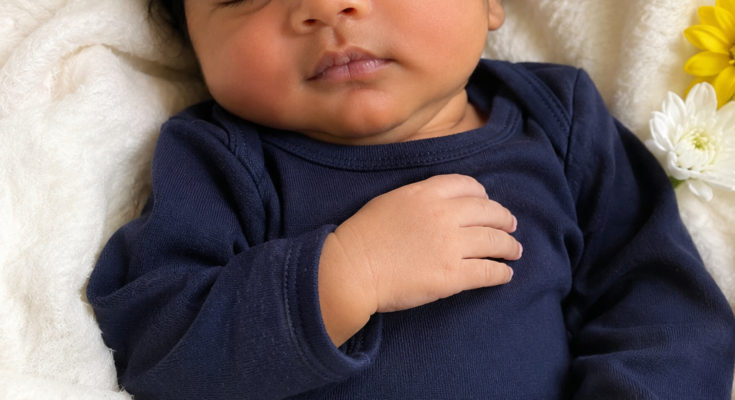
Before Ethan Carter took his first breath, doctors had already warned his family that he might never take one. Two extremely rare conditions affected his brain, skull and face, and doctors were unsure whether he would survive delivery.
Ethan survived. His family finally got to meet the baby they had spent months waiting for. Then, at just five months old, he underwent complex reconstructive surgery. The family that had once waited to learn whether Ethan would survive delivery now had to wait for news from an operating room.

For many expectant parents, the questions leading up to delivery are familiar. When will the baby come? Who will he look like? What will it feel like to hold him for the first time? Ethan’s family had a more immediate question. Would he be alive when the day was over?
A warning like that changes how far ahead a family can imagine. Coming home, introducing the baby to relatives and seeing what makes him smile all depend on reaching that first day together. Until Ethan arrived, the family had to live with the possibility that the time they had been hoping for would be very short.
Then he was born, and he was alive. The medical concerns were still there, but his family finally had something they had spent the pregnancy hoping for. They had met their son.
At five months, another wait began
Five months is a short time in any child’s life. It’s the age when many parents are getting to know their baby’s expressions and discovering which familiar voices or sounds catch his attention. For Ethan, those first months also led to a complex reconstructive operation.
The conditions he was born with affected several closely connected parts of his body. At five months old, he was far too young to understand what was happening. His family, meanwhile, had already lived through one period of waiting for news that would shape the rest of their lives. The day of his surgery brought that uncertainty back.
This time, they knew the baby they were waiting for. They had spent five months getting to know him. A warning delivered before birth had once been about a child they had yet to meet. Now the child in the operating room was their son, with a face and a presence familiar to the people who loved him.
Ethan made it through the operation
Ethan survived the surgery. For his family, that news marked the end of the wait to hear whether he had made it through and the beginning of another stretch of time, this one focused on recovery.
There were still questions about what would come next. But there was now room to think about ordinary things again, like hearing him laugh, watching him reach for a toy and seeing what he would do as he grew. Those are the kinds of moments families often picture before a baby is born. For Ethan’s family, there had been a time when it was hard to imagine getting that far.
A collage can put “Before” and “After” a few inches apart. For Ethan’s family, those words span a warning before birth, five months of getting to know their son, and the wait for news after a complex surgery. On the other side of that wait, they had something they’d once been afraid to count on. They could look forward to more time with him.
The days a photograph skips

Put two photographs side by side and your eyes go straight to what changed. It takes a little longer to think about all the days the pictures leave out.
Before there was an “after” picture, there were five months in which Ethan was already someone his family knew. They knew the face that readers might be seeing for the first time. They had watched his expressions change and had time to notice the small things that make one baby unmistakable to the people who spend their days with him.
That was the baby they were waiting to hear about on the day of the operation. Anyone looking at the pictures now can see that there’s another image on the right. His family had to live through the hours when there was still only one.
What made the second wait different
Before Ethan’s birth, his family could imagine the sound of his voice, the weight of him in their arms, and what it might feel like to see him open his eyes. By the time he went into surgery, they had five months of memories to draw on.
Think about how much you can learn about someone who has never said a word to you. You watch their eyes to see what holds their attention. You get to know the difference between a face that’s about to cry and one that might break into a smile. Some days you can guess what will happen next. Other days they surprise you.
Those are small discoveries, easy to forget when you’re trying to remember what happened on a particular Tuesday. Put enough of them together and you begin to know a person. By five months, Ethan had already given his family days like that. The people waiting for news from surgery knew exactly whose face they wanted to see again.
The questions that could wait
When someone asks what comes next after a major operation, the question usually means recovery. How long might it take? What will the next few days bring? For a baby of five months, there’s also a whole other set of questions waiting beyond those immediate ones.
What will make him laugh so hard that everyone else in the room starts laughing too? Will he reach for the toy someone bought him, or will he be more interested in the paper it came wrapped in? When he starts making sounds that seem almost like words, who will insist they heard their name first?
Nobody needs the answers right away. Part of the pleasure is finding out by being there when it happens. For a family that once wondered whether they would meet their baby at all, there was something to look forward to in questions like these. Ethan would get to answer them himself, in his own time.
The stories a family keeps
Someday, if Ethan asks about the photographs, his family will have more to tell him than how old he was when they were taken. They can tell him what they knew before he was born, what they were afraid of, and how it felt when they finally got to meet him. They can tell him that five months later, while he was in surgery, they were waiting for news about a baby they had already grown used to seeing every day.
And he might ask the sort of question children ask when adults are telling a very serious story.
“What was I like as a baby?”
That question could take the conversation somewhere else entirely. A family can spend ten minutes trying to remember the date of a photograph and then remember, all at once, an expression a baby used to make. One person remembers it happening one way. Someone else is sure it happened differently. The child hears both versions and wants to know which one is true.
There’s room for all of it in the story Ethan may hear one day. The operation was part of his first year. So were the days when the people around him were simply getting to know him, one look and one sound at a time.

More time with Ethan
The first question in Ethan’s story was whether he would live long enough for his family to meet him. He was born, and they did. Five months later, another day came when they had to wait to hear whether he had made it through. He did that, too.
What followed was the chance to find out things no photograph could tell them. A baby who catches your eye today may surprise you tomorrow. An expression you’ve seen a dozen times may turn into a laugh you’ve never heard before. These are the things you learn in the course of spending time with someone.
Before he was born, even one day together had felt uncertain. Now his family could wonder what he might do tomorrow and look forward to being there to see it.
The date in the corner
Years from now, someone looking through Ethan’s baby pictures might pause over a date. He was only five months old when he went into surgery. It takes a moment for that to sink in. Five months is young enough that, when someone asks how old your baby is, you might still answer in weeks.
The dates in a family album can tell you how quickly things happened. They can also make a long day look remarkably short. An entire afternoon of waiting for a phone call can sit behind a single date in the corner of a picture. Someone who lived through it could tell you where they were when the news came. Someone seeing the picture for the first time would have to ask.
There were two days early in Ethan’s life when a few words could change what his family understood about the future. The first was the day he was born. The second was the day he came through surgery. To someone reading about him now, those moments are separated by a few paragraphs. His family had five months between them.
What happens when people ask about the pictures
A photograph can make a stranger stop scrolling. They may look from one picture to the other and wonder what happened in between. The answer begins well before either picture was taken, when Ethan’s family was told he might never survive delivery.
Once you know that, it’s easy to linger over the first photograph. Whatever differences brought someone’s eyes to the second image, the first shows something his family once had reason to fear they would never see at all. Ethan was here. He had reached an age that, before he was born, they could only hope to call his.

Someone close to the family might notice an entirely different detail. A blanket, perhaps, or a familiar expression. In any family album, those details can send a conversation off in a direction nobody expected. A picture everyone remembers for one reason turns out to hold a memory someone else has been carrying for years.
Two people can look at the same baby picture and have two different stories to tell. One asks what happened to him. The other remembers what he was like.
When the questions change
The first question about Ethan’s future came before he could open his eyes. Would he survive? By the time he arrived, that question had occupied so much of the story that it can be hard, reading about those early months, to make room for all the others.
But there are questions a child gets to ask about his own beginning. Who picked my name? Who held me first? Did I look like anyone in the family? Ask the last one in a room with enough relatives and you may hear three different answers before anyone thinks to take out a photograph.
Ethan might someday want to know what his family was told about him before he was born. He might also want to know who first said his name out loud. Both questions belong to the same story. One reaches back to an uncertain time his family lived through. The other is about a name he has heard all his life.
And if he wants to keep asking, there’s a question only the people who were there can answer for him.
“Tell me about the day you met me.”
Before he could remember
Ethan was too young to remember either of the days that would become part of the story of his first year. If he ever wants to know what those days were like, he’ll have to ask someone who remembers them for him.
That’s true of most of us. We grow up hearing accounts of a day we were there for and have no memory of. We learn how long people waited for us, who heard the news first, and what the adults around us remember feeling when they finally saw us. Sometimes we hear the same story so often we can tell it ourselves, right down to the detail a relative always interrupts to correct.
In Ethan’s case, there’s a question worth asking about those first five months. If you set aside the day he was born and the day he had surgery, which day would his family tell him about next?
It might be a day nobody wrote down at the time. Families often remember something ordinary with surprising precision, years after they’ve forgotten what else happened that week. And if Ethan asks two people that question, he might get two different stories about himself.
What a five-month-old knows
An adult hearing Ethan’s story knows that something important happened when he was five months old. A baby that age experiences the world much closer to home. There’s a face coming into view, a voice he’s heard before, or the sudden interest of something moving just beyond his fingers.
For the adults, the calendar gave those months a shape. For Ethan, whatever made one day different from another would have been much more immediate. There’s something easy to recognize in that difference. A grown-up can spend an entire afternoon thinking about the future while a baby beside them is fascinated by the way the light moves across the wall.
That’s part of what makes it worth stopping at five months old. It tells us how early the operation came. It also gives us a way to picture how small Ethan’s world still was, and how much of it he was only beginning to discover.
When he’s old enough to tell it himself
If Ethan chooses to tell the story of his first year someday, he’ll get to decide how much of it he wants to share. He may spend time talking about the operation. He may tell it in a few sentences and move on to something that happened when he was old enough to remember.
And the person listening will have a choice, too. They can ask another question about the pictures. Or they can follow Ethan into whatever story he wants to tell next. It might be about something he’s proud of, something he finds funny, or an argument he’s still determined to win.
The account of what happened before Ethan could speak belongs among the stories his family can tell him. The longer they spend together, the more stories he’ll be able to tell them.
The days with nothing to announce
When Ethan made it through surgery, his family finally had an answer to the question they had been waiting on. For anyone hearing the story later, that answer can feel like the end of the suspense. For a family beginning to think about recovery, it’s also the moment when one question gives way to several smaller ones.
What can we do today? What should we ask when we get the chance? And when someone calls and says, “How’s he doing?” how much can we tell them?
There’s a particular kind of tiredness in having to give an update while you’re still taking in the news yourself. A relative asks because they care. Another asks because someone told them half the story and they’ve spent the rest of the day wondering about the other half. You may be grateful that so many people are thinking of you and still wish, just for a while, that somebody would talk to you about dinner.
Those days rarely make it into a short account of a child’s first year. They’re hard to sum up. A family may still have questions on a day that ends with nothing new to tell anyone. The baby may still need their attention. Someone may still have to go and find a clean shirt.
Ethan was five months old when he came through his operation. Whatever questions the adults around him had about the weeks ahead, the next day would still belong to a five-month-old. Babies have their own sense of what needs attention first. Anyone who has tried to finish an important phone call with a hungry baby in the room knows how quickly the order of things can change.
The first time someone asks about you
When a baby has been through a frightening medical experience, people tend to ask about the baby first. A parent can get so used to answering that it takes a moment to register a different question.
“How are you doing?”
There’s a good chance the first answer will be about the baby anyway. It’s the answer the parent has ready. It may take a second question, asked when there’s enough time to hear the answer, for the conversation to turn.
One reason Ethan’s story stays with you is how early the uncertainty entered it. His family learned before he was born that he might not survive delivery. By the time he needed surgery, they’d already had to get through one day they’d been afraid to think about too far in advance. They now knew from experience how slowly an hour could pass when all they wanted was news.
Relief can take time to settle after a day like that. Anyone who has spent hours waiting for a call may recognize the strange feeling of still reaching for the phone after it has finally rung. For a while, checking it was something you could do when there was very little else you could do. It takes a moment for your hands to catch up with what you’ve heard.
And then there are the people who have been waiting for your call. How do you tell someone the news when they’ve been worrying all day? Often the most important words come first. Everything else can wait until both of you are ready to talk again.
How people can help on an ordinary day
Most of us have said, “Let me know if you need anything,” and meant every word of it. It’s an offer made out of care. The person hearing it may still have trouble thinking of an answer, especially if they’re used to being the one who helps everybody else.
It can be easier to answer a question about something specific. Would you like me to bring dinner? Can I pick up a few things while I’m at the store? Do you want me to tell the rest of the family what you just told me so you can put the phone down?
A person can say yes to one of those things without having to decide everything they might need for the next week. And when you’re the person trying to help, you can do a small thing and let it be enough for that afternoon.
It’s easy to imagine people rallying around a family on the day of an operation. Think, too, about what it means when someone checks in later, after the excitement of hearing good news has died down. The person who calls then might get a more honest answer. There’s been time to notice how tired everyone is. There may finally be a chance to finish a conversation that got cut short.
The account we have of Ethan’s early life centers on two days when people were waiting to hear whether he would survive. It leaves open the question of what support looked like on the days in between. That’s worth thinking about the next time someone you know is going through a long wait. The day everybody hears about may be the easiest day to remember to call.
The future comes back in pieces
Ask someone who has been through a long period of uncertainty when they started thinking about the future again, and they may give you a surprisingly ordinary answer. It might be when they bought something they knew they wouldn’t need until next month. Or when they put a date on the calendar and realized they had thought about what to bring before thinking about what could go wrong.
Nothing in Ethan’s story tells us when that happened for his family. What we know is that there had once been a real question about whether they would get to meet him. By the time he came through surgery, they’d already spent five months with the child they had once been told might never take a breath.
Five months is long enough for someone to become part of how you think about your day. When you see a soft shirt in a shop, you think about whether it would fit him. When you’re getting ready to leave the house, you start picking things up for him before you’ve found your own keys. Soon there’s a whole list in your head of little things that take a few seconds each and somehow make it impossible to leave on time.
There’s a welcome kind of impatience in everyday plans like that. You want everybody dressed and out the door. You want to get somewhere before it starts raining. You want the person who said they’d be ready in five minutes to have meant five minutes. Any family that has tried to get a baby out of the house can supply its own ending to that scene.
That’s one of the things people mean when they hope a child will have a chance to grow up. They’re hoping for the days when everyone can be too busy looking for the keys to think about what it took to get there.
The part of the story Ethan gets to keep
There may come a day when someone outside the family knows how old Ethan was at the time of his surgery and has no idea what to buy him for his birthday. A person close to him might have the opposite problem. They might need a moment to remember how old he was during the operation, yet know exactly what kind of birthday cake he’d ask for if given the choice.
That’s how knowing someone changes the details you remember. A fact that stays with a stranger may become one small piece of what a friend knows. The friend has heard the same joke three times, knows how Ethan tells it, and knows which part he can barely get through without laughing.
If someone who has read about his first year ever meets him, they may come with a question about his operation. He might answer it. He might ask a question of his own. A real conversation gives him the chance to change the subject, bring it back, or decide he’d like to hear something about the other person for a while.
That’s a small freedom most of us take for granted. We can tell a story about ourselves over lunch and, when the food comes, spend the rest of the meal arguing over who ordered the better dish. We can share a dozen details with one person and one sentence with another. We can wait until we trust someone before we tell them what something meant to us.
At five months old, Ethan needed other people to speak for him. As he grows, he gets more say in who hears his story and how much he tells. His family may still remember the days that were hardest for them. Ethan will have favorite days of his own.

“Look what I can do”
There’s a phrase many children discover early, and once they find it, the people around them get used to hearing it several times a day.
“Look what I can do.”
Sometimes it’s a jump off the bottom step. Sometimes it’s a drawing the child has worked on for so long that you’re expected to understand immediately who everybody in it is. And sometimes you look up a second too late and have to persuade the child to do the whole thing again.
It’s a funny thing to ask of another person when you think about it. A child is asking you to put down whatever you were doing and give your full attention to something that might take less than a second. If you happen to get there in time, the child usually looks at you as soon as it’s over. They want to know you saw it.
Before Ethan was born, the people who loved him were waiting for someone else to tell them how the day had gone. When he was five months old and in surgery, they found themselves waiting for news again.
There’s another kind of waiting a family gets to do as a child grows. He tells you to look. He takes a little longer than he thought he would. You almost say something, then see how hard he’s concentrating and give him a moment. And when he’s finally ready, he gets to show you himself.
What do you say when a child catches you staring?
A child can tell when someone is looking at them. Adults sometimes forget this. They hold a glance a second too long, then look away so quickly that the movement draws more attention than the glance did.
A child might go right on with what they’re doing. Or they might ask, plain as anything, “Why are you looking at me?”
It’s the sort of question that leaves an adult wishing they had a few more seconds to come up with an answer. But imagine hearing it from the child’s side. Someone across the room keeps looking over. You want to know why. The grown-up is the one making it complicated.
Ethan’s story begins with two rare conditions that affected his brain, skull and face. Readers come to the photographs knowing something about his appearance before they know much else about him. In everyday life, introductions happen in the opposite order all the time. You learn someone’s name because you’re sitting beside them. You find out what they like because they happen to be carrying it, talking about it, or asking if you want a turn.
Imagine two children at a table with a box of crayons between them. One wants the green crayon the other is using. There are several ways this can go. They can wait. They can ask. They can make a very persuasive case for why their picture needs green more urgently. By the end of the conversation, they might know more about each other than the adults who have spent the same amount of time wondering whether to say hello.
A question can change the whole conversation
Picture a parent at a birthday party, trying to keep a paper plate level while a child beside them decides whether to have cake. Someone they’ve just met asks about the child’s medical history. The parent now has to decide, in the middle of an ordinary afternoon, whether to tell a story that may be tender, complicated, or simply too long for the moment.
The person asking might be making a genuine effort to connect. They may even have a personal reason for asking that they haven’t shared. The parent could be happy to talk about it another day. For the moment, there’s a fork sliding off a plate and a child who has just changed their mind about the frosting.
Try starting a different conversation at that same party. Ask how they know the hosts. Ask whether their child has already spotted the cake. Ask the child which piece looks best, and you may discover you’ve been standing next to the person who has spent the last ten minutes keeping track of the corner slice.
Small talk gets a bad reputation. At its best, it gives people a choice about where to go next. Anyone can answer a question about cake with a single word, or turn it into a story about the year somebody dropped the entire birthday cake on the kitchen floor. And if a family wants to tell you about an operation their child had as a baby, there’ll be time to hear it properly once you know each other.
“He can tell you”

Adults do something curious around children who are old enough to answer for themselves. They ask a question while looking at the child, then turn toward the parent before the child has time to speak.
“What’s your favorite thing to do?”
There’s a pause. The adult fills it.
“Does he like drawing?”
A parent could answer and keep the conversation moving. Or they could say, “He can tell you,” and leave room for the child to finish thinking.
That small pause can change what everyone learns. The parent might have said drawing because the child has covered the refrigerator with pictures. The child might say he likes standing by the kitchen sink and trying to catch a falling drop of water in a spoon. There’s a follow-up question worth asking about that. How many times have you caught one? If the child is anything like most children, the answer may depend on what counts as catching it.
Earlier in Ethan’s life, adults had to make decisions and answer questions on his behalf. He was five months old at the time of his operation. Stories about that age naturally draw on what other people saw, heard, and remember. As a child gets older, the conversation can begin to include something even the people closest to him couldn’t supply on their own. His answer, in his own words, after he’s had a second to think.
A hundred things to be known for
Many of us have gone into a room expecting people to know one thing about us. We’re the new person at work. We’re somebody’s younger sibling. We’re the neighbor who moved into the house three doors down. That first detail gives people a place to start. What happens next depends on how much time we spend together and what we happen to do with it.
For a child, that process can be wonderfully fast. On Monday, one kid is simply the new kid. By Friday, that same kid may be the only person you want on your team because they know how to get the ball out from under the fence without losing it to the yard on the other side. A week later, you might be annoyed with them because they’ve invented a rule that seems to apply whenever their team is losing.
That last part matters. Friendship comes with the freedom to be unreasonable about a game and find someone willing to argue with you. It means having people who notice when you’re quiet because they’re used to hearing what you think. It means somebody saves you a seat and then complains that you took too long to get there.
A reader knows that Ethan survived delivery and underwent reconstructive surgery at five months old. Time spent with a person gives you details of another kind. You learn which stories they make longer every time they tell them. You learn when they need a moment to themselves and when they’d rather have somebody sit beside them. Eventually, someone asks what they’re like, and you have to stop and choose where to begin.

