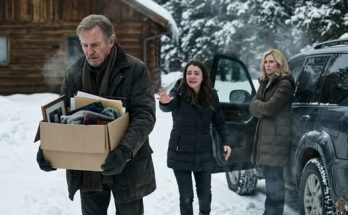
“Terrible ones.”
He stretched.
Then looked at me.
“You look different.”
“Wind damage.”
“No.”
He studied me for a moment.
Then gave up trying to explain.
I was glad.
I did not want to become another person’s lesson that afternoon.
I wanted to finish the drive.
Get home.
Put my green bowl by the window.
THE GATE
My father was at the cabin when we arrived.
He had asked first.
He stood on the porch holding a broom.
Arthur had driven him up.
The grass beside the path had been cut.
A basket of mail waited inside.
My father looked better.
Still tired.
Still moving carefully.
But upright.
Here.
He came down one step.
Then stopped, remembering the instructions he had been given.
Daniel carried in the bags.
Arthur opened the trunk.
I stood beside the car.
For a second, the years folded strangely.
A vehicle in the clearing.
My father on the porch.
A box in my arms.
But this time, nothing was being taken away.
My father looked at me.
“How was it?”
I smiled.
“Cold.”
He laughed.
“Beautiful?”
“Yes.”
I went up the steps.
He waited.
Then I put down the little box holding the bowl and hugged him.
Not because he had earned a scene.
Not because illness had erased anything.
Because I had been away.
Because I was glad he was alive.
Because I wanted to.
He held me carefully.
When I stepped back, his eyes were wet.
He did not say anything that made the hug smaller.
THE WINDOW
After the men left, Daniel helped me unpack the car.
He set the album on the table.
Then took out his postcard.
He had written on it during the last motel night.
I tried not to read it.
He noticed.
“You can.”
So I did.
Daniel,
You came.
You saw it.
Nobody sent you away.
Come back if you want.
I handed it back.
He slipped it into the album.
Not beside Sandra’s returned envelopes.
Beside the Thanksgiving photograph.
Then he looked toward the window.
I had placed the green bowl near my mother’s glass bird.
Blue.
Green.
Two small pools of light on the sill.
“Looks right,” he said.
I nodded.
It did.
THE CALL AFTER MIDNIGHT
I had been asleep for almost an hour when the phone rang.
For one sharp second, I thought of my father.
The hospital.
Arthur’s voice.
I reached for it before the second ring.
Maisie.
I sat up.
“Hello?”
For a moment, I heard only breathing.
Then her voice.
“Did I wake you?”
“Yes.”
“What happened?”
She made a small sound.
Not quite crying.
Not yet.
“I’m at the bus station.”
I pushed back the blanket.
“What bus station?”
“Tamarack.”
“The late one from Denver.”
“Where’s June?”
A pause.
Then, very quietly, “I didn’t call her.”
I stood.
“Are you safe?”
“Yes.”
“Are you alone?”
“Yes.”
I reached for my trousers.
“Maisie.”
She began crying then.
The careful kind.
Trying not to be heard.
“I went to see my father.”
I stopped.
The room went still around me.
Then she said the sentence I had heard in so many different voices, at so many different ages.
“He said I could come.”
I closed my eyes.
Opened them.
Picked up my keys.
“Stay inside the station.”
“Wren—”
“I’m coming.”
Outside, the ridge lay dark beneath the stars.
The cabin was warm behind me.
On the windowsill, blue glass stood beside green.
I turned on the porch light before I left.
THE GIRL UNDER THE STATION LIGHT
Maisie was sitting beneath a television with the sound turned off.
Her backpack rested between her shoes.
One strap had twisted around her ankle.
She looked younger than seventeen.
Not because of her face.
Because of the way she was holding herself still.
As though taking up less space might keep the night from getting worse.
I parked directly outside the glass doors.
When she saw me, she stood too quickly.
Her backpack caught.
She stumbled, freed the strap, and bent to pick up a paper cup she had knocked over.
Nothing spilled.
It was empty.
She tried to put the lid back on anyway.
I went inside.
“Maisie.”
She looked up.
For a moment, her mouth trembled.
Then she said, “I’m sorry.”
I took the cup from her hand.
Put it in the bin.
“Are you hurt?”
“No.”
“Did anyone hurt you?”
She shook her head.
“Do you have everything you came with?”
A pause.
Then she nodded.
I held out my hand for the backpack.
She kept it.
“All right,” I said.
“Let’s go.”
Outside, the night air had turned cold.
She stopped beside the passenger door.
“You’re not going to ask?”
“I will.”
“But you can get warm first.”
Her face changed.
She climbed into the car.
I turned the heater toward her.
For nearly a minute, neither of us spoke.
Then I said, “Your mother needs to know you’re safe.”
Maisie looked at me immediately.
“No.”
“She doesn’t need every detail tonight.”
“But she needs to know where you are.”
“She thinks I’m at Hannah’s.”
I kept my hands on the steering wheel.
“Then she especially needs to know.”
Maisie covered her face.
“She’s going to hate me.”
“No.”
“You don’t know.”
I looked at her.
“I know June.”
Her shoulders began shaking.
“I lied to her.”
“Yes.”
“I went anyway.”
“Yes.”
“You said she wouldn’t hate me like it was easy.”
“It isn’t easy.”
“But I’m not going to leave her asleep believing you’re somewhere you aren’t.”
Maisie cried harder.
I waited beside her.
Then I asked, “Do you want to tell her, or would you like me to start?”
She held out her phone.
“Can you start?”
“Yes.”
THE PHONE CALL TO JUNE
June answered on the fourth ring.
Her voice was thick with sleep.
“Wren?”
“Maisie is with me.”
The change was immediate.
“Where?”
“At the bus station.”
“She’s safe.”
“She isn’t hurt.”
“I’ve picked her up.”
I heard something fall.
A drawer closing.
“Why is she at the bus station?”
“She went to Denver.”
“She’ll explain.”
“Right now, I wanted you to know she’s with me.”
Silence.
Then, very carefully, “Is she there?”
“Yes.”
“Can I speak to her?”
I handed over the phone.
Maisie stared at it.
“Mom?”
Whatever June said made her fold forward.
“I’m sorry.”
A pause.
“No.”
Another pause.
Then Maisie shook her head, forgetting June could not see her.
“No, he didn’t.”
Her voice disappeared into a sob.
I looked through the windshield.
The station attendant came to the doors and checked the lock on one side.
The television inside changed to an advertisement.
Somebody, somewhere, was trying to sell a family holiday.
Beside me, Maisie whispered, “I wanted to see for myself.”
June spoke for a long time.
Maisie listened.
Finally, she said, “Can I go to Wren’s tonight?”
She looked at me.
I nodded.
“Yes, she said it’s okay.”
A pause.
“I know.”
“I love you too.”
When she handed back the phone, June was crying.
Quietly.
Trying to stay useful.
“I’ll come up,” she said.
“Give me twenty minutes.”
“Drive carefully.”
“I will.”
I waited.
Then June asked, “What happened?”
I looked at Maisie.
Her eyes were closed.
“I don’t know yet.”
June breathed in.
Let it out.
“All right.”
Before she hung up, she said, “Thank you for answering.”
I looked toward the dark road home.
“I’m glad she called.”
THE HOUSE THAT WASN’T IN THE PHOTOGRAPH
Maisie spoke halfway up the ridge.
Without warning.
Without looking at me.
“He sent pictures.”
I eased around a bend.
“Of what?”
“His house.”
“A dog.”
“A little room with a desk.”
She wiped her cheek with her sleeve.
“He said I could study there if I ever wanted to visit.”
I said nothing.
“He remembered I liked drawing.”
The heater hummed.
“I didn’t think he remembered anything.”
She looked down at her hands.
“He called on my birthday.”
“Not late.”
“On the actual day.”
I remembered Daniel holding a card.
Evelyn describing a boy beside a telephone.
“He said he was proud.”
Maisie gave a small, angry laugh.
“He didn’t ask what he was proud of.”
“But I filled that part in.”
I kept my eyes on the road.
“You wanted him to know you.”
She nodded.
Then, after a while, “He said Mom made everything difficult.”
I felt my jaw tighten.
“What did you think?”
“I told him she didn’t.”
“He said I was too young to remember.”
“He said grown-up relationships were complicated.”
The word moved through the car like something unwelcome finding a familiar doorway.
Maisie looked out at the trees.
“I remember the cupboard.”
My hands tightened around the wheel.
“What cupboard?”
“The one under the sink.”
“At our old house.”
She swallowed.
“I used to sit in front of it because the dishwasher was loud.”
“If I sat there, I couldn’t hear them as much.”
I had known Maisie since she was six.
I had fed her pancakes.
Taught her to label jars.
Watched her grow tall enough to reach the shelf above my head.
There were still rooms in her childhood I had never entered.
I drove more slowly.
“You don’t have to tell me all of it tonight.”
“I know.”
A pause.
“But I want somebody to know I remember.”
I looked at her.
Then back at the road.
“I’m listening.”
WHAT HE HAD ASKED
He had met her at the bus terminal in Denver.
Bought her lunch.
Asked about school.
For almost an hour, Maisie said, it had been everything she had imagined.
“He listened.”
“At least, I thought he did.”
“He asked what I wanted to study.”
“I told him.”
“He said it was expensive.”
That was where her account slowed.
Where the good part ended.
They had driven to his house.
Not the house in the photograph.
An apartment behind a tire shop.
“He said they were between places.”
“Who was?”
“Him and Carrie.”
“His girlfriend.”
“She was nice.”
Maisie looked at me quickly.
“She really was.”
“She didn’t know I was coming.”
I felt something cold settle beneath my ribs.
“Did he say you could stay?”
“He said we’d work it out.”
I waited.
“She thought I was visiting for lunch.”
“She had a shift.”
“He had work too, but he said he’d called out.”
For a while, only the tires made a sound.
Then Maisie said, “He asked about my scholarship.”
I glanced at her.
“What about it?”
“How much.”
“What it covered.”
“Whether any of it came straight to me.”
I could see the gate ahead.
The porch light glowed through the trees.
“He said if I took a year off, I could save money.”
“He knew somebody hiring.”
“He said it might be a chance for us to get to know each other properly.”
Her voice broke.
“I wanted that part.”
“I wanted it so much I almost didn’t hear the rest.”
I stopped the car outside the cabin.
Turned off the engine.
“What was the rest?”
Maisie stared at the light above the door.
“He said family helps family.”
THE WARM ROOM
Inside, Maisie stopped beside the stove.
She looked toward the place where Mabel’s bed had been.
I had moved it the week before.
The floor looked too empty.
For a moment, I thought she might begin crying again.
Instead, she whispered, “I forgot.”
“I know.”
I took her coat.
She kept the backpack.
I pointed toward the spare room.
“The same room.”
“The same hook.”
She nodded.
Then she stood in the doorway without entering.
“What?”
She looked at the bed.
“Does Mom know I asked to come here instead of home?”
“Yes.”
“Did it hurt her feelings?”
“I don’t know.”
Maisie turned toward me.
I let the answer stay honest.
“But she wants you safe more than she wants the evening to happen her way.”
She pressed her lips together.
Then went into the room.
I put water on.
Found bread.
Cut cheese.
The ordinary work steadied my hands.
I was angry.
Not the useful, quiet anger I had learned to work beside.
The first kind.
Hot.
Immediate.
Wanting somebody to call so I could answer.
Wanting Maisie’s father to stand in my kitchen and explain why a girl with a college letter had come home believing her future was available for negotiation.
I cut the bread too thickly.
Put down the knife.
Took a breath.
This was not the time to make my anger another thing Maisie had to carry.
When she returned, I set the plate in front of her.
She looked at it.
“I’m not hungry.”
“All right.”
I sat opposite her.
Five minutes later, she picked up the smallest piece of bread.
I pretended not to notice.
JUNE AT THE DOOR
June arrived with her coat over her pajamas.
Her shoes were on the wrong feet.
I noticed.
She did not.
She came through the door and stopped.
Maisie stood.
For a moment, neither moved.
Then June crossed the kitchen.
Maisie folded into her.
“I’m sorry.”
June held the back of her head.
“I know.”
“I lied.”
“I know.”
“I thought—”
“I know.”
Maisie cried against her shoulder.
June closed her eyes.
I stepped into the hallway.
Gave them room.
From there, I could see the edge of the kitchen table.
The plate.
Maisie’s backpack.
June’s hand moving slowly over her daughter’s hair.
After a while, June asked, “Are you hurt anywhere?”
“No.”
“Did he leave you alone?”
“No.”
“Did you have enough money to get home?”
“Yes.”
A pause.
Then Maisie said, “I used some of my housing money.”
June went still.
Not much.
Enough.
I saw her hand stop.
Then begin again.
“All right.”
“It was for the deposit.”
“I understand.”
“I thought he’d pay for my ticket back.”
June breathed in.
Let it out.
“We’ll work out the money tomorrow.”
Maisie lifted her head.
“Aren’t you angry?”
“Yes.”
The word was quiet.
Clear.
Maisie’s face crumpled.
June held on.
“I’m angry that you lied.”
“I’m frightened by where you went.”
“And I’m very glad you’re here.”
Maisie stared at her.
June brushed the hair from her face.
“You don’t have to choose which one I’m allowed to feel.”
THE PART JUNE HAD TO HEAR
We sat together at the table.
Maisie between us.
She told the story again.
More of it this time.
Her father had overdue rent.
A car payment.
A problem with work.
He had said the money would be temporary.
That he would repay it before she needed it.
“He asked what Mom had told me about him.”
June looked at her daughter.
“What did you say?”
“That you said we left because the house wasn’t safe.”
June nodded.
“He said you always exaggerated.”
I watched June’s face.
Something old moved through it.
Maisie saw.
“I told him I remembered things.”
“What things?”
“The wall.”
“The plate.”
June looked down.
Maisie’s voice shook.
“He said I was remembering what you told me to remember.”
For a moment, nobody spoke.
Then June looked up.
“What did you say?”
“I said you didn’t tell me the sound.”
My throat tightened.
Maisie pressed both hands against her knees.
“You didn’t tell me how I used to count the cracks in the cupboard door.”
“You didn’t tell me the smell when he poured the beer in the sink.”
Her voice rose.
“He kept saying I was confused.”
“So I said I wasn’t giving him the money.”
June’s eyes filled.
Maisie wiped her face angrily.
“He said I came all that way just to judge him.”
“That I sounded exactly like you.”
June reached for her hand.
Maisie pulled back.
Not rejecting her.
Trying to finish.
“I told him I had to leave.”
“He said fine.”
“He drove me to the station.”
“He didn’t wait.”
There it was.
The moment she had been carrying inside the rest.
The vehicle leaving.
The doors closing.
The small, terrible change from being expected to being inconvenient.
I looked down at the table until I could trust my face.
Maisie whispered, “I thought he might come back.”
June took her hand then.
This time, Maisie let her.
THE SENTENCE I DIDN’T SAY
I wanted to tell her he would regret it.
That one day he would understand what he had missed.
That losing her would become the great sorrow of his life.
I knew better.
Sometimes people regretted consequences.
Sometimes they rewrote the story until the child became the one who had abandoned them.
Sometimes there was no satisfying moment when truth entered the room and everybody recognized it.
So I did not promise Maisie a better father in the future.
I asked, “What made you call?”
She looked at me.
“I almost didn’t.”
“I know.”
“I thought if I waited until morning, I could tell Mom the trip was okay.”
June closed her eyes.
Maisie stared at the table.
“I could make up things.”
“Say we had dinner.”
“Say he was busy.”
Her voice faded.
Then she said, “I was trying to think of the story.”
I felt my chest ache.
“What changed?”
She looked toward the window.
At the porch light reflected in the glass.
“I remembered you saying I didn’t need to be certain before I could ask for help.”
I had no memory of saying it exactly that way.
Perhaps I had.
Perhaps it was something she had made from a dozen conversations.
Either way, she had carried it to the bus station.
She looked at June.
“I thought if I started lying about the visit, I might have to keep doing it.”
June’s tears spilled over.
“Oh, sweetheart.”
Maisie began crying again.
This time, she did not apologize.
THE NIGHT NOBODY HAD TO FINISH
It was nearly three when June and I stood in the hallway.
Maisie was asleep.
Not peacefully, perhaps.
But asleep.
Her backpack sat beside the bed.
The strap no longer twisted around anything.
June leaned against the wall.
“I should have known.”
“No.”
“She’s been quieter.”
“She’s seventeen.”
“That can mean six different things before breakfast.”
June gave a tired laugh.
Then covered her mouth.
“I told her I wouldn’t keep her from knowing him.”
“I thought that was the right thing.”
I looked toward the closed door.
“You didn’t keep her from calling you either.”
June’s eyes filled again.
“She called you.”
“Yes.”
I let that sit between us.
Then I said, “And you’re here.”
June looked at me.
I knew the hurt.
Not all of it.
Enough.
A mother could be grateful her child had reached someone and still feel the sting of not being the first number.
“You don’t have to pretend that part doesn’t hurt.”
June wiped beneath her eyes.
“I don’t want to make it her problem.”
“Then tell me.”
She lowered herself onto the hallway bench.
For a while, she talked.
About all the years she had tried not to make Maisie feel caught.
About keeping old photographs in a drawer.
About answering questions without letting her own memories speak over her daughter.
About the fear that being honest would make her seem bitter.
I sat beside her.
When she finished, dawn had begun to pale the little window at the end of the hall.
“I’m so tired,” she whispered.
“I know.”
She leaned her head back against the wall.
I brought her a pillow.
For once, she did not apologize before taking it.
THE MORNING AFTER
Maisie woke at ten.
She came into the kitchen wearing an old sweatshirt from the spare-room drawer.
Her hair was tangled.
Her eyes were swollen.
June stood at the stove.
I was making toast.
Nobody asked whether she felt better.
She sat down.
June put a plate in front of her.
Eggs.
Bread.
A little bowl of cut fruit.
Maisie stared at it.
Then she asked, “Are we going to talk about it?”
“Yes,” June said.
“Not every minute.”
Maisie nodded.
She ate.
Halfway through breakfast, her phone buzzed.
She froze.
June looked at the screen.
Then back at her daughter.
Maisie did not pick it up.
It buzzed again.
She turned it over.
A message.
Then another.
Her face tightened.
“What?” June asked.
Maisie swallowed.
“He says I embarrassed him.”
I set down the butter.
June stayed still.
Maisie read further.
“He says Carrie thinks I’m ungrateful.”
A pause.
“He wants to know what I told you.”
The kitchen seemed to narrow around the phone.
Maisie looked at her mother.
“What do I say?”
June took a breath.
“What do you want to say?”
“I don’t know.”
“All right.”
Maisie stared at the screen.
Then she looked at me.
“I don’t want to do this today.”
“Then today can be a day you don’t do it.”
She held the phone for several seconds.
Then switched it off.
Not threw it.
Not surrendered it.
Switched it off herself.
She put it beside the plate.
Picked up her fork.
THE MONEY IN THE FOLDER
That afternoon, Maisie brought out the college folder.
The same one she had carried into the cabin with the acceptance letter.
Now there were bus receipts tucked inside it.
A motel cancellation.
Numbers written on the back of an envelope.
The difference between what she had saved and what she still needed.
She set it in front of June.
“I’ll work more shifts.”
June looked at the figures.
“We need to see what the deadline actually is.”
“I know.”
“I’m not paying it off secretly for you.”
Maisie’s face changed.
June held up a hand.
“I’m also not letting one bad weekend decide whether you go to college.”
They sat side by side.
I brought a calculator.
For an hour, we worked.
The shortfall was real.
Unpleasant.
Possible to solve.
Not a moral judgment.
Not evidence Maisie could not manage her life.
June could contribute part.
Maisie could cover some through the summer job she already had.
The housing office had an option to divide the deposit into payments.
We would call Monday.
By the time the pages were stacked again, Maisie looked exhausted.
But the fear had changed shape.
It was no longer a dark, endless thing.
It was a number.
A date.
A telephone call.
She leaned back.
“I thought I’d ruined everything.”
June closed the folder.
“You spent money you needed.”
“You lied about where you were.”
“We’re going to deal with both.”
Maisie looked down.
Then June touched her wrist.
“You didn’t become a ruined person.”
THE VOICE I CALLED
After they went home, I called Daniel.
He answered from a grocery-store parking lot.
“Everything all right?”
“No.”
I told him.
Not the details that belonged only to Maisie.
Enough.
A promised visit.
Money.
A station.
A parent driving away.
Daniel was quiet.
Then he said, “Is she with June?”
“Yes.”
“Good.”
A cart rattled past his car.
Somebody laughed in the background.
The ordinary world, continuing.
For a while, neither of us spoke.
Then I said, “I was so angry.”
“Of course.”
“I wanted to call him.”
“Did you?”
“No.”
“Good.”
I laughed without humor.
“I knew you’d say that.”
“What would you have wanted him to do?”
“Tell me why.”
Daniel let the question hang.
Then he said, “Would you have believed the answer?”
I looked at the empty kitchen.
The chair Maisie had sat in.
The bread crumbs beside her plate.
“No.”
“Then maybe you did the thing that mattered.”
I leaned my forehead against the cupboard.
“She was waiting for him to come back.”
Daniel drew a slow breath.
“I know.”
There was nothing else to say.
He stayed on the phone while I washed the cups.
THE WALK TO THE BRIDGE
Maisie returned the following weekend.
Alone.
In daylight.
She parked properly.
I told her I was disappointed to lose one of my few remaining opportunities for criticism.
She almost smiled.
We walked to the bridge.
The creek ran high from the last snowmelt.
She leaned against the railing.
For a while, we watched the water.
Then she said, “I keep remembering nice things.”
“About him?”
She nodded.
“Before.”
“He used to let me stand on his shoes when we danced.”
I looked at her.
She stared at the creek.
“I remember that.”
“Even after everything.”
“You’re allowed.”
“What if it means I’m making too much of the rest?”
“It doesn’t.”
She swallowed.
“He bought me a red coat.”
“I loved that coat.”
I thought of my father teaching me to ride a bicycle.
Of the man who had taken my keys.
Both memories belonging to the same person.
“The coat was real,” I said.
“So was the bus station.”
Maisie closed her eyes.
A tear slipped down.
I waited.
She wiped it away.
Then she asked, “Do you think he loves me?”
I gripped the railing.
I could not answer for a man I barely knew.
I could not turn a complicated word into a promise.
“I don’t know what he means when he says it.”
She looked at me.
“I know you deserved to be treated with care when you arrived.”
“And when you said no.”
“And when you wanted to leave.”
Maisie turned back toward the water.
After a while, she nodded.
“That’s what I wanted.”
“I know.”
“No.”
She looked at me again.
“That’s the answer I wanted.”
“Not about what’s inside his head.”
“About what I was allowed to need.”
THE THING SHE HAD DRAWN
A month later, Maisie brought me a sketchbook.
Not as a gift.
She made that clear immediately.
“You can look.”
“You can’t keep it.”
“Understood.”
We sat on the porch.
She turned the pages.
Figures.
Windows.
A dog that was unmistakably Mabel, despite being built from six impatient lines.
Then a drawing of a cupboard door.
Dark pencil.
The perspective low.
A child’s view.
I felt my throat tighten.
Maisie watched my face.
“Too much?”
“No.”
“Tell me about it.”
She ran a finger beside the drawing without touching the graphite.
“I kept trying to make it look less ugly.”
“Then my art teacher asked why.”
“What did you say?”
“That I didn’t want people to feel sorry for me.”
“And?”
“She asked what I wanted them to see.”
I looked at the dark lines.
“What did you want?”
Maisie took a breath.
“That somebody was in there.”
I sat very still.
Then she turned the page.
The same low view.
A doorway.
Light on floorboards.
The edge of a braided rug.
I knew the room immediately.
“This one’s yours,” she said.
“The drawing?”
She nodded.
“I made a copy.”
I looked at it.
There were no people in the doorway.
No heroic figure.
Just light.
And enough space to step into it.
THE LETTER SHE SENT
Maisie wrote to her father in July.
Not to win.
Not because she had found words powerful enough to force him to understand.
Because she wanted her own account outside her head.
She read part of it to June.
Then part to me.
I came because you invited me.
I said no to giving you money.
Those are separate things.
I am allowed to visit my father without paying for the visit.
I am allowed to remember what happened when I was little.
I am going to college in August.
I will not be postponing it.
She stopped reading.
Looked at me.
“Is that last part rude?”
“No.”
“I keep thinking I should make it sound softer.”
“Do you want the decision to sound less settled?”
“No.”
“Then leave it.”
She folded the paper.
That afternoon, she went to the post office herself.
When she came back, she helped me pick plums.
We did not spend the evening watching her phone.
THE NIGHT BEFORE SHE LEFT
June held a small supper the night before the college trip.
Not a farewell party, she insisted.
Maisie was going to school.
Not crossing an ocean in a wooden boat.
Then she cried while setting out the plates.
Ruth arrived with enough food for twelve people.
There were seven of us.
She refused to discuss the discrepancy.
Daniel brought a basic toolkit for the dorm room.
Maisie held it up.
“What do I do with this?”
“Mostly lend it to people who lose theirs.”
My father gave her a good flashlight.
“Batteries included,” he said.
“Groundbreaking.”
He laughed.
I had brought a quilt.
Blue squares.
Some straight.
Some visibly mine.
Maisie unfolded it.
For a moment, she said nothing.
Then she looked at me.
“Did you make this?”
“Parts.”
“How many parts?”
“The uneven ones.”
She laughed.
Then pressed the quilt against her face.
June turned away toward the sink.
Daniel suddenly became interested in the window.
I sat beside Maisie.
“There’s no speech attached.”
“Good.”
“There are washing instructions.”
“Of course there are.”
We laughed.
A little later, she took the quilt upstairs.
When she came back, her eyes were wet.
Nobody asked.
THE DRIVE OUT OF TOWN
I went with them.
June drove.
Maisie controlled the music.
I sat in the back beside a laundry basket and a bag of shoes.
At the edge of town, we passed the diner.
Ruth stood outside.
Arms folded.
Pretending she happened to be there.
Maisie rolled down the window.
“Subtle!”
Ruth waved her away.
Then wiped her face with the corner of her apron.
We kept driving.
For the first hour, Maisie talked almost without stopping.
The room assignment.
The course schedule.
A message from the girl who would be her roommate.
After the second hour, she grew quiet.
June glanced at her.
“All right?”
“Yes.”
A pause.
Then, “No.”
June nodded.
“Me too.”
They did not turn around.
THE ROOM WITH TWO WINDOWS
The dormitory smelled of cardboard.
New plastic.
Too many people trying not to cry in public.
Maisie’s room was at the end of a corridor.
Two beds.
Two desks.
Two windows facing a courtyard.
She stood in the doorway.
Her key card hung from one finger.
June waited behind her.
For a moment, I saw the spare room at the cabin.
A little girl touching a mattress that did not fold.
Then Maisie stepped inside.
“This one,” she said.
She put her bag on the bed near the left window.
Just like that.
A place chosen.
A claim made without apology.
We carried boxes.
Made the bed.
Lost the tape.
Found the tape beneath the quilt.
June organized a drawer, then emptied it because Maisie wanted it differently.
Nobody took offense.
By late afternoon, the room had begun to belong to her.
Books on the desk.
A mug.
A photograph of June laughing on the porch.
And, half-hidden behind a pillow, a very old stuffed rabbit.
I looked at Button.
Maisie caught me.
“Don’t.”
“I said nothing.”
“You were thinking loudly.”
I smiled.
She rolled her eyes.
But she left him where he was.
THE MOMENT AT THE DOOR
June checked the time three times.
The drive home was long.
There were things to unpack.
There was no reason to stay.
Every reason to stay.
Finally, Maisie stood.
“We should—”
June nodded too quickly.
“Yes.”
Then neither moved.
I stepped into the hallway.
A few minutes later, June came out.
Her face was wet.
Maisie stood behind her.
Trying to look brave.
Not succeeding.
June turned back.
“You can call.”
“I know.”
“Even if it’s late.”
“I know.”
“Even if—”
“Mom.”
June stopped.
Maisie crossed the small space and hugged her.
Hard.
When they separated, June touched her cheek.
Then picked up her bag.
I hugged Maisie next.
She held on longer than I expected.
Against my shoulder, she whispered, “What if I hate it?”
“Then you’ll tell us.”
“What if I love it?”
I smiled.
“Tell us that too.”
She laughed through tears.
We stepped into the corridor.
June looked back.
Maisie stood inside her doorway with one hand on the frame.
Then she said, “You can go.”
June made a small sound.
Maisie’s mouth trembled.
“I’m scared.”
June nodded.
“I know.”
“But you can go.”
This time, when we walked away, nobody had been left without a choice.
THE WAY HOME
June cried for the first twenty miles.
Then stopped.
Then began again because we passed a shop selling college sweatshirts.
I drove.
She held a packet of tissues and apologized only once.
By then, we had both learned enough to leave the apology unanswered.
At a rest stop, she washed her face.
Bought coffee.
Came back carrying two paper bags.
“What’s that?”
“Sandwiches.”
“We ate.”
“I know.”
I took one.
We sat on a bench beside the car.
The evening had turned gold.
For a while, June looked at her phone.
No message.
Then it buzzed.
A photograph.
Maisie’s bed.
The blue quilt.
Button lying on the pillow.
Beneath it:
Roommate seems nice.
We’re going to find food.
June stared.
Then laughed.
Then cried again.
I looked away so she could have a little privacy.
After a while, she said, “She’s all right.”
“For this minute,” I said.
June nodded.
“For this minute.”
It was enough to start the car.
THE LIGHT IN THE WINDOW
When I reached the cabin, it was nearly dark.
I unlocked the door.
Put down my bag.
The rooms were quiet.
For a moment, the quiet felt like loss.
Mabel.
Harlan.
All the years when somebody had been waiting to hear the latch.
Then my phone buzzed.
Daniel.
Did you get back?
I answered.
Yes.
Another message arrived.
Maisie.
A photograph of a crowded dining hall.
A tray of food.
One sleeve of her new roommate’s sweater at the edge.
No explanation.
Just proof she was there.
I sat at the kitchen table.
On the windowsill, my mother’s blue bird stood beside the green bowl from the coast.
Above the desk, I had hung Maisie’s drawing.
The low view.
The open doorway.
Light across the floor.
For years, I had thought keeping a place ready meant waiting for someone to arrive cold and frightened.
It could mean that.
It could also mean letting them leave with a quilt.
I turned on the lamp.
Not because I expected a call.
Not because somebody needed rescuing.
Because I liked the light.
Then I took out a clean notebook.
There was something I had been postponing for years.
Not a letter to my mother.
Not an account for an attorney.
Not a list of what to stock before winter.
A story.
Mine.
I wrote the first sentence slowly.
When I was nineteen, my father drove me eleven miles into the snowy mountains.
I stopped.
Read it.
Then, beneath it, I wrote another.
That is where I used to think my life had ended.
Outside, wind moved through the plum tree.
I turned the page.
And kept going.