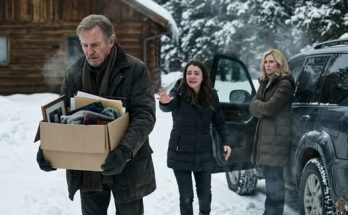
THE NEXT WINTER — THE LETTER WITH NO RETURN ADDRESS
The letter arrived three weeks after my thirtieth birthday.
It was waiting between the electric bill and a grocery-store circular when I opened the mailbox at the bottom of the ridge.
Plain white envelope.
No return address.
My name written in careful block letters.
WREN LAUREL MADDOX.
I stood beside the road longer than I meant to.
People who knew me usually wrote Wren.
People who wanted something often used the whole name.
Snow drifted off a branch behind me.
Somewhere down the valley, a truck changed gears.
I turned the envelope over.
The flap had been sealed with clear tape.
Inside were two sheets of notebook paper and a photograph.
The photograph slid out first.
A boy stood beside a bicycle in front of a redbrick school.
He was perhaps twelve.
Dark hair.
An awkward smile.
One sleeve pulled down over his hand.
Behind him, holding the handlebars, stood a younger version of Sandra.
For a moment, I could not understand what I was looking at.
Then I recognized the school.
Not because I had attended it.
Because I had stood outside it once, years earlier, waiting in my father’s truck while Sandra went inside to sign something for Tyler.
I looked down at the letter.
The first sentence was short.
You don’t know me, but I think you knew my mother.
I stopped feeling the cold.
THE NAME SHE NEVER SAID
His name was Daniel.
He was twenty-four.
He lived in Grand Junction.
And according to the letter, Sandra was his mother.
I read that sentence three times.
Then I read the next paragraph.
I am not writing to ask for money.
I know that probably makes it sound as though I am.
I don’t know how else to begin.
I folded the letter.
Unfolded it.
Read it again.
Sandra had one son.
Tyler.
That had been one of the fixed facts of my childhood.
Sandra’s son needed my bedroom.
Sandra’s son needed tuition.
Sandra’s son was having a difficult time.
I had lived beneath the same roof as that woman for eight years.
She had never mentioned another child.
Not once.
I got into the car.
The heater blew cold air against my hands while the engine warmed.
I should have driven home.
Instead, I finished the letter in the mailbox turnout.
Daniel wrote that he had spent part of his childhood with his paternal grandparents.
Later, there had been an aunt.
Then a cousin.
He described the movement between houses with almost no emotion.
Dates.
Addresses.
School changes.
As though if he kept it orderly enough, it might stop sounding like a childhood.
My mother used to say she couldn’t bring me because things were complicated.
When I was little, I thought complicated was a place.
I thought she was living somewhere she couldn’t get out of.
I lowered the page.
A snowplow came around the bend.
I waited until it passed.
Then I kept reading.
He had found my name in an old local newspaper report about Sandra’s case.
He had looked for more.
Eventually, he had found the small organization where I worked.
He had not called because he did not know what to say to a receptionist.
At the bottom of the second page, he had written a telephone number.
Underneath it was one final sentence.
I just want to know whether she was ever different with you.
I sat in the car until the windshield began to fog.
Then I put the letter back in its envelope.
I drove up the ridge slowly.
WHAT I DIDN’T OWE
June came for coffee that afternoon.
I had already called her.
She took off her boots, hung up her coat, and sat at the kitchen table.
Mabel raised her head from her bed.
June bent to scratch behind her ears.
“Well?”
I handed her the letter.
She read it once.
Then more slowly.
When she finished, she set it on the table without folding it.
“Did you know?”
“No.”
“Does your father?”
“I haven’t asked.”
June looked at the photograph.
“How do you feel?”
“I don’t know.”
She nodded.
I waited for her to say I should call him.
That he sounded lonely.
That perhaps there was a reason this letter had found me.
She said none of those things.
Instead, she asked, “Do you want more coffee?”
I looked at her.
“Yes.”
She got up.
The kettle clicked.
Mabel sighed in her sleep.
“I keep thinking about him waiting,” I said.
“Beside a phone.”
“Checking the mail.”
“Wondering whether I’m going to decide he isn’t worth answering.”
June set a mug in front of me.
“That sounds familiar.”
“I know.”
“You can recognize the feeling without becoming responsible for all of it.”
I ran a finger along the edge of the photograph.
“What if I say the wrong thing?”
“Then you can correct it.”
“What if he wants something I can’t give him?”
“Then you can tell him.”
I looked toward the window.
The glass bird caught a pale winter afternoon.
For years, people had trusted me with the moments when they had run out of places to go.
I knew how to make tea.
How to ask practical questions.
How to leave a room so somebody could cry without feeling watched.
But this letter had reached past those skills.
It had found the part of me that still wanted an explanation for Sandra.
Some hidden fact that would make her make sense.
June watched me for a while.
Then she said, “You don’t have to call today.”
I pressed both palms flat against the table.
“I know.”
“Do you?”
I almost said yes.
Then I let out a breath.
“I’m working on it.”
MY FATHER’S SILENCE
I called my father that evening.
He answered with a mouthful of something.
“Sorry,” he said.
“Toast.”
I heard him set down a plate.
“What’s up?”
“Did Sandra have another son?”
The silence was immediate.
Not confusion.
Recognition.
My hand tightened around the phone.
“Dad.”
“Yes.”
I stared at the kitchen wall.
“What was his name?”
“Daniel.”
I closed my eyes.
“You knew.”
“Yes.”
“For how long?”
“Before we got married.”
Outside, the porch light came on automatically.
I watched its reflection appear in the dark window.
“Why didn’t I?”
He breathed out.
“She told me it was private.”
“Private.”
“She said he lived with his father’s family.”
“She said it was better for him.”
“Did you ask him?”
“No.”
“Did you meet him?”
“Once.”
I sat down.
“When?”
“Early on.”
“Before she moved in.”
“He came for a weekend.”
I looked at the envelope.
“Where was I?”
“At your aunt’s.”
There it was.
An ordinary memory I had never thought to question.
A weekend with my aunt.
Pancakes.
A movie.
My father telling me he needed to sort out some grown-up things.
I could hear a clock ticking through the phone.
“Did he want to stay?”
My father did not answer quickly.
“Dad.”
“Yes.”
The word barely reached me.
I pressed my lips together.
“What did Sandra say?”
“That the arrangement was temporary.”
“That his grandparents were attached to him.”
“That moving him would be disruptive.”
“And you believed her.”
“I accepted it.”
The difference hurt.
I was glad he had said it anyway.
“He wrote to me,” I said.
“Oh.”
“He wants to know whether she was different with me.”
My father made a quiet sound.
I did not help him through it.
After a while, he asked, “What are you going to tell him?”
“The truth.”
“All right.”
“I’m not calling to ask permission.”
“I know.”
“And I’m not calling so you can explain her.”
“I know.”
I looked down at Daniel’s careful handwriting.
“I wanted to know whether there was another child in the room that nobody was willing to see.”
My father was silent.
Then he said, “There was.”
I waited.
“And I was one of the adults.”
For a long time, neither of us spoke.
Finally, I said, “I need to go.”
“All right.”
He did not ask whether I was angry.
He already knew.
THE PHONE CALL
I called Daniel the next morning.
He answered before the second ring finished.
“Hello?”
“Daniel?”
“Yes.”
“This is Wren.”
I heard movement.
A chair scraping.
A door closing.
Then nothing.
“Are you still there?”
“Yes.”
His voice had changed.
Thinner.
“I didn’t think you’d call.”
“I read your letter.”
“I’m sorry if it was strange.”
“It was unexpected.”
“Right.”
“I shouldn’t have sent the photograph.”
“It’s okay that you did.”
A pause.
Then he asked, “Did you know?”
“No.”
He exhaled.
I could hear how long he had been holding that question.
“I thought maybe she talked about me.”
I looked toward Harlan’s chair.
“No.”
The word felt brutal.
But I would not make him build another year around something that wasn’t true.
“She never mentioned you to me.”
He was quiet.
Then, “Okay.”
I waited.
“That’s actually better,” he said.
“How?”
“I don’t have to wonder whether everybody knew and agreed.”
I put my hand over my mouth.
At last, I understood why he had written.
He was not looking for Sandra.
Not exactly.
He was looking for someone who could confirm that what had happened was real.
“I didn’t know,” I said again.
“If I had, I would remember.”
“Okay.”
We stayed quiet for a while.
Then he asked the question from the letter.
“Was she different with you?”
I watched a chickadee land on the porch rail.
“No.”
He took a breath.
I heard it shake.
“She wasn’t kind to me,” I said.
“My father let it happen.”
“I spent years thinking if I could become easier, she might stop.”
Daniel made a sound that was almost a laugh.
“She used that word?”
“What word?”
“Easy.”
I closed my eyes.
“Yes.”
“She told my grandmother I wasn’t an easy child.”
“How old were you?”
“The first time I remember?”
“Yes.”
“Five.”
Mabel stirred beside the stove.
I lowered my hand to her head.
“You were five,” I said.
“I know.”
But he said it the way I used to say I knew things I did not yet believe.
COFFEE HALFWAY
We met two Saturdays later.
Not at the cabin.
At a coffee shop halfway between us.
I arrived early.
He arrived earlier.
He was standing outside when I pulled into the parking lot, wearing a brown work jacket with a company name stitched over the pocket.
He looked nothing like Tyler.
A little like Sandra around the eyes.
I hated that I noticed.
Then I hated that he noticed me noticing.
He touched his face awkwardly.
“People say that.”
“I’m sorry.”
“It’s just my face.”
“Yes,” I said.
“It is.”
Something in his shoulders loosened.
Inside, he bought his own coffee.
I bought mine.
Neither of us knew whether to hug.
So we shook hands, which made us both laugh.
We sat beside a window.
For the first ten minutes, we discussed roads.
Weather.
Work.
He repaired commercial refrigeration units.
“I keep restaurants from losing three thousand dollars’ worth of chicken.”
“That sounds useful.”
“It mostly involves being cold in places where everybody else is sweating.”
I told him about the diner.
About classes.
About my job.
Not about the mountain yet.
He had already read some of that.
I wanted there to be something he knew about me before the worst thing.
Finally, he pulled a folded page from his pocket.
“I wrote things down.”
“That’s all right.”
“I didn’t want to get home and realize I forgot everything.”
I nodded.
He smoothed the page against the table.
“Did she ever keep your birthday presents?”
I looked at him.
“What do you mean?”
“Things people sent.”
“Money.”
“Cards.”
“Did she say she was holding them until later?”
My chest tightened.
“Yes.”
He nodded once.
He made a mark beside something on the paper.
“Did she tell people you didn’t want to come?”
“Sometimes.”
“Family things?”
“Yes.”
He looked out the window.
“She told me Tyler didn’t like being around me.”
I remembered Tyler at sixteen.
Loud.
Selfish.
Often cruel in the casual way people could be when nobody required better of them.
I could not honestly tell Daniel that Tyler had been a secretly loving brother.
But I could tell him what I knew.
“She told Tyler things about me too.”
“Like what?”
“That I was jealous.”
“That I wanted attention.”
“That my mother had spoiled me.”
Daniel looked down.
“She said my grandparents spoiled me.”
I watched his finger trace a crease in the page.
“What happened when you were upset?” I asked.
He smiled without humor.
“I got sent back.”
The coffee shop door opened.
Cold air moved across the floor.
For one terrible moment, I imagined a small boy standing beside a bag.
Waiting to find out whether the adults had decided he was worth keeping this weekend.
“I’m sorry,” I said.
He shrugged.
Then stopped himself.
“Me too.”
THE THING HE HAD BROUGHT
Near the end of our coffee, Daniel reached into his jacket.
“I brought something else.”
He set a small envelope between us.
Inside was a photograph.
My mother.
Standing in the diner.
Laughing behind the counter with a woman I recognized as Ruth, only younger.
I stared at it.
“Where did you get this?”
“My grandmother.”
He watched me carefully.
“She used to work breakfast there.”
“Before she retired.”
“I told her I’d written to you.”
“She said she remembered your mom.”
I touched the corner.
My mother wore a yellow cardigan.
Her hair was tied back badly.
A pencil stuck out above one ear.
There was flour on her sleeve.
Not a hospital gown.
Not a posed family portrait.
A day.
An ordinary day somebody had happened to save.
“She said your mother once drove her home when her car wouldn’t start.”
Daniel smiled.
“Apparently she talked the whole way.”
“She would have.”
“My grandmother said she made being helped feel like you were doing her a favor.”
I laughed.
Then my eyes filled.
Daniel reached for a napkin and slid it toward me without speaking.
I took it.
For years, my memories of my mother had come to me through things she had deliberately left behind.
Letters.
Tapes.
The cabin.
This was different.
She had not known a camera would catch her.
She had not known this small piece of a Tuesday would find me twenty years later.
I looked at Daniel.
“You didn’t have to bring this.”
“I know.”
“I wanted to.”
I understood.
I had heard those words before.
I had finally learned how to receive them.
WHAT WE COULDN’T ANSWER
We did not become family that afternoon.
We did not decide what to call each other.
There was no sensible word for the children Sandra had treated as obstacles in two different houses.
We exchanged numbers.
We agreed to speak again.
In the parking lot, Daniel put his hands in his pockets.
“I kept hoping you’d tell me she was nice to somebody.”
I looked at him.
“Why?”
He thought about it.
“Then maybe I could believe she just didn’t know how with me.”
I watched a drop of melted snow slide down the side of his car.
“I don’t know everything she was.”
“Neither do I.”
“But I don’t think what she did to you becomes smaller if she was kind somewhere else.”
His jaw moved.
He looked away.
“I know.”
I waited.
Then he added, “I want to know.”
“That part takes longer.”
He nodded.
Before we got into our cars, he asked one more question.
“Do you ever stop waiting for her to explain?”
I could have given him something polished.
A sentence from counseling.
Something hopeful enough to carry home.
Instead, I told him what was true.
“Sometimes I forget I’m waiting.”
He looked at me.
“That’s where I started.”
THE VISIT
Daniel came to the ridge in March.
By then, we had spoken six times.
Once about Sandra.
Twice about ordinary things.
Once because his grandmother was in the hospital and he did not want to sit in the parking lot alone.
The other two calls had begun with one of us saying, “I don’t actually have a reason.”
That seemed important.
He arrived carrying oranges.
“I didn’t know what people bring.”
“Oranges are good.”
Mabel inspected him.
Then she inspected the bag.
Then she leaned against his leg because age had made her practical about sources of attention.
He knelt.
“Hello.”
She put her cloudy face in his hands.
I looked away for a moment.
Not because of Sandra.
Because of Dutch.
Because apparently a heart could remember several things at once.
Inside, Daniel walked slowly.
He looked at the stove.
The windowsill.
The photographs.
He stopped beside Harlan’s chair.
“Is that him?”
“Yes.”
He studied the picture.
“He looks like he’d know if you lied.”
“He usually did.”
I made lunch.
Daniel cut bread.
He asked where the plates were before opening cupboards.
Then apologized for asking.
Then apologized for apologizing.
I pointed the knife at him.
“We may be here all day if you keep that up.”
He laughed.
It was the first time I had heard him laugh without stopping himself halfway through.
After lunch, he asked to see the cellar.
I opened the hatch.
He stood at the top of the ladder for a long moment.
“Are you all right?”
“Yeah.”
He swallowed.
“It’s strange seeing it.”
We climbed down.
The shelves were full.
Not extravagantly.
Sensibly.
He ran a hand over one stone in the wall.
“She really did all this?”
“Hazel built it.”
“Mom made sure it stayed ready.”
He nodded.
Then he saw the jar.
FOR WHOEVER NEEDS IT.
His face changed.
I recognized it.
The moment somebody realized an offer might include them.
“Can I buy one?”
“No.”
His hand withdrew immediately.
I stepped closer.
“Daniel.”
He looked at me.
“You can take one.”
He shook his head.
“I don’t need food.”
“I know.”
“I have a job.”
“I know.”
“I’m not—”
“I know.”
We stood beneath the low cellar ceiling.
Above us, Mabel’s nails clicked along the boards.
Finally, he said, very quietly, “I don’t know how to take things without knowing when somebody’s going to want them back.”
I looked at the jar.
Then at him.
“You don’t have to take it today.”
He breathed out.
The relief was almost painful to watch.
We went upstairs.
We drank coffee.
We talked about a compressor he had spent six hours trying to repair.
When he left, the jam remained on the kitchen table.
I did not put it in his bag.
I did not make kindness another thing he had to surrender to.
THE CALL AFTER DARK
That night, my father called.
He knew Daniel had visited.
I had told him.
“How was it?”
“Good.”
“I’m glad.”
I sat in Harlan’s chair.
Mabel slept beside my feet.
For a while, we talked about the weather.
Then my father said, “Would he want to hear from me?”
“I don’t know.”
“Would you ask?”
“No.”
The answer came easily.
That surprised both of us.
My father went quiet.
I waited.
Then he said, “All right.”
“If you have something to say, you can write it.”
“You can give it to me.”
“I’ll ask whether he wants it.”
“He gets to decide.”
“Yes.”
“And if he doesn’t want it, that’s the answer.”
“Yes.”
I looked toward the little photograph Daniel had brought.
My mother laughing in the diner.
“I’m not going to make your apology easier for you.”
“I’m not asking you to.”
“You just did.”
The silence lasted a moment.
Then he exhaled.
“You’re right.”
I closed my eyes.
There were still days when I hated being right.
Days when I wanted a father who knew what to do without needing me to draw a line around it first.
But he did not argue.
He did not make me comfort him.
“All right,” I said.
“Write it if you want.”
“I will.”
We said goodnight.
Then I sat for a while, listening to the stove.
SOMETHING ORDINARY
Two weeks later, Daniel sent me a photograph.
A piece of toast on a chipped blue plate.
Beside it, a jar of plum jam.
Not mine.
A supermarket brand.
Underneath, he had written:
Started here.
I laughed.
Then I called him.
“How was it?”
“Too sweet.”
“Harlan would have liked you.”
“High praise?”
“Extremely.”
He was quiet for a moment.
Then he said, “Could I come up again sometime?”
“Yes.”
“Just for lunch.”
“All right.”
“And maybe take that jar.”
“It’s here.”
He drew a breath.
“Good.”
After we hung up, I went to the kitchen.
The jar still sat beside the breadbox.
I picked up a pen.
For a moment, I considered writing his name on it.
Then I stopped.
It did not need a new label.
The old one already included him.
THE SOUND AT THE GATE
Daniel came back the following Sunday.
This time, he brought a toolbox.
“The porch step’s loose,” he said.
“You noticed?”
“I fix things for a living.”
“Mostly refrigerators.”
“A step’s just a refrigerator with fewer electrical problems.”
I stared at him.
He grinned.
“That was terrible,” I said.
“I know.”
He spent twenty minutes repairing it.
I made soup.
We ate with the door open because the afternoon had turned unexpectedly warm.
Snowmelt ran beneath the bridge.
Mabel slept in the patch of sun just inside the doorway.
After lunch, Daniel took the jar.
No speech.
No apology.
He wrapped it in a clean dish towel and set it carefully in his bag.
Then we walked down to the gate.
He was telling me about his grandmother’s insistence that all hospital coffee was a deliberate insult when we heard another vehicle on the road.
A dark sedan.
Moving slowly.
I assumed it was my father.
Then the car came around the final bend.
Daniel stopped speaking.
The sedan pulled up outside the gate.
Its engine remained running.
Through the windshield, I saw a woman sitting very straight behind the wheel.
Her hair was shorter.
Grayer at the temples.
But I knew the angle of her chin.
I knew the hand resting on the gearshift.
And when she looked up toward the cabin, I knew the expression she wore when she expected a door to open for her.
Sandra.
Beside me, Daniel went completely still.
For the first time since I had known him, his face looked exactly as young as the boy in the photograph.
The woman in the car saw him.
Her mouth opened.
Then she looked at me.
Neither of us moved.
Behind us, the cabin door stood open.
Warm air.
The smell of soup.
Mabel asleep in the sun.
In Daniel’s bag, the jar touched the side of his toolbox with a small glass click.
He looked at me.
Not asking what he owed her.
Not asking what a good son should do.
Only this.
“Do we have to let her in?”
I reached for the gate.
“No.”
And this time, there was someone beside him when he heard it.
THE WOMAN OUTSIDE THE GATE
Sandra opened her car door as though she had arrived for an appointment.
One boot touched the wet gravel.
Then the other.
She wore a charcoal coat belted tightly at the waist, and for one foolish moment I was nineteen again, watching a woman in warm clothes decide how much cold I could survive.
My hand tightened around the gate.
Beside me, Daniel had stopped breathing evenly.
I could hear the shallow catches.
Sandra looked from him to me.
“Well,” she said.
Just that.
As though she had caught us discussing her over lunch.
As though she had not driven eleven miles up a mountain where she had no invitation to be.
Daniel moved half a step backward.
She noticed.
Her expression softened immediately.
“There you are.”
His face changed.
Later, I would remember those three words more clearly than anything else she said that afternoon.
Not hello.
Not I’m sorry.
There you are.
As though he were a misplaced possession.
Sandra came toward the gate.
I slid the bolt into place.
The small metallic sound stopped her.
“Wren.”
“You need to leave.”
She glanced at my hand.
Then at the cabin.
“I came to speak to my son.”
“Did he invite you?”
Her mouth tightened.
“That’s between Daniel and me.”
I turned toward him.
He was staring at the gravel.
“Daniel?”
His throat moved.
“No.”
Sandra lifted one hand.
“I tried calling.”
He looked up then.
“I blocked your number.”
“I know.”
The words fell between us.
Daniel blinked.
Sandra seemed to realize too late what she had admitted.
“I mean, I assumed.”
“No,” he said quietly.
“You knew.”
Behind us, a breeze moved through the plum tree.
A few stubborn leaves from the previous autumn trembled against a branch.
Sandra folded her arms.
“Can we please do this somewhere private?”
Daniel looked past her at the road.
I knew that look.
Calculating distance.
Time.
How difficult a scene would become if you refused to help the person creating it.
I stepped away from him.
Just enough.
Not leaving.
Making room.
He looked at me.
I waited.
Then he said, “You can say what you came to say here.”
Sandra stared at him.
For the first time since she stepped out of the car, she seemed uncertain.
THE EXPLANATION SHE HAD PRACTICED
“I heard you were seeing each other.”
Daniel’s eyebrows drew together.
“From who?”
“That doesn’t matter.”
“It matters to me.”
Sandra glanced at me.
I said nothing.
She was looking for the old arrangement.
An adult who would agree that Daniel’s questions were making things unnecessarily difficult.
There was nobody there to agree.
“Your aunt mentioned that you had been asking about the past.”
“Aunt Lorna told you I wrote to Wren?”
“She was concerned.”
“About what?”
“About you opening old wounds.”
Daniel gave a short, disbelieving laugh.
“They weren’t closed.”
Sandra’s expression shifted.
Hurt now.
Carefully visible.
“I know you’re angry.”
“You don’t know anything.”
“I’m your mother.”
He flinched.
I watched his hand close around the strap of his bag.
Inside it were his tools and a jar of jam.
Ordinary things.
A small part of a day that had belonged to him before she arrived.
Sandra took another step.
The gate held between us.
“I didn’t come here to fight.”
“Then why did you come?” he asked.
“To explain.”
“You’ve had years.”
“Because every time I try, you’ve already decided what kind of person I am.”
I felt the old pull.
The instinct to make my face agreeable.
To soften my voice.
To prove I was reasonable enough to deserve being heard.
It startled me, how quickly the body could remember a room it had escaped.
I put my palm against the cold iron.
Daniel looked toward me again.
This time, I understood.
He was not asking me to answer for him.
He was checking whether I was still there.
I nodded once.
Sandra saw the exchange.
“What has she told you?”
Daniel’s head turned.
“Don’t.”
“I’m only asking.”
“Don’t make this about Wren.”
“I haven’t.”
“You just did.”
A car passed on the county road far below.
We heard it for a few seconds.
Then the mountain went quiet again.
Sandra looked older than I remembered.
There were lines beside her mouth that had not been there when she took my phone.
For a moment, that made me sad.
I had not expected sadness.
Anger, yes.
Fear.
Disgust.
But there was something bleak about seeing a person grow older without seeming to have learned how to meet another person honestly.
She looked at Daniel.
“Your grandparents had a stable home.”
“So did you.”
“It wasn’t that simple.”
He swallowed.
“Why not?”
Sandra’s eyes moved toward me.
Daniel caught it.
“No.”
She stiffened.
“If you have an explanation, tell me.”
“I’m not discussing every private detail of my life in front of—”
“Then you shouldn’t have come to her house.”
He said it without raising his voice.
The sentence surprised him.
I saw that too.
For a moment, his shoulders straightened.
Sandra looked through the gate at the porch he had repaired.
At the open doorway.
At Mabel, who had woken and was now standing just inside it, peering out with cloudy suspicion.
Then Sandra said, “I was trying to give you a better life.”
Daniel looked at her for a long time.
“Then why did you keep promising you’d come back?”
THE BOY IN THE DRIVEWAY
She had an answer for school.
For housing.
For finances.
For why moving him would have been disruptive.
But not that.
Not immediately.
Daniel shifted the bag on his shoulder.
“When I was seven, you said Christmas.”
Sandra looked away.
“When I was eight, you said summer.”
“Daniel—”
“When I was nine, Grandma bought a suitcase.”
His voice thickened.
“A green one.”
“She put it on top of the wardrobe so I wouldn’t keep packing it.”
Sandra’s lips parted.
I could not tell whether she remembered the suitcase.
Perhaps she did.
Perhaps she had never known it existed.
“When you married Ken, you told me there wasn’t room yet.”
Her face changed at my father’s name.
“You said you were working on it.”
“Things were complicated.”
He nodded slowly.
“Yes.”
“That was the word.”
Sandra brought her hands together.
“I was trying to handle several difficult situations.”
“I was one of them.”
“That is not what I said.”
“It’s what happened.”
She looked at me.
“You of all people should understand that children can misunderstand adult decisions.”
I felt something settle inside me.
A small, hard certainty.
“Daniel was old enough to remember waiting.”
Sandra’s chin lifted.
“This is exactly what I was afraid of.”
“What?”
“That you’d encourage each other.”
I looked at Daniel.
His face had gone pale.
Then I looked back at her.
“If hearing each other makes it harder to pretend, you’re going to have to live with that.”
Her eyes narrowed.
For a second, the woman at the gate was exactly the woman in the greige kitchen.
Not older.
Not diminished.
Simply interrupted.
“You always were dramatic, Wren.”
The sentence should not have hurt.
I was thirty.
I owned the ground beneath my feet.
I had a degree, a job, a bank account, and enough people who loved me to fill my kitchen.
It hurt anyway.
Daniel’s head turned sharply.
Sandra saw it.
She tried to recover.
“I mean, you always felt things deeply.”
“No,” he said.
She looked at him.
“You meant what you said first.”
I had defended myself many times in the years since the mountain.
In counseling.
In letters.
In conversations with my father.
But hearing someone else catch the cruelty before I had to explain it made my eyes sting.
Daniel did not seem to notice.
He was looking at his mother.
“You did that to me too.”
Sandra let out an impatient breath.
“Oh, Daniel.”
His expression changed.
Not because of the words.
Because of the tone.
Dismissal could make a grown man look seven years old if it reached him in the right voice.
He stepped back again.
This time, he turned toward me.
“I need a minute.”
“All right.”
Sandra moved immediately.
“We’re finally talking, and now you’re going to walk away?”
He stopped.
For one terrible second, I thought he would stay.
Then he said, “Yes.”
He walked toward the cabin.
I stayed at the gate.
Sandra watched him go.
Then she looked at me.
“What are you doing to my son?”
I had spent much of my childhood afraid of that question in one form or another.
What are you doing to your father?
Why are you making this difficult?
Why can’t you let people be happy?
I no longer searched for an answer that would satisfy her.
“I’m letting him go inside.”
THE FIRST CLOSED DOOR
Sandra demanded five minutes.
Then two.
Then asked whether I intended to keep her standing in the cold.
She had a warm car six feet behind her.
I looked at it.
So did she.
For a moment, neither of us spoke.
Then she said, “I know you think you’ve won.”
I looked up at the cabin.
The porch.
The repaired step.
The window where my mother’s glass bird stood.
“I was having lunch.”
Her face tightened.
“This isn’t a game, Sandra.”
“I never said it was.”
“You came to my home without asking.”
“You found someone who had made it clear he didn’t want your calls.”
“And now you’re angry because the gate is closed.”
Her eyes shone suddenly.
Whether from tears or wind, I could not tell.
“I’ve lost enough.”
I almost answered.
Something sharp.
Something about the years she had taken from me.
The sweater.
The money.
The way my father had knelt in the driveway after discovering there were consequences he could not hand to her.
Instead, I took out my phone.
“If you won’t leave, I’ll call for help.”
She stared at it.
Perhaps she remembered taking it from my hand.
Perhaps she did not.
Either way, I kept it.
Sandra looked toward the cabin once more.
“Tell him I tried.”
“You can decide what you tried to do.”
“I’m not delivering that message for you.”
She stood there for several seconds.
Then she turned.
She walked back to the sedan.
Opened the door.
Sat down.
I remained at the gate until the car disappeared around the bend.
Only then did I realize my legs were shaking.
I held the iron rail until they steadied.
Then I went inside.
THE KITCHEN AFTERWARD
Daniel was standing by the sink.
His bag sat on the table.
He had taken the jar out.
It stood beside the breadboard, wrapped halfway in the dish towel.
Mabel leaned against his leg.
“She gone?”
“Yes.”
He nodded.
I closed the door.
Turned the lock.
Not dramatically.
Just because I wanted it locked.
Daniel watched my hand.
“I’m sorry.”
I hung my coat on the peg.
“You didn’t bring her.”
“I wrote to you.”
“You were allowed.”
“She wouldn’t have come if I hadn’t.”
“I don’t know that.”
He looked down.
“I ruined the day.”
I thought about Maisie apologizing for a pancake.
June apologizing for a towel.
Myself apologizing for wanting a future.
“No.”
He rubbed both hands over his face.
“I had all these things I wanted to say.”
“You said some.”
“Not the right ones.”
“What were the right ones?”
He opened his mouth.
Then closed it.
“I don’t know.”
I pulled out a chair.
“You can sit.”
“I should go.”
“You can do that too.”
He glanced toward the window.
The road was empty.
His car waited beside the plum tree.
Leaving was available.
Staying was available.
I could see him struggling to trust both.
Finally, he sat.
I put the kettle on.
After a while, he said, “I wanted her to ask if I was happy.”
I stopped with two mugs in my hands.
“Just once.”
He stared at the table.
“She drove all the way here.”
“She saw me.”
“She could have asked anything.”
The kettle began its low, familiar murmur.
I set down the mugs.
“Yes.”
His mouth trembled.
“I repair things all day.”
“I walk into a place and people are relieved to see me.”
“I pay my bills.”
“My grandmother calls when she needs somebody.”
“I have a whole life.”
“I know.”
“She didn’t ask one thing about it.”
There was nothing useful I could add.
No explanation that would make that absence smaller.
So I sat opposite him.
And when he began crying, I stayed.
THE CALL I MADE
Daniel left two hours later.
He took the jam.
He also took half the soup because I had made too much, and because this time he accepted the container without trying to pay for it.
At the door, he said, “I’m glad I came.”
I looked at him carefully.
“Even now?”
“Especially now.”
He glanced toward the gate.
“If that had happened anywhere else, I think I would have got back in the car with her.”
“To talk.”
“To make it less embarrassing.”
“To get her to stop looking at me like that.”
I knew.
He shifted the bag on his shoulder.
“Here I could go inside.”
After he drove away, I stood in the kitchen for a long time.
The house was warm.
The dishes were still in the sink.
My hands had finally stopped shaking.
I called June.
She answered with, “Everything all right?”
“No.”
A chair scraped on her end.
“What happened?”
I told her.
Not smoothly.
Not in order.
At one point, I began crying over the sentence dramatic, which embarrassed me so badly I nearly stopped talking.
June did not let the embarrassment take over the conversation.
“Of course it hurt.”
“I’m too old for it to hurt that much.”
“Apparently nobody told the part of you she used to frighten.”
I sat down.
For a while, all I could hear was June breathing.
Then she asked, “Do you want company?”
“Yes.”
“Food?”
“No.”
“More food?”
I laughed through tears.
“Maybe.”
“I’ll be there in forty minutes.”
After we hung up, I looked toward the refrigerator.
The list was still there.
Updated many times.
New numbers.
New names.
Harlan’s line copied onto each fresh sheet.
ASK THEM WHAT THEY NEED.
I had asked Daniel.
June had asked me.
The cabin had held both of us.
THE PERSON WHO TOLD HER
Daniel called the next afternoon.
His voice sounded tired.
“I spoke to Aunt Lorna.”
I sat on the porch steps with a mug between my hands.
“What happened?”
“She told Mom.”
I waited.
“She didn’t give her your address.”
“She said I was seeing you.”
“That I seemed happier.”
“That maybe Mom should talk to me before I got the wrong idea.”
I looked out toward the gate.
“The wrong idea.”
“Yes.”
He let out a breath.
“Apparently the wrong idea was that I was allowed to be angry.”
“What did you tell your aunt?”
“That she doesn’t get updates about me for a while.”
My eyebrows lifted.
“How did that go?”
“Badly.”
“What did she say?”
“That she was trying to bring the family together.”
I watched a small bird hop beneath the plum tree.
“What did you say?”
“That she should have asked whether I wanted to be brought.”
For a moment, I could not speak.
Then I said, “That sounds clear.”
“It felt horrible.”
“Those things happen together sometimes.”
He was quiet.
Then he asked, “Did it feel horrible for you?”
“What?”
“Closing the gate.”
I considered lying.
Giving him the version where confidence made every choice painless.
“Yes.”
“Oh.”
“My hands shook afterward.”
“Mine too.”
We sat with that.
Two people in different towns.
Holding telephones neither had been required to surrender.
After a while, Daniel said, “I slept last night.”
“I’m glad.”
“Usually after I see her, I stay up thinking of everything I should have done differently.”
“And last night?”
“I kept thinking about the door.”
I looked behind me.
The brass lock.
The warm room beyond it.
“It was a good door,” he said.
THE LETTER MY FATHER FINISHED
My father brought his letter the following Thursday.
I had told him about Sandra.
He had listened without interrupting.
Then he asked whether Daniel was all right.
It was a simple question.
It should have been asked years earlier.
I was still glad he asked it now.
He arrived at five with a plain envelope.
Unsealed.
“You can read it.”
“I’m not checking your work.”
“I know.”
He set it on the table.
“I wanted you to know what I said.”
I looked at him.
He seemed tired.
Not theatrically.
Just a man in his sixties who had spent several nights looking directly at an old failure.
“I told him I remembered the weekend.”
I stayed standing.
My father sat.
“He had a red backpack.”
“He kept it beside him.”
“Even at supper.”
I thought of Daniel gripping his work bag at the gate.
“He asked where he would sleep.”
My father looked down.
“I said we’d work it out.”
My chest tightened.
“Did you?”
“No.”
The room went quiet.
“When Sandra said he was going back Sunday, I let her.”
“She told me his grandparents expected him.”
“That they knew what was best.”
He rubbed his thumb along the envelope.
“I didn’t ask why he looked surprised when she told him.”
I sat opposite him.
For a while, neither of us moved.
Then I asked, “Why?”
My father looked at me.
Not because he did not understand.
Because he did.
“Because asking meant I might have to disagree.”
I stared at him.
“And I had already decided being agreeable was the safest way to keep my life working.”
His eyes filled.
“I keep finding more people who paid for that.”
I looked toward Harlan’s chair.
At the cardigan folded over its back.
My father waited.
He did not ask whether I thought the letter was good.
He did not ask whether Daniel might forgive him.
After a while, I picked up the envelope.
“I’ll ask if he wants it.”
“Thank you.”
“That isn’t a promise he’ll read it.”
“I understand.”
I put it in the drawer beside my mother’s letters.
Separate.
But nearby.
The things people had prepared.
The things they had failed to do.
I needed room for both if I was going to understand the life I had actually lived.
THE PHOTOGRAPH ON THE PHONE
Daniel accepted the letter.
He waited four days before opening it.
Then another two before calling.
“I thought I’d be angry.”
“Were you?”
“Yes.”
He paused.
“But not only.”
I listened.
“He remembered the backpack.”
I closed my eyes.
“He remembered I asked where I was sleeping.”
“Yes.”
“I thought maybe I made that part up.”
The sentence hurt more than his anger would have.
“Why?”
“Because nobody else ever mentioned it.”
“Because when I asked Mom later, she said I’d always preferred Grandma’s.”
“She said I cried whenever I had to stay with her.”
I thought of a little boy learning that even his desire to be wanted could be retold as rejection.
“Did you?”
“Sometimes.”
He breathed out.
“I cried because I didn’t know the rules.”
“Because she got angry when I asked questions.”
“Because I wanted to go home and I wanted her to want me there.”
I leaned against the kitchen counter.
Both things.
A child could want both.
A grown man could spend years being told one canceled the other.
“My father should have asked you.”
“I know.”
This time, when he said it, he sounded closer to believing it.
A few days later, Daniel sent me a photograph.
Two pieces of toast.
The jar open between them.
A second mug at the edge of the picture.
I typed a question.
Company?
His answer came a minute later.
Grandma.
Then another.
She says you need less sugar.
I laughed so hard Mabel woke up.
For a moment, the cabin was full of Harlan.
Not his ghost.
Not a sign.
Just the familiar shape of affection arriving as criticism of my jam.
THE WOMAN WHO HAD STAYED
Daniel’s grandmother was named Evelyn.
I met her in May.
She lived in a small brick house with a narrow garden and a porch crowded with pots she insisted were not in anyone’s way.
Daniel drove me.
He carried a bag of groceries in without knocking.
“Kitchen,” she called.
“I’m aware of where it is, Grandma.”
“Then why are you standing in the doorway?”
He grinned at me.
“Warm welcome.”
Evelyn came around the corner holding a wooden spoon.
She was small.
White-haired.
Her cardigan had one mismatched button.
When she saw me, her expression softened.
“Oh.”
I had heard that sound before.
Margaret in her office.
Harlan on the floor.
People seeing a trace of my mother in a face that belonged to me.
“You have Laurel’s eyes.”
I smiled.
“So people tell me.”
“Yes, well.”
She set down the spoon.
“Come here before I say something foolish.”
She hugged me.
Briefly.
Firmly.
Then she stepped back.
“Tea?”
“Yes, please.”
At lunch, Daniel told a story about a restaurant freezer.
Evelyn interrupted twice to correct details she had not been present to witness.
He argued.
She argued back.
Neither seemed afraid the disagreement would cost him his chair.
I watched them without meaning to.
Evelyn noticed.
She said nothing until Daniel went out to move a bag of soil from the trunk.
Then she folded her napkin.
“I should have come for him sooner.”
I looked at her.
She watched the doorway.
“When he was little.”
“Every visit I sent him on, I told myself a boy ought to know his mother.”
“Sometimes he wanted to go.”
“Sometimes he didn’t.”
I stayed quiet.
“He would come home and go straight to his room.”
“I asked whether he’d had a nice time.”
“He said yes.”
Her mouth trembled.
“It was a lazy question.”
I thought of Dr. Ruiz looking at my plastic-bag shoes.
Who’s taking care of you?
The right question could open a life.
The wrong one could let everybody go comfortably back to their business.
“Did you stop sending him?”
“When he was ten.”
“What happened?”
Evelyn looked at her hands.
“He asked whether she had to pay us to keep him.”
I could not speak.
“I told him no.”
“He asked if that was why she didn’t want him full-time.”
“Because she couldn’t afford us.”
Outside, Daniel laughed at something a neighbor called over the fence.
Evelyn closed her eyes for a moment.
“That night, I called her.”
“What did she say?”
“That he was manipulating me.”
I looked down.
“She said if I kept letting him make me feel sorry for him, he’d never learn.”
There it was again.
Learning.
That convenient word adults used when they wanted a child’s suffering to sound useful.
Evelyn lifted her head.
“I told her he was staying.”
Daniel came back inside before I could answer.
He looked from her face to mine.
“What?”
Evelyn picked up the teapot.
“Nothing you need to fix.”
He studied her.
Then nodded.
“All right.”
I watched him sit.
I had spent the last two months learning about the places he had been left.
That afternoon, I began learning about the place that had kept making room.
THE LETTER SHE SENT BACK
Sandra wrote to Daniel in June.
He called me before opening it.
“I don’t know why I’m telling you.”
“You don’t need a reason.”
“I think I want somebody to know it’s here.”
“All right.”
“I’m not asking you to listen while I read it.”
“You can call afterward.”
“Okay.”
He called two hours later.
“She says she was overwhelmed.”
I sat down.
“She says she didn’t have the support she needed.”
I thought about Evelyn carrying groceries from the car.
My father accepting explanations.
Aunts.
Grandparents.
A whole network of people Sandra had somehow managed to place between herself and the consequences of her decisions.
“What else?”
“She says she never stopped loving me.”
He was quiet.
Then, “I don’t know what to do with that.”
“You don’t have to do anything tonight.”
“I keep reading it.”
“Does it say what she’s sorry for?”
A pause.
“Making me feel unwanted.”
I looked out the window.
The plum tree was heavy with green fruit.
Daniel spoke again.
“Not leaving.”
“Not lying.”
“Making me feel it.”
I let him hear that I was still there.
After a while, he said, “I wrote something.”
“Do you want to read it?”
“Yes.”
Paper rustled.
Then his voice steadied.
Mom,
I believe you were overwhelmed.
I was still a child.
You keep writing about what you meant.
I am asking you to acknowledge what you did.
You told me to wait for you.
You knew I was waiting.
You let years pass without telling me the truth.
I am not ready to meet.
Please do not come to my house, my work, Grandma’s house, or Wren’s.
If I want contact, I will make it.
He stopped reading.
I waited.
“What do you think?”
I looked toward the gate.
“I think it says what you want.”
“It sounds harsh.”
“It sounds like you want her to understand it the first time.”
He let out a breath.
“Yes.”
“Then leave it clear.”
A PLACE AT THE TABLE
By August, Daniel had become part of the cabin’s ordinary life.
Not every weekend.
Not on demand.
Sometimes he came for lunch.
Sometimes we met in town.
Once he canceled because he was tired.
I said, “Rest.”
The next morning, he texted to make sure I wasn’t angry.
I sent him a photograph of Mabel asleep on his usual chair.
Your replacement seems satisfied.
He replied with a laughing face.
Then, several minutes later:
Thank you for making that easy.
I did not know whether it had been easy.
I knew I wanted it to be possible.
On the first Saturday of September, June and Maisie came to help with jam.
Maisie was old enough now to insist she had a social life more important than plums.
She came anyway.
Ruth arrived with extra jars.
My father brought a repaired ladder.
Daniel stood at the counter removing pits.
Evelyn supervised from the table.
For ten minutes, everyone behaved.
Then Evelyn tasted the syrup.
“Too much sugar.”
Ruth reached for a spoon.
“Let me see.”
My father moved discreetly toward the porch.
Maisie burst out laughing.
I stood in the middle of my kitchen with purple juice on both hands and listened to three people argue over a recipe none of them had followed.
Daniel caught my eye.
He was smiling.
Not carefully.
Not waiting to see whether it was permitted.
Just smiling.
I thought of him at the gate.
His mother outside.
The old fear moving through him.
Then I looked at him now.
Holding a sticky knife.
Standing in the wrong place.
Being told by Evelyn to use a bigger bowl.
He was not a guest being handled gently.
He was part of the mess.
For reasons I could not have explained without crying, that made me happier than almost anything.
THE BOX EVELYN BROUGHT
After supper, Evelyn asked Daniel to fetch something from her car.
“A brown box.”
“There are three.”
“The sensible one.”
He looked at me.
“She thinks that’s a description.”
He returned carrying a battered file box.
Evelyn rested both hands on its lid.
“I should have done this sooner.”
Daniel’s smile faded.
“What is it?”
“Yours.”
He looked uncertain.
She opened the lid.
Inside were school photographs.
Report cards.
Birthday candles in little paper envelopes.
A spelling certificate.
The paper crown from a restaurant.
Things too ordinary for anyone outside a family to understand.
Daniel lifted a photograph.
Him at eight.
Missing a front tooth.
Holding a fish no longer than his hand.
“I thought you threw these away.”
Evelyn looked startled.
“Why would I?”
He shrugged.
It was such a familiar movement now that I could see the work he was doing to stop hiding inside it.
“I never saw them.”
“They were in the cupboard.”
“Behind the tablecloths.”
She touched the edge of a report card.
“I kept meaning to put them in albums.”
The room went very quiet.
Daniel lifted another envelope.
A child’s handwriting on the front.
For Mom.
He stopped moving.
Evelyn’s face changed.
“Oh.”
He looked at her.
“These came back?”
“Some.”
“How many?”
She did not answer.
He looked into the box.
I saw three more.
Then five.
Handmade cards.
Drawings.
A little folded paper with a crooked heart.
He put down the envelope very carefully.
My father stood near the sink.
He did not move toward Daniel.
Neither did I.
This was his grandmother.
His box.
His moment to decide what he wanted.
Daniel looked at Evelyn.
“Why didn’t you tell me?”
Her eyes filled.
“I thought it would hurt you.”
His face crumpled.
“I thought she kept them.”
Evelyn reached toward him.
Then stopped.
He looked back into the box.
At the proof of a child who had kept trying.
The room seemed to hold its breath.
Finally, Daniel sat down.
Evelyn pulled out the chair beside him.
“I’m sorry,” she said.
No explanation after it.
No request.
Just the words.
He stared at the envelope.
Then he asked, “Did you read them?”
“Yes.”
“All of them?”
“Yes.”
“Even when she sent them back?”
Evelyn’s voice broke.
“Especially then.”
He covered his eyes.
She sat beside him.
This time, when she reached out, he let her take his hand.
THE FIRST PAGE
Later, after Ruth had gone and June had taken Maisie home, Daniel remained at the table with the box.
My father washed dishes.
Evelyn slept in the spare room.
The day had tired her more than she wanted to admit.
I put two mugs beside Daniel.
He had arranged the photographs by age.
Seven.
Eight.
Nine.
Ten.
A childhood appearing in pieces.
“I don’t know what to keep,” he said.
“You don’t have to decide tonight.”
He touched one of the returned cards.
“I’m angry with her.”
“Evelyn?”
He nodded.
“I know she was trying.”
“She still should have told me.”
“Yes.”
He looked up.
The quickness of my answer seemed to surprise him.
“Both?”
“Both.”
He leaned back.
For a while, we listened to the dishes.
Then he lifted the first school photograph.
His hair stuck up on one side.
His tie was crooked.
He looked determined to be good.
“I feel sorry for him.”
I looked at the little boy.
“What would you say to him?”
Daniel watched the picture.
I let the question stay.
At the sink, my father turned off the water.
He did not interrupt.
Finally, Daniel said, “You don’t have to get it right this time.”
His voice was barely audible.
I waited.
“You don’t have to be funny.”
“Or quiet.”
“Or easy.”
He swallowed.
“You can just come home.”
My father lowered his head.
I looked at Daniel.
He was still staring at the photograph.
Then he picked up an empty sheet of paper from beside the box.
“Have you got a pen?”
I handed him one.
He wrote the year at the top.
Underneath, he placed the picture.
Not perfectly straight.
It did not matter.
“Do you have tape?”
“In the drawer.”
He got it himself.
For the next hour, while the stove settled and Mabel dreamed beneath the table, Daniel began making his album.
He wrote names beneath the photographs.
Places.
Things he remembered.
Things he wanted to ask Evelyn in the morning.
On the first page, above the little boy in the crooked tie, he wrote four words.
I WAS HERE TOO.
Then he sat back.
Looked at it.
And left the page open………